
Toolbar

Reference & Study Guides | 20 Chapters
Author: Anand Vijayakumar
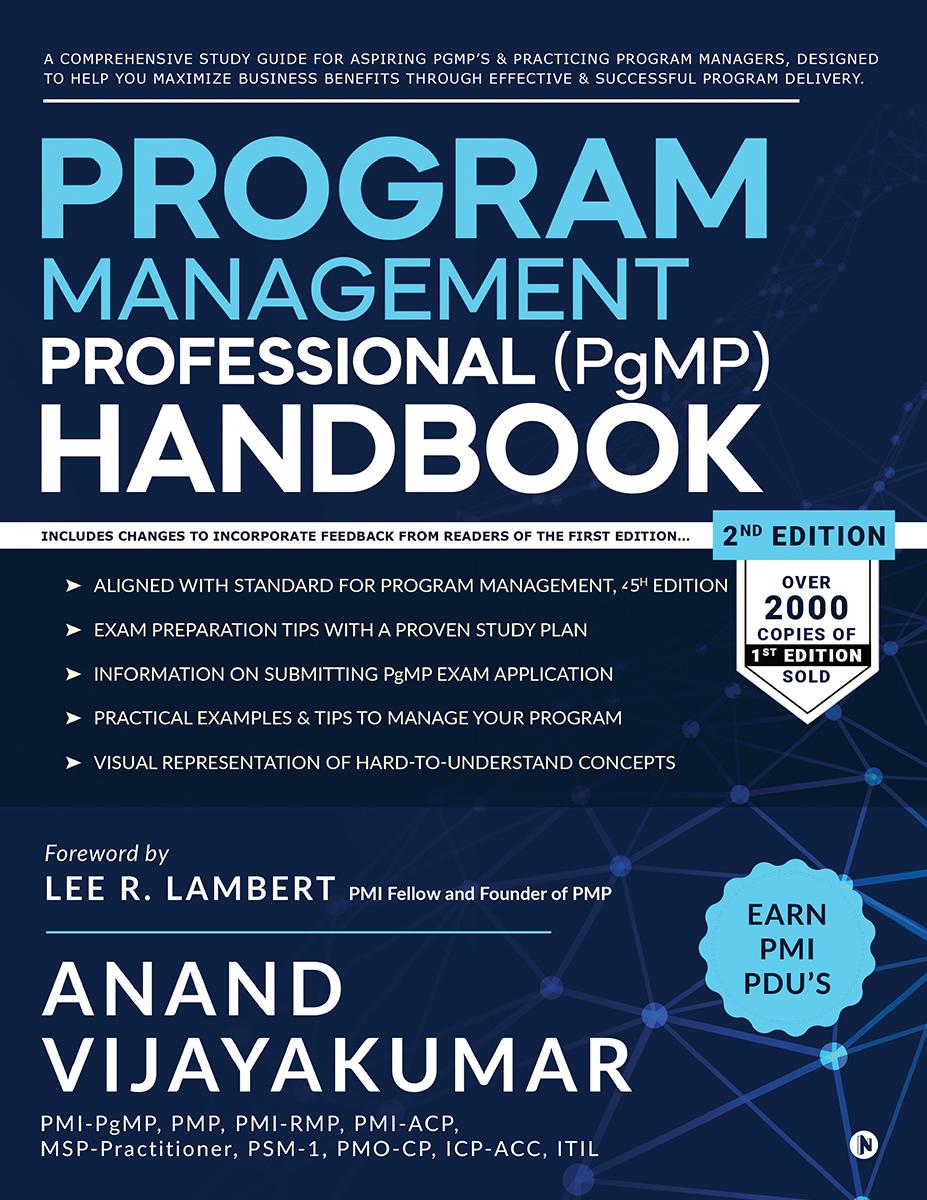
"Deliver Exceptional Business Value aligned with Organizational Strategy through structured program management, and distinguish yourself by earning the elite PgMP credential." Programs are the vehicles for organizations to achieve their strategic objectives and goals. As the industry shifts from simply delivering projects and programs to adopting a value-driven, benefits-oriented model, program management emerges as the critical enabler that help....
Foreword by Lee R Lambert
In the case of Anand’s new book, “Program Management Professional (PgMP) Handbook”, it was I that requested the opportunity to comment. This topic is of utmost importance as organizations find themselves not only facing the daunting challenge of managing individual projects in a high pressure, time sensitive environment they now see the need to add even more management attention to groups of related projects assembled and aligned in a program format. Management must focus on the achievement of program objectives and realization of program benefits. Fundamentally, Program Management is Project Management “on steroids” with more complexity and significant need for comprehensive communication.
I found this book to be very well organized and with comprehensive treatment of the topic of Program Management. The author has provided salient examples to confirm concepts. As Anand points out, he had an objective of writing a book that would help prepare someone aspiring to earn the Program Management Professional (PgMP) Credential AND/OR add value to understanding what the performance criteria would be to become an accomplished manager of sophisticated and complex projects/programs while they also look to improve their personal performance.
Anand has accomplished his objectives with this book. I highly recommend this read to anyone anticipating becoming a Program Manager or anyone seeking to successfully pass the PMI PgMP exam. I am confident it will become a much, needed and trusted reference guide. I assure you that this book will make a significant contribution to any individual’s Program Management skills.
Lee R. Lambert, 14 June 2020
PMI Fellow
A Founder of the PMP
Preface
The benefits realized by the coordinated management of multiple related projects is reason enough for organizations to embark on their journey to introduce program management as a discipline. As with any subject, the need to demonstrate strong understanding of the subject matter is on the rise and nothing speaks like a, hard-to-attain premier certification like the PMI-PgMP which has solid entry criteria set (to ensure the certification doesn’t dilute its value) and involves assessment of strong practical program management skills in an ultra-tough exam.
Unlike the PMBOK, the SPM (Standard for Program Management) is not a body of knowledge and you will realize it when you start reading it. It’s quite dry and does not go into detail to help the reader understand it clearly. When I took-up my journey to PMI PgMP, I had to refer to multiple books to understand industry-standard program management concepts and use my practical program management experience to make sense of what the SPM V4 was trying to convey. Plus, the exam application process was another long journey which required a lot of guidance from my PgMP Trainer and Mentor Sanjeev Kumar who helped me every step of the way.
Your journey with this book would start with an introduction about what the PMI-PgMP credential is all about and then we move on to, what is program management and further dive into the exam content or syllabus. This book will be your companion on your PgMP Exam journey and guide you every step of the way, right from submitting the application to the point where you are in the exam center taking the exam.
Apart from being an exam preparation guide, I have included practical examples that will help you dispose your duties as a program manager in your real life role better.
My ambition was to make this book a worthwhile read for program managers who are aspiring to pursue the PMI PgMP credential as well as individuals who wish to understand structured program management as a topic and excel at their day to day roles.
Words cannot describe how thankful I am, to Mr. Lee Lambert for taking time out of his busy schedule to write the foreword for this book and his review comments. I would like to thank the other reviewers Sajeev Kumar, Vikram Bir Singh, Keval Chheda, Gowrishankar Sundararajan and Rohit Bawa for their feedback and suggestions to improve this book.
Lastly, I want to thank Akash, Hamza and the team at Notion Press (Dhanya, Ilayaraja and Karthikeyan) for helping get this book out into the market.
Hope you find this book useful in your PMI-PgMP Journey.
Good Luck.
Best Regards
Anand Vijayakumar, June 2020.
Reviews
Gowrishankar Sundararajan, PgMP, PMP, CSM
Senior Program/Project Management consultant, Canada
Anand has provided relevant examples in the book making it a great companion with SPM v4 and ECO for the PgMP credential exam. This book is must have for Program Managers and aspiring PgMP professionals.
Sanjeev Kumar, PfMP, PgMP, PMP, PMI-ACP, PRINCE2
Founder & Lead PgMP Trainer, Augment Consultancy

Vikram Bir Singh
Program Manager and PgMP Aspirant, Singapore
There is an absolute dearth of appropriate study resources for PgMP on the market which makes it a difficult exam to crack. Moreover, you seldom find books which cover the fundamentals of the PMP framework. You can always expect some questions from the PMBOK on the PgMP exam which pose a challenge to the people who have not earned the PMP credential beforehand. This book provides a truly holistic treatment of the PgMP by establishing a thorough groundwork before progressing to the advanced concepts. The language is lucid, and all the concepts are fit in a coherent and comprehensible manner. The progression of ideas is also well articulated. If you want to ace the PgMP look no further. This indeed is the best book you can lay your hands on.
Keval Chheda, PgMP,
Program Management & Business Transformation Consultant, India
The book that you are currently holding isn’t just a tool to understand the program management concepts but also a very lucid and interesting interpretation of the standard for program management v4, published by PMI. Anand has explained the most confusing topics like program activities and its relation in program life cycle and topics like benefits management so effectively that you enjoy how different domains talk to each other. I rate this book a must read for all the aspiring program managers and practicing program managers to align their concepts with global standards.
Rohit Bawa, PgMP, PMP, SPoC
Program Manager, India
Chapter 1
Introduction and Basics
1.1: About the PgMP Credential
1.1.1: What Is the PMI and Its PgMP Certification?
PMI stands for the Project Management Institute. PMI is the leader and the most widely recognized body that has been promoting project management best practices since 1969. PMI strives to maintain and endorse standards and ethics in the field of project management and offers publications, training, seminars, chapters, special-interest groups, certifications and much more to further the project management discipline.
PgMP stands for Program Management Professional and is one of PMIs elite credentials in the field of program management. PMI started offering this credential since 2007. As of February 2020, there are only 2923 PgMP certified individuals worldwide. By the time you get your hands on this book, this number would’ve probably crossed the 3000 mark but, compare that to the PMP which has over 1 million credential holders. Holding this PgMP credential demonstrates the fact that you possess advanced levels of experience, skills, and performance in the oversight of multiple related projects, subsidiary programs and its resources, in a coordinated manner to achieve benefits that may not be realized if they were managed individually.
Even though a program effectively contains many related projects (in most cases), neither the PMP nor the CAPM certifications are added as eligibility criteria for taking the PgMP exam. Any individual with sufficient program and project management experience as mandated by the PMI, can pursue the credential regardless of whether they hold any project management credential offered by PMI.
In the current ultra-competitive job market, continuous learning and endorsements by industry leading bodies like the PMI are helping people stand-out from their peers.
Pursuing and attaining the PgMP credential will have multi-fold benefits, which are as follows:
Apart from above benefits, if you are someone in the consulting or services industry, it will also help you (and your company) build customer confidence. Just like potential employers, potential customers too, take into account the credentials demonstrated by the individuals or entities when they are comparing proposals. Let’s say a government agency is evaluating proposals from 3–4 vendors to run a large program and your company is the only one that is nominating a PgMP certified program manager (you) to lead the program, don’t you think your company’s chances of bagging the contract are higher than the others?
1.1.3: PgMP Eligibility Criteria
Unlike other credential issuing bodies, PMI is very selective and strict when it comes to eligibility criteria to pursue one of their credentials. You can always purchase their standard for program management or attend a program management course provided by one of the PMI Registered Education Providers (REP’s) but, if you don’t meet the eligibility criteria, you wouldn’t be able to pursue the PgMP certification.
You can visit PMI’s official website for the most up-to-date requirements for each of their certifications. You need to fulfil several requirements in order to pursue the PgMP credential including minimum years of project and program management experience.
| Educational Background | Project Management Experience | Program Management Experience |
| Secondary Diploma (High School diploma, associates’ degree or global equivalent) | Minimum 4 years (6000 hours) of unique non-overlapping professional project management experience | Minimum 7 years (10,500 hours) of unique non-overlapping professional program management experience |
| Or | ||
| Four Year Degree (Bachelors degree or global equivalent or higher) | Minimum 4 years (6000 hours) of unique non-overlapping professional project management experience | Minimum 4 years (6000 hours) of unique non-overlapping professio al program management experience |
Figure 1.1: PgMP Eligibility Criteria
Each year is roughly 2000 hours (8 hours a day, 21 days a month, 12 months a year) if we consider and if you were managing multiple projects or programs that overlapped, the experience cannot be double counted. Let’s say you managed project A from Jan to June and another project from April to December of the year, your total effort across the two projects can only add up to around 2000 hours.
1.1.4: PgMP Application Process
If you successfully meet the eligibility criteria for taking the PgMP exam, you can get started on the application process. It’s a multi-step process which would take a few weeks before you get the final approval to proceed to take your shot at the exam.
Step 1: The Application Form
Just like any other PMI credential, the application process starts with the filling up of the application form which is similar to the other PMI credentials application (if you have already taken the PMP or other PMI certifications). Apart from the usual sections that expect you to explain your professional history and experience, you are also expected to answer five questions pertaining to your specific program management skills in a short summary of about 500 words each. Don’t worry, Appendix B of this book will explain about those five questions, its choices as well as how you should go about answering them in the application. For now, let’s just assume that you’ve filled up the form well and are ready to submit it.

W-o-W:
Your application will expire in 90 days once started and if it expires, you would need to start afresh.
Step 2: PMI Evaluation
Step 3: Fees Payment
Once your application is accepted, you will receive a notification to pay the fee in order to move forward on the application process. As of this writing, the fees for PMI Members was US$ 800 and US $ 1000 for non-members.
Step 4: The Panel Review
Once you make the fee payment, your information and the answers you provided for the 5 questions will be shared with a Panel to review & assess your eligibility to sit for the PgMP Exam. This Panel consists of experts in the field of program management and their job is to make sure that you possess enough experience to be able to make justice to this credential. This step adds to the mystique of the credential as PMI strongly filters out people with insufficient program management experience which is also a contributing factor to the fact that, in spite of this credential being active for more than 12 years, there are only less than 3000 credential holders in the world.
This process takes about 4 weeks, again assuming that there are no follow up questions from the Panel.
In the event the panel find that your experience isn’t sufficient for taking the exam, your application may be declined and PMI will contact you to discuss the next steps. You would not be allowed to take the exam until you clear the Panel Review. You may be asked for additional information to justify your experiences or you may be asked to withdraw your application which we will cover in section 1.1.5.
Step 5: Scheduling the Exam
Once you clear the Panel Review, you will be eligible to take the computer based test. You can contact the authorized administrator for the tests Pearson VUE to fix a date for yourself in your location. You can find more info on scheduling your test in Appendix C.
Prepare for the exam using this book, PMI’s Standard for program management and your notes. There is an entire chapter dedicated to exam preparation (chapter 10) which you will find very useful.
W-o-W:
I strongly encourage you to take your own notes as you read through this book and PMI’s SPM or at least use a highlighter to mark the points you feel are important. You could quickly scan through those points instead of the entire book prior to the exam day to refresh your memory.
Step 7: Ace the Exam
Step 8:
Celebrate and don’t forget to meet the PDU requirements every 3 years to keep your hard earned credential active.
1.1.5: Payments, Claims and Refunds
You may have noticed that, unlike other PMI examinations, you are being asked to make a fee payment even before PMI fully approves your application. So, what happens if the panel review deems that you do not have sufficient experience to move further?
PMI would refund you, US$ 375 if you fail the panel review step or wish to withdraw your application after passing the panel review.
If you miss to schedule your exam within 12 months of passing the panel review, PMI wouldn’t refund you anything and you would need to start from step 1, all over again, if you decide to pursue the PgMP credential in the future.
In the event, you fail the exam in your first attempt, you could apply for a “Re-test” by paying a fee ($600 for members and $800 for non-members). If an applicant fails the PgMP Exam 3 times within his/her eligibility period of 1 year, they must wait for one more year before they can be eligible to “Reapply” for the credential. Note that you need to “Reapply” for the credential and cannot just take the “Re-test”.
Of course, they may proceed to pursue other credentials offered by PMI without any limitations during this 1 year period.
Even though all applications can actually be subject to an audit, PMI only chooses to audit a small % of the applications selected on a completely random basis. If your application is actually selected for the audit, you will receive a notification prior to the payment of the certification fees.
The notification email will provide you with detailed information on how to comply with the terms of the audit. Typically, during this process, you will be asked to submit supporting documentation like copies of your education certificates, signatures from your managers/sponsors for the programs or projects that have been included in your experience as part of the application.
Reference & Study Guides | 20 Chapters
Author: Anand Vijayakumar
Support the author, spread word about the book to continue reading for free.
Program Management Professional (PgMP) Handbook





Comments {{ insta_features.post_zero_count(insta_features.post_comment_total_count) }} / {{reader.chap_title_only}}
{{ (txt.comment_text.length >= 250 ) ? txt.comment_text.substring(0,250) + '.....' : txt.comment_text; }} Read More
{{ txt.comment_text }}
{{txt.timetag}} {{(txt.comment_like_count>0)? txt.comment_like_count : '' }}{{x1.username}} : {{ (x1.comment_text.length >= 250 ) ? x1.comment_text.substring(0,250) + '.....' : x1.comment_text; }} Read More
{{x1.comment_text}}
{{x1.timetag}} {{(x1.comment_like_count>0)? x1.comment_like_count :''}}{{x2.username}} : {{ (x2.comment_text.length >= 250 ) ? x2.comment_text.substring(0,250) + '.....' : x2.comment_text; }} Read More
{{x2.comment_text}}
{{x2.timetag}} {{(x2.comment_like_count>0)?x2.comment_like_count:''}}