
Toolbar

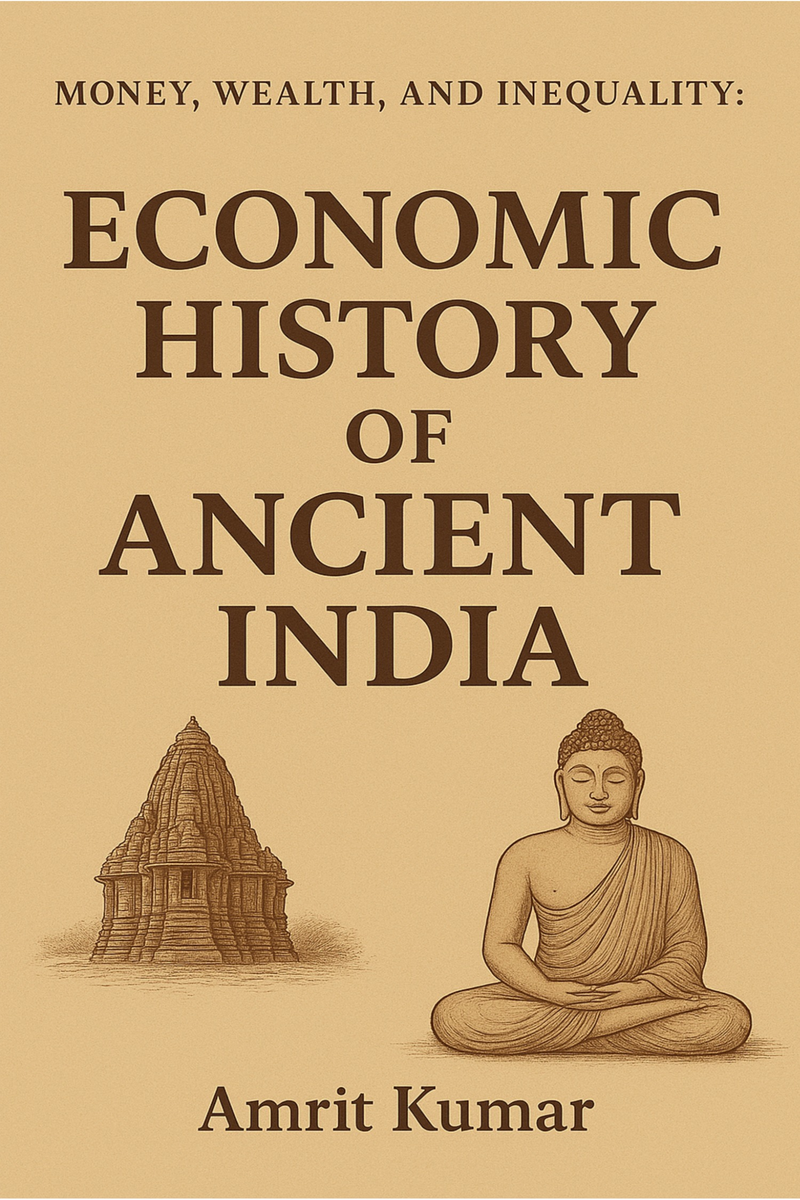
Business, Investing & Management | 8 Chapters
Author: Amrit Kumar
This book—Money, Wealth, and Inequality: Book I – Economic History of Ancient India—has been written with a single guiding purpose: to understand how the economic foundations of early Indian civilization shaped the enduring structures of wealth, inequality, technology, and social organization that continue to influence the subcontinent today. For centuries, interpretations of ancient India have been dominated by mythology, roma....
This book is dedicated to my mother and my greatest inspiration, Baidehi Kumari, whose values, wisdom, and rational way of living have shaped the person I am today. Her unwavering support, guidance, and faith in me have been my constant source of strength throughout my life
This book—Money, Wealth, and Inequality: Book I– Economic History of Ancient India—has been written with a single guiding purpose: to understand how the economic foundations of early Indian civilization shaped the enduring structures of wealth, inequality, technology, and social organization that continue to influence the subcontinent today.
For centuries, interpretations of ancient India have been dominated by mythology, romanticism, and fragmentary narratives that often obscure the material realities of life. This work seeks to bridge that gap by placing archaeological evidence, economic reasoning, and historical continuity at the center of analysis. The history of ancient India is not a tale of static perfection; it is a story of continu ous innovation—beginning with the chipped stone tools of the Paleolithic age, advancing through the polished craftsmanship of the Neolithic, the metallurgical experiments of the Chalcolithic era, the urban sophistication of the Indus Valley Civilization, and the agrarian transformations of the Vedic and Brahmanical periods.
This volume is the first in a multi-part series examining how economic systems— tools, technology, trade, property relations, monetary forms, and institutional structures—evolved across millennia and shaped human life. The aim is not merely to catalogue historical facts, but to reconstruct how people lived, worked, produced, traded, governed, and conceptualized their world.
It is my hope that readers will find in these pages a clearer understanding of our economic past—not as a distant relic, but as a living foundation of the present. The same forces that shaped ancient societies continue to operate today: control over resources, technological change, organization of labour, and the persistent tension between wealth creation and social inequality.
May this book inspire curiosity about the long arc of Indian economic history and encourage deeper, evidence-based exploration of our shared past.
Amrit Kumar
For a long time, early human life has been imagined in romantic terms—as a simple and harmonious existence lived in close balance with nature. Archaeological research, however, offers a far more realistic and restrained picture. The earliest human communities in the Indian subcontinent lived under conditions that were demanding, uncertain, and often perilous. Survival was never guaranteed, and daily life revolved around responding to environmental pressures rather than enjoying any imagined primordial comfort. Excavations and material evidence make it clear that there was no "golden age" free from disease, injury, or death. Instead, what we observe is a slow and uneven process of adaptation shaped by climate fluctuations, changing landscapes, and limited technological means.
Paleolithic humans in India lived as hunter-gatherers, entirely dependent on naturally available resources. They had no knowledge of agriculture or animal domestication and relied on hunting wild game, fishing in rivers and streams, and collecting fruits, roots, tubers, and seeds. Food availability was unpredictable, and periods of relative abundance were frequently followed by scarcity. Mobility was therefore essential; groups moved from place to place in search of water, shelter, and food, leaving behind temporary camps rather than permanent settlements. The absence of pottery, architecture, or long-term storage further underlines the fragile nature of their subsistence.
Material culture during this period was limited but significant. Tools were fashioned primarily from stone, with occasional use of bone and wood, reflecting an early but growing understanding of raw materials and functionality. There is no evidence of land ownership, social stratification, or specialized occupations. Economic life was based on immediate needs rather than surplus or accumulation, and social organization was likely simple and flexible.
The Paleolithic period constitutes the longest phase of human history. Within this immense timeframe, the foundations of human behavior—tool-making, cooperation, environmental awareness, and adaptive intelligence—were laid. All later cultural and technological developments ultimately rest upon the slow but crucial achievements of this formative age, making the Paleolithic period indispensable to understanding the origins of human society in India.
Stone tools constitute the most enduring and informative evidence of Paleolithic life, serving as the primary means through which archaeologists reconstruct the technological and cognitive world of early humans. Unlike organic materials, stone survives across immense stretches of time, preserving clear traces of human intention, skill, and adaptation. The gradual transformation of stone tool technologies in India reflects not only improvements in craftsmanship but also deeper changes in planning ability, manual dexterity, and understanding of raw materials. Each technological stage marks a distinct phase in humanity’s long engagement with its environment.
The Lower Paleolithic: Early Innovation
The Lower Paleolithic phase, represents the earliest sustained evidence of tool-making in the Indian subcontinent. During this period, humans produced large, heavy-duty implements such as hand-axes, cleavers, and choppers. These tools, often associated with Acheulean traditions, were typically made from quartzite, a stone widely available in riverbeds and outcrops across peninsular India. Although simple in appearance, their manufacture required a clear understanding of how stone fractures under controlled blows.
Lower Paleolithic tools were multipurpose in nature. A single hand-axe could be used for cutting meat, breaking bones to extract marrow, processing plant matter, or scraping hides. The standardized shapes observed at several sites indicate that toolmakers followed mental templates, suggesting foresight and deliberate planning rather than random experimentation. These early innovations laid the foundation for all later technological developments.
The Middle Paleolithic: Technological Revolution
A major shift occurred during the Middle Paleolithic period. This phase is marked by the widespread adoption of prepared-core techniques, most notably the Levallois method. Unlike earlier approaches, this technique involved carefully shaping a stone core in advance so that a single, well-controlled strike would produce a flake of predetermined size and shape. The result was thinner, sharper, and more standardized tools, including scrapers, points, and cutting implements designed for specific functions.
The site of Attirampakkam in Tamil Nadu has fundamentally altered scholarly understanding of this transition in India. Excavations led by Kumar Akhilesh and Shanti Pappu have demonstrated that Levallois technology was present at the site as early as 385,000 years ago—far earlier than previously assumed. More than 7,000 tools recovered from the site indicate repeated and prolonged occupation, spanning nearly 200,000 years. This evidence challenges older models that viewed such technological sophistication as a late arrival from Africa, instead pointing to either early dispersals of advanced hominins or independent technological development within the subcontinent.
The Upper Paleolithic: Refinement and Specialization
The Upper Paleolithic period, represents the culmination of stone tool evolution in the prehistoric era. Toolmakers increasingly favored blade technology, producing long, narrow flakes with sharp, regular edges. Alongside these blades, microliths—small, finely made stone tools—became common. These were often hafted onto wooden or bone handles to create composite tools such as spears, arrows, and cutting instruments.
This emphasis on efficiency and specialization reflects a sophisticated understanding of material economy. By maximizing usable cutting edges from limited raw material, Upper Paleolithic communities demonstrated refined planning, adaptability, and technical skill. These developments not only enhanced hunting and processing activities but also paved the way for later innovations in subsistence and social organization, marking a crucial step toward the post-Paleolithic world.
Robert Bruce Foote’s Pioneering Discovery
The formal study of Paleolithic archaeology in India began with an observation that would permanently alter perceptions of the subcontinent’s human past. In 1863, Robert Bruce Foote, a British geologist working with the Geological Survey of India, was conducting fieldwork near Pallavaram, close to present-day Chennai. During this survey, he noticed several unusually shaped quartzite stones lying on the surface of a lateritic formation. Drawing upon his familiarity with European prehistoric discoveries—particularly the stone tools identified by Boucher de Perthes in France—Foote immediately recognized these objects as deliberately fashioned human implements rather than products of natural fracture.
On 30 May 1863, Foote formally recorded and collected a quartzite hand-axe, now acknowledged as the first scientifically documented Paleolithic tool from India. Its resemblance to Acheulean hand-axes from Europe demonstrated that early humans in India had followed similar technological principles, thereby challenging prevailing assumptions that prehistoric cultural development was largely confined to Europe. Initially, some scholars expressed skepticism, questioning whether such antiquity could truly be attributed to human activity in the Indian context. Foote’s careful documentation and geological reasoning, however, gradually established the credibility of his claim.
Business, Investing & Management | 8 Chapters
Author: Amrit Kumar
Support the author, spread word about the book to continue reading for free.
MONEY, WEALTH AND INEQUALITY : Book 1





Comments {{ insta_features.post_zero_count(insta_features.post_comment_total_count) }} / {{reader.chap_title_only}}
{{ (txt.comment_text.length >= 250 ) ? txt.comment_text.substring(0,250) + '.....' : txt.comment_text; }} Read More
{{ txt.comment_text }}
{{txt.timetag}} {{(txt.comment_like_count>0)? txt.comment_like_count : '' }}{{x1.username}} : {{ (x1.comment_text.length >= 250 ) ? x1.comment_text.substring(0,250) + '.....' : x1.comment_text; }} Read More
{{x1.comment_text}}
{{x1.timetag}} {{(x1.comment_like_count>0)? x1.comment_like_count :''}}{{x2.username}} : {{ (x2.comment_text.length >= 250 ) ? x2.comment_text.substring(0,250) + '.....' : x2.comment_text; }} Read More
{{x2.comment_text}}
{{x2.timetag}} {{(x2.comment_like_count>0)?x2.comment_like_count:''}}