
Toolbar

Outdoors & Nature | 14 Chapters
Author: Narendra K. Dadlani
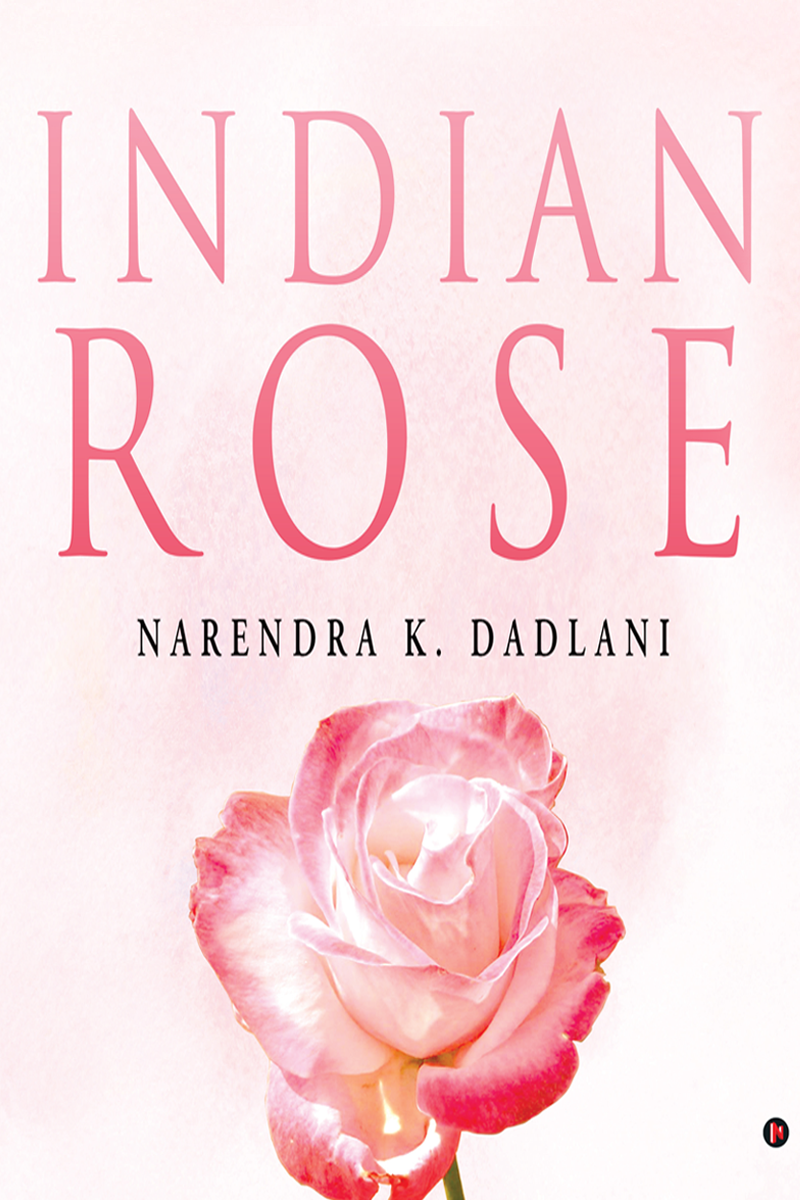
‘THE INDIAN ROSE’ by Narendra K. Dadlani, is the first complete book that describes the beauty of Indian roses. It is structured to provide a comprehensive account of the evolution of rose breeding in India, including its objectives, choice of parents used, criteria for naming the varieties, their salient features such as size, shape, color and fragrance along with promotion of the varieties. It presents the work of more than seventy eminent ....
The word ROSE immediately suggests beauty. While flowers are considered among the loveliest gifts to human mankind from nature, Rose has universally been regarded as the ‘Queen of Flowers’.
And the rose like a nymph to
the bath addrest,
Which unveiled the depth of
her glowing breast,
Till, fold after fold, to the
fainting air,
The soul of her beauty
and love lay bare.
(P.B. Shelly)
 Oh! No man knows through what wild centuries roves back the rose.
(Walter de la Mare)
Even though no written records are available to trace India’s association with the rose, it is widely believed that our fascination for this beautiful nature’s creation, dates back to beyond 5000 years B.C. The rose finds a regular mention in myths and legends, in poetry and music, besides being used in rituals, architectural decorations, beautiful jewelry and embroidery designs. The presence of many wild rose species in the 1800 mile long abode of the Gods – the Himalayas, establishes its presence in Indian culture. According to the generally accepted classification of Rehder, there are about 120 species of roses that grow wild, in different parts of the world. At least 12 of these, namely, Rosa brunonii, R. sericea, R. webbiana, R. foetida, R. longicuspis, R. macrophylla, R. gigantean, R. beggariana, R. eglanteria, R. laevigata, R. baksii and R. bracteata are found wild in the Himalayas. Various studies have established their possible role in the development of modern roses. Dr. William Roxburgh, the first Director of Indian Botanic Garden, Howrah, mentioned that the garden housed several species, e.g. R. indica, R. microphylla, R. triphylla, R. brunonii and R. macrophylla, among others (Flora Indica, Vol. II, 1832).
A mention of the rose is also found in old texts like Kashyapa’s Agricultural Treatise (c. 800 C.E.), or the old Sanskrit works, e.g. Taruni Pushpa, Atimanjula and Semantika or Chakrapani Mishra’s Vishwa – Vallabha (15th Century) as well as in the famous Kama Sutra (100 C.E.). Later, works like Geet Govinda of poet Jayadeva (1150 C.E.) are replete with the reference of roses.
The Moguls were known to be ardent admirers of the rose and the first Emperor, Babur (1483-1530), epitomized his love for a rose in his poem:
My heart, like the bud of the red, red rose,
Lies fold within fold aflame,
Would the breath of even a myriad spring,
Blow my heart’s bud to a rose?
Even the third Emperor, Akbar (1556-1605), carried loads of roses for the wives of his allies. Nur Jehan, wife of the next Emperor Jahangir, is credited with the discovery of rose oil, ‘Attar’. Roses were integral to the several gardens established by Jahangir (1605-27), around Dal Lake in Kashmir, and he chose to be buried in a garden nearby.
The Moguls set up large gardens across the country, which are now described as “Mughal Gardens” and roses found a prominent place in this formal garden style. Later, in the 17th Century, the Britishers brought in many varieties of roses from China through their East India Company, which were planted in Calcutta, before being shipped to England. Dr. Roxburgh, Curator of Calcutta Botanic Garden, mentioned about roses in the garden, around 1794. Rose occupied the most prominent place in the 1864 Flower Show, organized by the Agri-Horticultural Society of India (AHSI).
Mr. B.S. Bhatcharji, in his book ‘Rose Growing in Tropics’, mentioned that ‘due to ignorance, most of us are accustomed to think that rose is not Indian, but an European flower, but the rose is as much Indian, as it is European.’ Availability of China Rose in the Indian gardens in the 1st century, established its long historical presence in India. Chinese travellers (5th century) to Buddhist sites, mentioned about rose garlands being commonly used.
The modern rose era, has fortunately given us a wealth of form. This ranges from a simple five petalled one to the double flowers, exhibited on our show benches today with a spectrum of color, where we are probably missing only the true black and blue. The plant size varies from a few centimeters high miniatures to large shrubs, rampant climbers and ramblers. And of course, the delightful range of scents.

Dr. Zakir Hussain Rose Garden
The culture of rose, particularly for appreciation by general public, has always been promoted by the planting of rose gardens. While the Western world boasted of several magnificent rose gardens, which enthrall visitors, we in India, did not have such enchanting rose gardens. The first such garden, ‘The Zakir Hussain Rose Garden’, named after the former President of India, a great connoisseur of roses, was laid out in Chandigarh. The garden is spread over an area of more than 40 acres and was designed by Dr. M.S. Randhawa, in 1966-67. It is perhaps the largest rose garden in Asia. The Rose Society of India (RSI), laid out the beautiful ‘National Rose Garden’ in Chanakyapuri, New Delhi, during the 1980s. This garden, planted in two plots of 3 acres each, also served as the first ‘Rose Trial Ground’ for Indian roses for many years. It was named as ‘India Africa Rose Garden’ in 2015. In mid 1990s, a large rose garden, ‘The Centenary Rose Park’ was started in Ootacamund (Ooty), not far from the Sims Park in Coonoor, where a large rose collection was started more than a century earlier (1874), under the British rule.
Roses are being grown in India for centuries, both for religious and ornamental purposes. Its culture is seen in all parts of the country by flower lovers, in their home gardens, in pots, on rooftops and in public gardens. In a large country like India, with varied climatic zones, the growers have been largely using the exotic varieties from the Western world. While roses are valued as a garden flower, in India, roses are much in use for the purpose of worship and in exquisite garlands. The first Prime Minister of free India, Jawaharlal Nehru, always wore a red rose in his buttonhole.
With the advancement in rose breeding in India in the last five decades, a large number of Indian varieties have also become available to the growers. Both, the exotic and Indian varieties, have been performing well in areas like Delhi, with extreme weather in summer and winter, as well as in parts of Eastern and Southern India, with practically no or very mild winter. Several rose species are found growing wild in India, mostly in the Himalayan ranges. These have been sourced and used by breeders across the world.
Rose historians have observed India’s location near two major centers of historically important roses – China and Persia (now Iran) – besides the Middle East, to be interesting for the study of origin of roses. Also, the fact that the famous ‘Silk Route’ from Southeast and Central Asia, passed through India, could be a likely reason for the occurrence and availability of many roses and Rosa species in the region. Love for roses and their introduction into India by the Moghuls, as well as the Britishers, who ruled India for long, gave us a host of roses that have significantly contributed to our wealth of this queen of flowers. Historians are also intrigued by the presence of several roses in India, for which they fail to establish their origin as India or elsewhere. Though mystery surrounds their origin, yet they have enjoyed considerable popularity in India.

An interesting rose of mystery is the red, fragrant, double flowered Hybrid Perpetual type Kakinada Red. Named after the port town on the Eastern Peninsular Coast, and used extensively for making garlands, this rose appears to be growing for a long time in this part of the world. Several international researchers, however, find it to be identical to Maggie (USA), Pacific (Bermuda) or Julius Fabianics Misefa. The research to prove them to be similar or otherwise goes on, while Kakinada Red continues to enjoy its popularity.

The origin of one more rose, found to be growing in Southern India in the Deccan Plateau, around Hyderabad City, may have reached India from China in the ancient times. It has perfect HT type buds, opening to the old rose form and has the typical shining China rose foliage, looking more like Mme. Cecile Brunner. Named Telengana Pink (by Viraraghavans), the mystery of its true origin still continues to be investigated by several international rose experts.
Several more roses grown in India for ages, continue to engage the attention of international rose botanists to unravel the mystery of their origin.
The beauty of a rose is eternal. It has not only stood the test of time, but its popularity has grown several folds through the ages. Notwithstanding our attraction to the beauty of earlier day roses, we continue to be fascinated by the rich spectrum of color, shade and hues, the continued refinement in the shape and form, and a remarkable assortment of rose fragrances in the modern day roses. The apprehension that Dean Hole, the father figure of the rose world in earlier times, noted in ‘A Book About Roses’ (1870), which states ‘the roses of today exhaust all our powers of admiration, our finite appreciation of the beautiful. The roses of tomorrow can do no more’, has been proven wrong. While welcoming the new ones that are introduced every year, one sometimes feels a pang of regret for the older varieties that are being lost. Yet, to our delight, the breeders continue to offer new beauties, each with unique features, better than the earlier varieties. Maybe, the day is not too far when the breeders will create a rose, which has the majestic look of Charles Mallerin, with its exquisite fragrance (unlike the beautiful Peace, which lacked the scent), clear pastel color and perfection in opening like Royal Highness, enormous size as Paul Neyron, shapely blooms like First Prize and long, slender buds of Eiffel Tower or Inge Horstman!

Prime Minister Indira Gandhi releasing IARI rose varieties
The failure of several exotic roses from Europe and USA, including the world famous, Peace, to perform well under the Indian conditions, led to a thinking that to enjoy this queen of flowers in India, we need to evolve varieties under our own growing conditions. It was evident what Rudyard Kipling wrote: ‘East is East and the West is West, and never the twain shall meet.’ With respect to rose growing, this was further supported by the views of a well-known English horticulturist, Rev. Firminger, who in his Manual of Gardening for India (1904), felt that of the two well defined rose groups – one, the roses of Europe and Western Asia and the other, the roses of Eastern Asia – the first group roses didn’t succeed in India, while those from the second group, bloomed better. This strengthened the opinion of our Pioneer rose breeder, B.S. Bhatcharji, who took up breeding roses for the tropical, more particularly, the warm, humid climate of Bengal, where he had his rose nursery, after facing several hurdles in importing roses for Indian growers.
Further, as the famous rosarian, Wilhelm Kordes, observed, ‘the soup ladle would only bring out what was in the soup tureen.’ Thus, suggesting that fresh blood was required to achieve real progress.
As would be seen from the following account, the Indian rose breeding fraternity included not only the scientists trained in plant genetics and breeding or at least with working knowledge of the subject, but also scores of rosarians, whose only qualification when they took up rose breeding, was their passion for roses and a vision of getting new types of their choice. Their success has clearly established that one need not be formally trained to be a successful rose breeder. If a person is passionate about breeding, he or she will surely develop the required faculties. After all, Francis Meilland (1912-1958), the originator of the most famous rose variety, Peace, was only 23 years old when he developed this variety and had learnt his breeding from another non-scientist rosarian, Charles Mallerin. The science of genetics was neither much developed nor popular among plant breeders at that time, who depended on their sharp observational powers and were guided mostly by their instinct and experience.
Outdoors & Nature | 14 Chapters
Author: Narendra K. Dadlani
Support the author, spread word about the book to continue reading for free.
Indian Rose





Comments {{ insta_features.post_zero_count(insta_features.post_comment_total_count) }} / {{reader.chap_title_only}}
{{ (txt.comment_text.length >= 250 ) ? txt.comment_text.substring(0,250) + '.....' : txt.comment_text; }} Read More
{{ txt.comment_text }}
{{txt.timetag}} {{(txt.comment_like_count>0)? txt.comment_like_count : '' }}{{x1.username}} : {{ (x1.comment_text.length >= 250 ) ? x1.comment_text.substring(0,250) + '.....' : x1.comment_text; }} Read More
{{x1.comment_text}}
{{x1.timetag}} {{(x1.comment_like_count>0)? x1.comment_like_count :''}}{{x2.username}} : {{ (x2.comment_text.length >= 250 ) ? x2.comment_text.substring(0,250) + '.....' : x2.comment_text; }} Read More
{{x2.comment_text}}
{{x2.timetag}} {{(x2.comment_like_count>0)?x2.comment_like_count:''}}