In the land of Mithra, a time before the Sangharsh had descended like a dark cloud, there was a whisper of forbidden knowledge that lingered in the shadows. It was a secret passed from one hand to another, from one heart to another—like a flame that could not be extinguished.
In her village, women were not supposed to learn to read or write. It was considered a man’s privilege, a luxury only afforded to sons of noble families, to scholars, to warriors. The very idea of a woman holding a pen or scroll was taboo, something whispered about in hushed tones, a rebellion in itself.
But for Elina, it was different.
It started with her grandfather, a man who had once served in the court of the Mughal emperors. Though the grandeur of the Mughal dynasty had long since faded, the stories, the knowledge, and the love for learning still burned in his heart. He had been a scholar, a poet, and a storyteller who believed that the light of knowledge should not be reserved for just one gender.
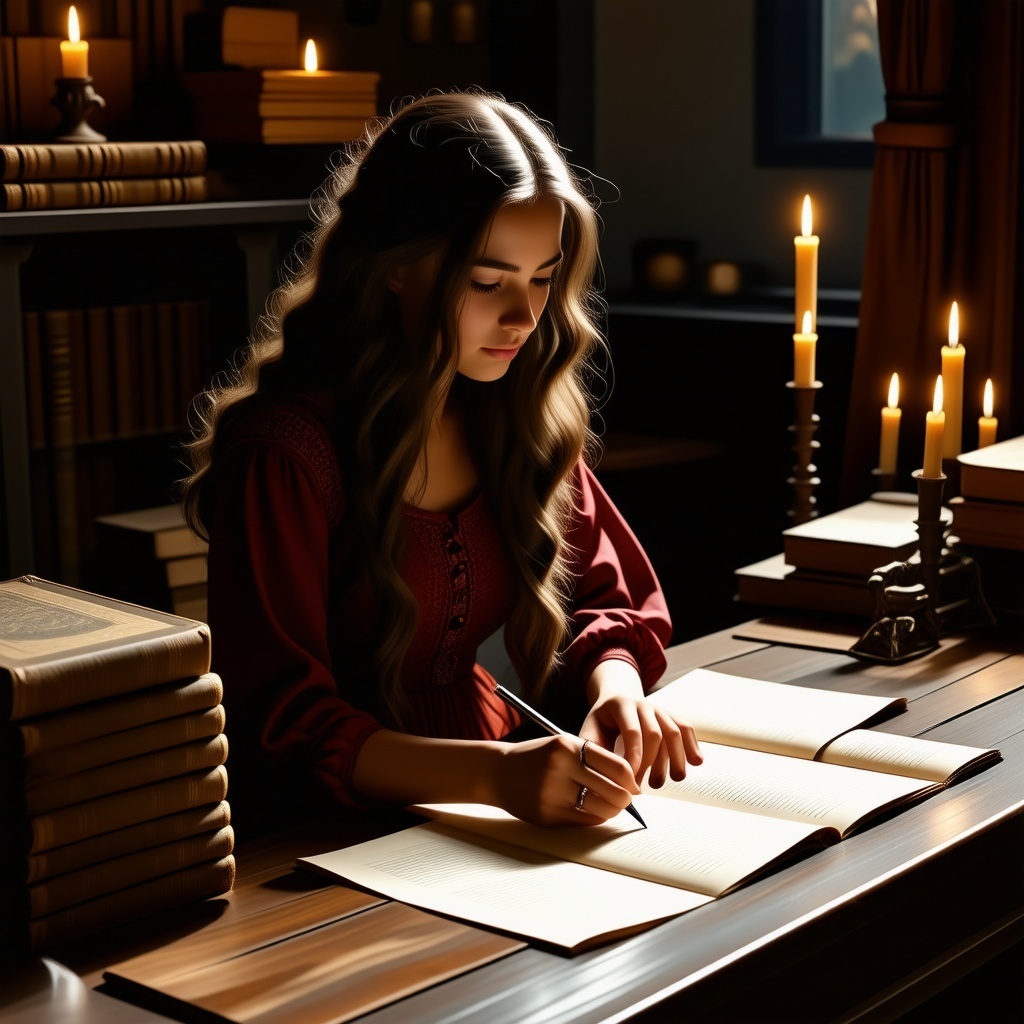
Every night, as the world slept, he would pull her aside, away from the prying eyes of the village. In the dim light of a small oil lamp, hidden beneath the old banyan tree, he would teach her the letters of the ancient Mithran script, the rich verses of Persian poetry, and the ways to weave words into meaning. At first, it was just the alphabet—small, delicate symbols that would later form her path toward something greater. But as time passed, Elina’s thirst for learning grew stronger. She began to read the ancient Mughal manuscripts that her grandfather had kept hidden, texts filled with tales of emperors, warriors, and beautiful gardens.
She was just a child then, but her heart felt the weight of every story. She felt the words swirling in her soul, like a melody she could not yet sing. She would write in secret, using pieces of old cloth and charcoal she had found. It was a dangerous game—one wrong move, and the wrath of the Sangharsh would come down upon her. But Elina was undeterred. She could not let the fire of knowledge fade away, not when her heart ached with the need to preserve what had been stolen.
In those early years, when her father’s eyes were not yet heavy with the sorrow of defeat and his hand was still firm on the plow, Elina’s secret lessons continued. Her mother, too, though she had been silent on many matters, knew of the knowledge Elina sought, and she had encouraged her in her own quiet way. They both understood the consequences if anyone discovered her learning. If the Sangharsh found out, they would not just burn the books—they would punish her family.
As Elina grew older, the regime’s grip on Mithra tightened. Books and scrolls were destroyed; knowledge was hidden away, forced into silence. The royal libraries, where once Mughal emperors and scholars had written their wisdom, were ransacked. But Elina was different. She had been taught to read and write in secret, and though her hands trembled with fear, she now knew the weight her words could carry.
One evening, after the sun dipped beneath the horizon, she found herself alone, standing in a forgotten corner of the camp, a piece of charred paper in her hands. It had been so long since she had written anything. Her mind, filled with half-forgotten memories of her village and the majestic Mughal palaces, rushed back to her. The paper was small, torn, but it was enough to begin. She remembered her grandfather’s lessons, his voice soft as he spoke of the great Mughal emperors who once sat under golden arches, their elephants and horses a symbol of power.
She held the charcoal tight in her hand, and though the world outside seemed bleak, she began to write. At first, her words were soft, cautious:
"I am not just a prisoner. I am Elina. I was taught in secret, to read the words of our ancestors, to learn the stories of Mithra. I will not let their flames burn our history. I will write it down, for it is our birthright."
The words were simple but powerful. Each stroke of the charcoal was a rebellion, a refusal to let the Sangharsh wipe away the past.
Her heart pounded as she wrote, but she knew she had no choice. She could not live in the shadow of a past she could not remember, and she could not let the stories of her people die. Her story was hers to tell, and it had been written in secret from the start.
As the days turned into weeks, Elina wrote whenever she could, her hidden knowledge a beacon in the darkness. She wrote about the stories her grandfather had shared with her—the Mughal emperors, the elephants that once carried kings across the land, the horses that galloped through the royal gardens of Zarif. She wrote about the beauty of Mithra, the golden domes of the temples that had once gleamed in the sun.
The more Elina wrote, the more she understood the weight of what she was doing. It wasn’t just about preserving the past. It was about creating a future—about keeping the flame of knowledge alive so that when the world finally turned toward the light again, her people would remember who they were.
The Sangharsh could destroy the books, could burn the libraries, but they could never destroy what she had learned in secret. For Elina, writing had become her defiance, her strength, and her freedom. The power to write was the power to survive, to remember, and to live beyond the cruelty of the present.
And as she sat beneath the flickering light of her small lamp, the words continued to flow—because some stories, some histories, cannot be erased. Not even by the darkest of times.






 React
React