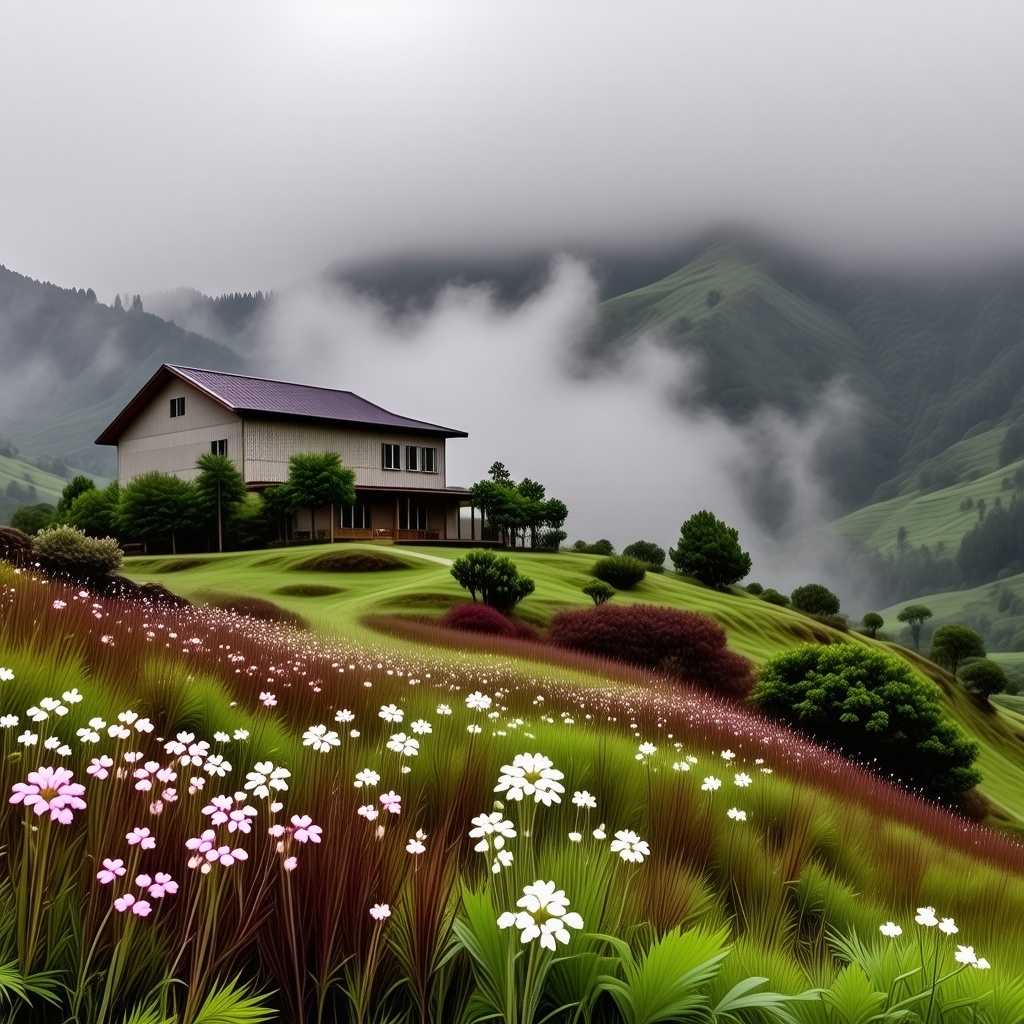
In his younger years, Raghavan lived in a house nestled in a stretch of highlands, where the clouds rolled low over the hills and the mornings arrived bathed in mist. His home overlooked a valley that bloomed with wildflowers in spring, sang with the rustle of leaves in summer, and sighed with silence in winter. The world was green, generous, and full of promise. The air carried birdsong, the laughter of neighbours, and the smell of wet earth after rain. He believed he would grow old there, beneath a roof that held tradition, laughter, and the quiet rhythm of belonging.
But life, with its unrelenting tide, charted a different course.
When he left the valley, he did not pack much—just a small suitcase, a photograph of his home, and the weight of silent resolve. His wife remained behind with their children, in the home that echoed with the footsteps of ancestry. They agreed he would go ahead and earn what he could in a new country, in the hope of something better. He would visit when he could, send money, and return someday—for good. That was the plan. Simple. Hopeful. Painful.
The airplane touched down in a land that looked nothing like the home he had known. The earth was flat and sun-scorched, the air heavy with heat, the wind carrying dust instead of blossoms. It was a city carved from desert—gleaming on the surface but hollow in its intimacy. Buildings rose like monuments, confident and cold, reaching toward a sky that seemed too distant. There were no mountains here, no valleys, only endless roads, construction cranes, and the sharp glint of glass. He arrived as many do—invisible.
Raghavan worked tirelessly. Days melted into nights in a series of jobs that gave him enough to live, but never enough to feel. He counted shifts, not hours. He ate alone, sitting on the edge of his cot, using the same plate each evening. When silence stretched too long, he reached for the photograph—his children playing near the house, the valley behind them, eternal and green. He did not complain. This was his choice. But in the hush of unfamiliar evenings, he longed not just for his family, but for the ease of belonging. For someone to ask how his day had been. For his name to be known, spoken, remembered.
Then, one day, a colleague lingered after work.
They drank tea together, in paper cups, beneath the harsh flicker of a tube light in the break room. The man’s Tamil was different from Raghavan’s Malayalam, but they found a rhythm. A few days later, the same man brought over a parcel of bread, and Raghavan invited him in. He had nothing grand to offer—just rice, a boiled egg, a spoonful of pickle, and a smile that said, You are welcome here.
That was the beginning.
Another came the next week. Then a friend of that friend. Word spread slowly, without announcement. People arrived for dinner, and sometimes just for silence. His flat was modest—bare floors, second-hand furniture, a fan that creaked in rhythm—but it was warm. It was human. He had a mat rolled up in the corner, extra plates, and always, a kettle on the stove.
He remembered names. He asked questions. He listened. He gave what he could, which was rarely money, but always care. The values of the valley—neighbourliness, patience, presence—lived on through him, stitched into conversations and cups of chai, into borrowed beds and shared meals. He stitched a home into the fabric of a foreign land, one relationship at a time.
His children, growing up in the hills, saw him only in fragments—summer visits, phone calls at dusk, letters written in his slanted handwriting. He watched them grow taller through photographs and their voices changing over phone calls. Their lives unfolded in the very landscape he once called home. He missed them deeply, achingly, but he poured that longing into the community he was building, without even knowing he was building one.
Years passed—thirty-three of them, in fact.
By then, Raghavan’s home was known across the city. Not famous, but remembered. Fondly. People spoke of him with reverence. “He gave me a place to stay when I had no one.” “He taught me how to make dal like my mother used to.” “He once drove me to the hospital and waited outside the whole night.” No favours were asked. None were tallied. His doors had no locks on compassion. His life was quiet, but his presence thundered in memories.
What Raghavan didn’t realise was that his children, too, were being quietly honoured because of him. Whether they were travelling for work or studying abroad, someone, somewhere, would recognise their surname and say, “You’re Raghavan’s child?” Always followed by a nod. A soft smile. A story. “Tell him he is remembered.”
His daughter once wrote to him, “Appa, people treat me kindly in ways I don’t understand until they mention your name. You left home, but home never left you—and now, it lives in people I’ve never met.”
And so, one quiet afternoon, with the sun slipping behind the skyline and the day cooling just slightly from its relentless heat, Raghavan sat at the edge of his bed. His back was more bent than before, his hair thinned, his hands lined with years of giving. On the shelf above him sat the same photograph from decades ago—his family against the hills, the valley unfolding behind them like a memory.
He reached for a notebook.
He wrote not to publish, not for glory. But to remember. To mark the trail of kindness he had left across a foreign land. He wrote of the meals, the conversations, the faces. He wrote of the desert, and how, against all odds, it had bloomed around him—not with flowers, but with people.
He had once feared he would vanish in a city that did not know his name.
Instead, he had created a place where the valley lived again—not in soil or sky, but in the hearts of those who had sat at his table.
Not a single stone of that valley had made it across with him.
But somehow, it had grown anyway.






 React
React