Romi had just moved to this quiet village of Dehna — far from the chaos she once called life in the bustling streets of Mumbai. The silence here felt unsettling. Not because it was loud, but because it wasn't. She had never known such stillness.
Growing up in a noisy joint family, privacy was a luxury — a locked door would have led to dramatic knocks and parental ultimatums. Back then, her diary had been her only refuge, her silent witness. Its pages held her whispered secrets — including the story of her first meeting with Dev during her Masters. Charming, unpredictable, and effortlessly warm, Dev had painted colors into her once grayscale world.
But the last few months had been heavy. Not because she didn’t love her family — she did, deeply. Especially Adwait, her miracle child born after years of hope and prayers when doctors had asked them to give up.
Yet, somewhere in the middle of everything she had once longed for — marriage, motherhood, love — she found herself craving the one thing she had never had: peace. After the recent fight with her husband, Dev, Romi decided to take this much needed trip.
So, she came to Dehna. To slow down the pace of a life that was beginning to feel like sand slipping through her fingers. In the hush of this village, she searched — not for happiness, but for stillness in the noise she once mistook for joy.
The village of Dehna was perfect — perfectly quiet, perfectly slow, and perfectly distant from everything Romi needed space from.
She had come here to breathe — to clear the fog in her mind and maybe, just maybe, quiet the storm in her chest. To forget, or at least hush, the words she had seen on Dev’s phone. Messages never meant for her eyes. Not from another woman — but something, in a way, more intimate. Secrets. Shame. Conversations revealing what he couldn’t bring himself to say aloud: that he had lost his job. That the distance in his gaze, the clipped replies, the half-hearted smiles — all of it — were not about her, but the weight he carried and didn’t know how to share.
Still, she couldn't help blaming herself. She had set aside her career to raise their children, pouring her days into packed lunches, school runs, bedtime stories. And now, in the face of real uncertainty, she felt useless. Not because Dev made her feel that way — not deliberately, at least — but because her worth had always been tethered to her role. At 35, she had never worked a day outside the home. She thought about volunteering, maybe starting somewhere small. But the fear gripped her like ice. It wasn’t laziness — it was paralysis. She was frozen, suspended between guilt and confusion.
She didn’t know how to confront him — or even if she should. So she did the only thing she knew: she retreated. Into her thoughts. Into silence. Into solitude, hoping it might offer her a map — or at the very least, a first step.
That morning, like most others since she arrived, she woke early. The sun was barely a rumour behind the mountains as she walked to the nearby peak, the air crisp with dew and unspoken things. On the way back, she picked up a bottle of milk from the local vendor, exchanging quiet nods instead of words.
In the past two weeks, she had visited all the places she was “supposed” to — the old temples, the popular scenic spots. She had smiled for photos she wouldn’t post. She had been raised to equate productivity with purpose. If she wasn’t contributing, wasn’t ticking boxes or fixing problems — then what was she even worth?
And yet, when her own life felt unsolvable, she always turned to stories. To books. To strangers who had bled ink onto pages and somehow made the chaos make sense. Somewhere in the world, someone had lived this ache before — and written it down. That was her quiet belief. That if she looked hard enough, she would find the answers tucked inside someone else’s truth in the pages of some book.
So that morning, instead of heading to a monument, or lying in her bed, depressed about the truth of her life she had escaped, she found herself walking toward a dusty little library on the edge of the town she used to visit as a child.
She packed her bag — a notebook, pens, an old diary — and walked toward the library nestled in the hills. Hidden beneath layers of forest and time, it wasn’t easy to find, but something told her she belonged there.
Sometimes, the quietest places help us hear the loudest truths.
The library sat at the edge of the village, where the cobbled road began to forget itself and the mountain rose like an old guardian. You wouldn’t stumble upon it — you had to seek it. A rusty, weather-beaten wooden gate marked the entrance, creaking faintly as it opened, as if annoyed at being disturbed. Wildflowers had claimed the path, brushing against her ankles as she stepped forward, past moss-covered stones and into something that felt like a secret.
The building was modest — small and crooked, its roof sagging slightly under the weight of years. Wooden beams peeked through crumbling plaster, and ivy curled around the windows like nature was trying to read what was inside. But there was a quiet dignity to it.
The old librarian seemed sweet — the kind of sweet that comes from a quiet life, not from sugar. Her grey hair was tied in a loose bun, wisps escaping like stories refusing to stay bound. Her cardigan was worn at the elbows, patched lovingly with fabric that didn’t quite match, but somehow made perfect sense — much like the library itself.
The library was not just a room — it was a living memory. Time hung from the ceiling and whispered from the floorboards. On the walls, sepia-toned photographs lined the wooden panels like relics from another life — moments framed not just in wood, but in reverence. Each picture felt like a badge of honour, a quiet testimony to a life well-lived.
In one, the librarian was laughing beside a canal, the wind tossing her hair as if trying to keep up with her joy. In another, she stood among a group of students, her eyes gleaming with the kind of mischief that doesn’t age — only softens. But it was the photograph tucked away in the far corner that caught Romi’s breath.
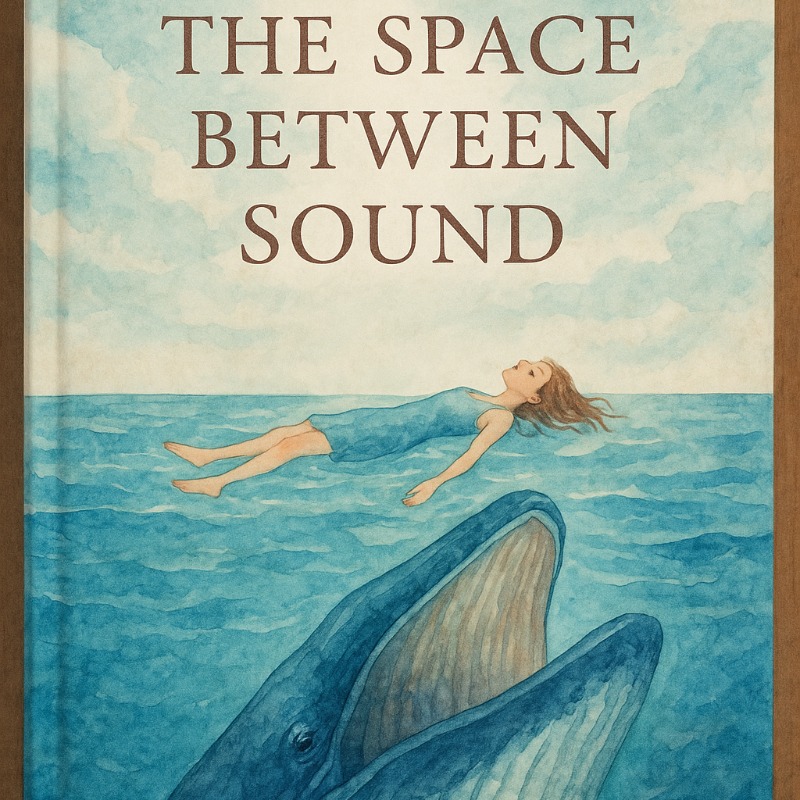
In it, the librarian stood before a vast sea, the sky stretching wide behind her. Just over her shoulder, rising from the waves, was what looked like the tail of a massive fish — or perhaps a whale. It was impossible to say. The image was faded, almost dreamlike. Yet she looked happy. Radiant, even. Like someone who had seen something impossible, and made peace with it.
Romi stared at it for a long time, the silence of the room thick around her. Something about that photo — the sea, the smile — tugged at her, as if it belonged not just to the woman in the frame, but to her, too.
She wore a loose nightgown, elegant in its simplicity, and spoke casually about having bought it during her student days in England. Romi blinked — England? It was hard to reconcile that detail with the modest, rustic surroundings of the mountain village.
The room itself was a blend of stories and stillness. Bohemian art covered the stone walls in rich colors and wild patterns. Candles flickered on every corner — not out of necessity, but choice — casting dancing shadows that made the books look like they were breathing.
There was something about this place — and the librarian — that made Romi feel safe. Not safe in the way locks and doors did, but in the way understanding does.
She looked around, then smiled softly.
“Maybe I’m not looking for a book today,” she whispered with a gloomy smile. Trying hard to keep away the pain she had buried not far.
The librarian just nodded.
“Then you’re in the right place. Child, seems like you are troubled.”
Romi’s breath hitched at the word “child,” a term she hadn’t heard in years. The weight of it landed on her like a gentle, yet unshakable reminder of a simpler time. A time when she could still believe in answers. She blinked, trying to hold back the tears, fighting the unspoken, yet overwhelming pull to let it all come crashing down.
Her voice trembled as she spoke, betraying the walls she had so carefully built. “I am tired. I need peace… I had a good life. I can't complain. Still, I wonder what it all means.”
The librarian didn’t speak right away. There was no rush, no hurried words of reassurance — just presence. It was as though the silence between them held more weight than anything spoken aloud.
“Peace isn’t a destination, child,” the librarian’s voice was soft but steady. “It’s a process. A discovery. Perhaps, what you need now is not peace in the way you expect, but something else entirely. The peace you seek may lie not in understanding everything… but in simply being with the questions.”
For a moment, she didn’t know how to respond. She could almost hear the hum of her racing thoughts and the soft ticking of the clock that seemed to mark the passage of time in slow, steady beats.
"Perhaps you're asking the wrong question," the librarian said, a hint of kindness in her voice. "Come with me. There is a book here that might answer more than you think."
Romi felt herself drawn forward without thinking. The librarian’s hand rested gently on a shelf, and she slowly slid out an old, weathered book from its place at the very edge. The dust that rose from it seemed to settle in the air like fine mist. She handed it to Romi with a quiet smile.
The aroma of chamomile hung in the air — gentle, soothing, almost like a third presence in the room. It drifted between pauses in their conversation, softening the silence, wrapping around Romi like a shawl she didn’t know she needed. The librarian took a sip of her tea, eyes distant for a moment, as if remembering something tucked between yesterday and long ago.
Then she turned, almost suddenly, and pointed with a wrinkled yet graceful hand toward a shelf in the far corner.
“The third book,” she said, her voice low but certain. “On the last shelf to your left.”
Romi followed the direction with her eyes. The shelf stood quietly near a half-curtained window, bathed in the warm amber glow of late morning sun.
She walked over slowly, feeling the floor creak beneath her bare feet. Her fingers brushed the cover. She pulled the book from its place.
The curiosity within Romi surged — fierce and childlike, impatient to get all her answers. She felt like Pandora standing before the forbidden box.
With trembling fingers, she opened it, half expecting spells, scriptures, or handwritten secrets.
But to her surprise it was empty with the face of the librarian drawn on the first page of the book.
Every other page was Blank.
She blinked. Flipped through again. Faster. Slower. Still blank.
How? Why?
Before she could ask anything, the old librarian — now facing the window answered “Listen to the book, its talking to you” — Compelled beyond logic, she turned back to the first page and slowly lowered her head onto the book. The moment her skin touched the paper, the vibrations began.
The lady whispered something under her breath. A mantra. Foreign yet familiar. The words rippled through the air like wind through trees.
Romi felt a strange jolt in her chest — not pain, not fear, but a sudden weightlessness. Her limbs grew heavy, her mind light. It was as if her consciousness was being pulled inward, like sleep laced with gravity.
A soft hum, like the distant ringing of a singing bowl.
And then — sounds. Layered, intimate. She could hear her child’s laugh, her mother’s lullabies, her sister’s jokes, Dev’s voice on the day they first met. Strangers from passing trains, teachers from forgotten classes — echoes from every corner of her life whispered from the pages. It was as if the book was speaking her story.
Time stretched, folding into itself. This one moment expanded into an eternity.
She felt every emotion — grief, love, longing, jealousy, loneliness — like notes of a song she'd never fully listened to before.
But the one emotion that stayed stubbornly absent was the one she always believed was at the core of her being: happiness. Where was it?
She searched through the sounds, the memories, the people. Nothing. Everything felt... pale. Meaningless. As if she had been painting her life with water colours on glass — beautiful, but never meant to last.
“Why is this book showing me all of it? What does it want from me?”
And maybe more importantly...
What truth have I been refusing to see?
Was there something in the tea? A drug, a trance, a portal?
Romi couldn’t tell anymore. Her body felt weightless, her mind like a flickering candle in a dark cathedral. Was she dying?
She was floating — in an ocean not made of water, but of memories, regrets, and truths too heavy to name. Her existence, stretched thin, dissolved into waves.
Then — something tugged at her.
A red thread.
She reached out instinctively. It pulsed with warmth. Familiar.
A sound rose, breaking through the heavy silence — a cry. A child’s voice, fragile but sharp as lightning through night air.
"Ma… Ma…"
Adwait.
Her precious son.
His voice cut through the haze like a reminder.
“If I am not there, Adwait will still grow up in a beautiful family,” she whispered to herself, clinging to the thread. “Where his grandma will raise him with stories, and softness, and strength. Dev is a good father. He is. He’s trying.”
She could see the nights , him lying awake, pretending to scroll through his phone, when his eyes held the weight of a man unsure of his place.
He hadn’t told her about the job — not because he wanted to lie — but because he didn’t want her to worry, to see him fail, to see him small. Him crying in the washroom in front of the mirror. She remembered the way he held Adwait — tightly, like a promise he was afraid he couldn’t keep. He was scared. Just like her.
She remembered the last time she saw Dev…
The silence between them had stretched so long that it felt like it had taken on a life of its own. He stood by the door, his hand on the handle, but neither of them moved. The space between them was heavy, charged with words they couldn’t find.
Romi could feel it. She knew, deep down, that it was her — her silence, her failure to step in, to understand him more, to be more present. She should have noticed the signs, should have asked him how he was really doing. But she had been so caught up in her own world, her own insecurities, that she hadn’t seen what was right in front of her. She should’ve done something. Anything.
The words didn’t come. She wanted to apologize, to tell him that she understood, that she could have been a better partner. But it felt like the space between them had swallowed up all the words she needed to say. She tried to speak, but her voice was stuck, trapped somewhere in her chest, unable to break free.
Dev, too, stood there, frozen. He looked at her, his eyes filled with a quiet guilt. He felt like it was his fault — that everything had unraveled because he hadn’t been enough, hadn’t done enough. But he couldn’t say that either. It felt like if he did, it would just make the distance between them grow even larger.
The silence stretched on, unbearable and thick. It was as if neither of them could break through it. Romi’s heart ached, knowing she was part of this, knowing she could have done something differently. But now, in this moment, she wasn’t sure if words could fix what had already been broken.
Dev finally stepped back, his hand slowly lowering from the door handle, but neither of them spoke. One couldn’t, and the other didn’t. The moment passed, but the silence remained.
But in this moment, tears spilled from her closed eyes. “I need nothing but this breath. this blankness more than anything. I can’t go back, I don’t want to go back.” She felt the calm in the surrender.
she whispered. “I like the blank space…”
In that moment, she dissolved.
There was no mother.
No wife.
No daughter.
No yesterday.
No tomorrow.
Just floating into Nothingness.
And for the first time in her life — she wasn’t running or seeking. She simply was.
But peace is a fickle companion in the race of the world. As she floated deeper into the quiet, she looked below — and saw it.
A Vortex, infinite massive, It looked like the whale beneath the ocean. Ancient, its mouth opening wide like a gate to the unknown. It wasn’t just swallowing water. It was swallowing time. Space. Self.
The peace was slipping. She was slipping.
Suddenly she was drowning. Flailing, gasping, desperate. Her hands reached for anything — her son’s giggle, Dev’s embrace, her sister’s touch — but nothing came. No one came.
She had bargained for peace at the cost of everyone she loved. She had abandoned them in thought, and now that thought was swallowing her whole.
What had she let go of, that now made her claw so violently to return?
Till now, she had floated...
Now, to get out of there, she had to swim.
Her arms felt heavy, her thoughts heavier. But a strange rhythm had started beating within her ribs — like a forgotten memory trying to come alive again. Was it the sound of her son’s laughter? Her sister’s voice on summer afternoons? Her mother humming a prayer while combing her hair?
She wasn’t sure. But it was familiar.
And familiarity gave her strength. What she called familiar was the “happiness” she looked for everywhere.
She moved her arms, uncertain but determined. The red thread was still wrapped loosely around her wrist — the only reminder that she was tethered to something, someone. Every stroke through that dense nothingness felt like dragging her whole past along. All the unspoken thoughts, the resentments she never allowed herself to feel, the apologies she never gave... they clung to her skin like algae. She cried underwater. But no one saw. Not even herself.
It was in that moment she realized —She didn’t want to escape the pain. She just wanted it to matter.
The ocean, the book, the mantra, the tea — maybe they were real. Maybe they weren’t.
But the swim was.
The effort was.
The choice was.
A small shimmer appeared ahead. Light? Surface? Hope?
She didn’t know. But she swam toward it anyway. She gasped. Not because she was afraid — but because she realized she still had the fight in her.
In a glimpse, she was out... in the library.
Her mouth was dry. Her limbs, stiff. But it wasn’t the body that hurt — it was the quiet return of weight. Of being. Of memory.
She looked around the room, as if seeing it for the first time. The mug on the floor. The chair pushed too far back. A photo frame turned facedown on the shelf. All traces of a life she had pressed pause on.
She lifted her head slowly, disoriented, her breath shaky. The scent of chamomile still hung in the air like a secret. Her hands, trembling yet alive, reached for the book — the same book, lying there, calm as ever, as if it hadn’t just swallowed her whole.
She flipped it open with urgency.
There — on the fragile, yellowed page — her image flickered. It was her, but fading. Her outline, her expressions, her essence... dissolving like ink in water. The book had taken something from her.
And now, it was returning it all.
“You are still the author,” She heard the whisper of the old lady who was nowhere to be seen.
A silence followed — not empty, but whole.
She finally understood what she had been too afraid to admit
She finally was able to see Dev, not as a man she was scared to face in pain, but the boy whose hand she held when he smiled at her. Talked to her like she was made of stardust and silly ideas. The one who had believed in her when even she had not.
And maybe, just maybe… he still did.
Her breath caught. Not out of fear this time, but possibility. She saw herself a person, not a role.
She rose, slowly, as if waking in a different skin — one shaped by grief, stitched with silence, but softened by truth.
Romi didn’t know what she would say when she saw him again.
She didn’t know if he’d listen.
But she knew she would show up.
Because love — the real kind — doesn’t always come with answers.
Sometimes, it just comes with a hand held out in the dark.
And this time, she would take it.
Not from pity.
Not from guilt.
But from awareness. From strength. From love that was now awake.No more being aloof inside her own storm. No more letting her worth get lost in the chaos of productivity or the silence of unspoken grief. She would go back.
To her son.
To Dev.
To the life waiting for her, unedited.
And this time, she'd write it with her eyes open. She will write her own story... in her own book.






 React
React