Arjun Mehra had always believed fiction was an escape. That it offered control, a world that bent to the author’s will. A bestselling thriller writer in Mumbai, he was known for his mind-bending plots and morally ambiguous protagonists. His stories danced on the edge of darkness—but never beyond his control. Or so he thought.
It began quietly.
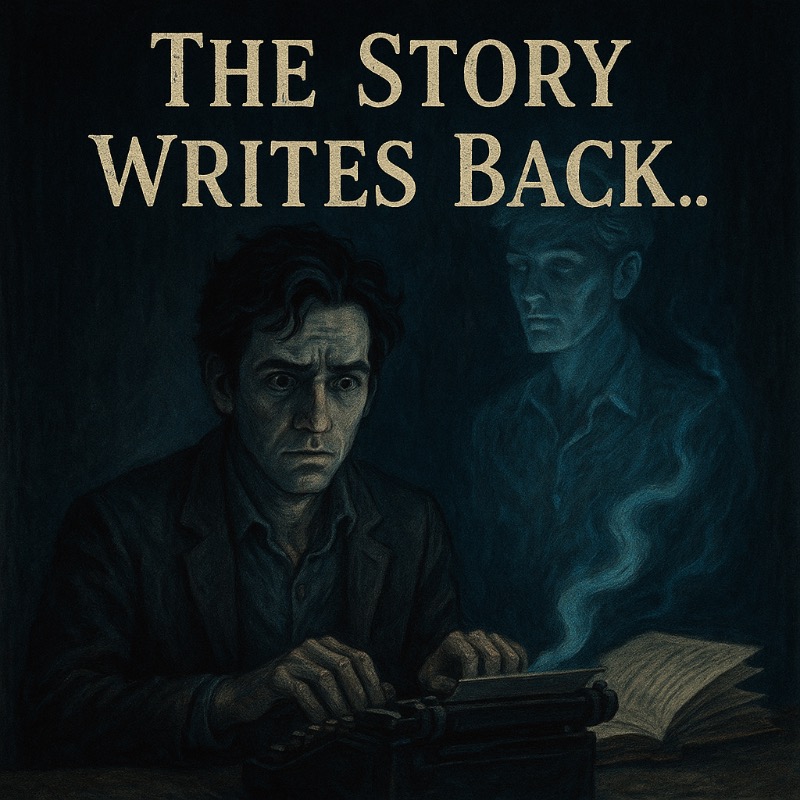
His new manuscript, The Vanishing Ink, was meant to be an experiment—a metafictional thriller where a writer creates a character so vivid, he begins affecting the real world. A clever twist on the “writer-as-god” trope. Arjun smirked as he typed the first lines on his old Remington typewriter. It clicked with a satisfying finality after each word, grounding him in the present.
In Chapter 3, he introduced Reva.
Mysterious. Brilliant. Dangerous. A former linguist turned rogue investigator. A woman with a tattoo of a broken compass on her left wrist. A symbol of someone who had lost all direction but was still moving—somehow.
The next day, Arjun saw her.
Not someone like her.
Her.
In the quiet corner of Café Monsoon, she sat alone. Reading. Not a magazine. Not one of his published novels.
She was reading The Vanishing Ink.
He froze. The manuscript was locked away at home. Not even his editor had seen a word. He rubbed his eyes and looked again. The cover was gone. She was sipping her coffee, scrolling through her phone.
He laughed under his breath, shook his head, and blamed it on sleep deprivation. The mind plays tricks, especially when it’s overfed with imagination.
But the unease lingered.
He went home and flipped through his pages. Reva had only appeared briefly so far. Yet her presence at the café felt… rehearsed. Too perfect, as if the universe had pulled her out of his thoughts and placed her there to see what he’d do.
By Chapter 7, things escalated.
He wrote a scene where Karan, the brooding protagonist, breaks into a corrupt politician’s mansion to retrieve classified documents. It was a key plot twist—Arjun had planned it just that morning. That night, he watched the news and dropped his glass.
The same mansion. The same politician. The same hour.
A real break-in. Real documents. Real scandal.
What the hell was going on?
He checked his draft. The details were identical, down to the color of the drapes in the politician’s study. He hadn’t shared this with anyone.
Freaked out, Arjun deleted the next chapter.
The following morning, the entire scene was lying on his desk—typed in his style, on his typewriter paper, but with one difference.
He hadn’t written it.
His name wasn’t on the top corner of the page.
It was Karan’s.
Arjun’s stomach twisted. He stopped writing. Burned the new pages. Locked the Remington away. For three days, he stayed away from fiction. Avoided the café. Slept with the lights on.
But fiction didn’t stay away from him.
He started hearing the typewriter at night. Mechanical clicks in the silence. He lived alone.
The fourth night, he found the typewriter back on his desk.
With a single page in the roller:
Arjun watches the door. He knows it will knock soon. He doesn’t want to open it. But he will.
Even before he finished reading, the knock came.
Three slow taps.
He didn’t move.
Another knock. Firmer this time.
He walked to the door like a man hypnotized. His heart thudded so hard he could feel it in his throat. He opened the door.
No one.
Except an envelope on the floor.
Inside, a photo of him—taken the day before from across the street—and a note:
Write. Or be written.
The following morning, he opened his manuscript. It was complete up to Chapter 20. His last written word had been in Chapter 9. The rest… had written itself.
Characters he hadn’t yet created now existed. Dialogues in his voice but revealing secrets he hadn’t invented. Karan had grown darker, more aggressive, aware of the writer watching him. Reva had become more prominent, her motivations more cryptic.
They were planning something. Arjun could feel it in every word.
One scene chilled him to the bone.
Karan stared at the screen. He typed one line: “You’re not the writer anymore.” Then he looked up at Arjun through the mirror and smiled.
That night, Arjun broke every writing tool in his flat. Disconnected his Wi-Fi. Burned the unfinished pages. Drank himself to sleep on the couch.
At 3:33 a.m., he woke to a familiar smell.
Ink.
The Remington was back.
A new page sat in it.
Arjun Mehra wakes up at 3:33 a.m., smelling the ink. He reads this very line, slowly realizing that it’s already too late. That the story isn’t about a character influencing reality. It’s about a writer being written into fiction.
He screamed and tore the page out. But the words were etched in his memory.
He grabbed his coat, rushed out of his apartment, and drove. Anywhere. Nowhere. Away.
He checked into an old beach lodge he remembered from childhood, left his phone behind, and sat on the porch for hours, staring at the waves. He hadn’t written in days.
Until he found the book in the room drawer.
A leather-bound copy of The Vanishing Ink.
Complete. Published.
The cover bore his name.
But the author photo on the back was not him.
It was Karan.
His eyes cold.
The final line of the book?
“In the end, it wasn’t about who created whom. It was about who was left holding the pen.”
Arjun dropped the book. He felt a chill on his wrist.
Looking down, he saw a faint image appearing on his skin.
A broken compass.






 React
React