No one woke up famous on a Wednesday. That was Mr. Tapan Dutt’s theory, which he muttered each week while unlocking his crumbling Delhi bookstore, adjusting his back like it was a reluctant co-worker.
The sign above the faded blue door read:
DUTT BOOK EMPORIUM
(Antiquarian, Rare, Slightly Possessed)
The last part had been added by his niece with a Sharpie and permanent audacity. He hadn’t erased it. Foot traffic increased. People liked haunted things, especially if they were Instagrammable.
Inside, the shop smelled like wet paper and quiet disappointment. Books sagged on the shelves like sleepy old men in lungis. Tapan, fifty-seven, moved among them with the reverence of a failed priest. His beard was patchy. His dreams were older than most of the inventory.
Once, long ago, he’d wanted to be a poet. Or at least a man who wrote things that made people stop mid-sentence. Instead, he alphabetized other people’s genius and argued with pigeons nesting in the travel section.
And then came the day he found the book.
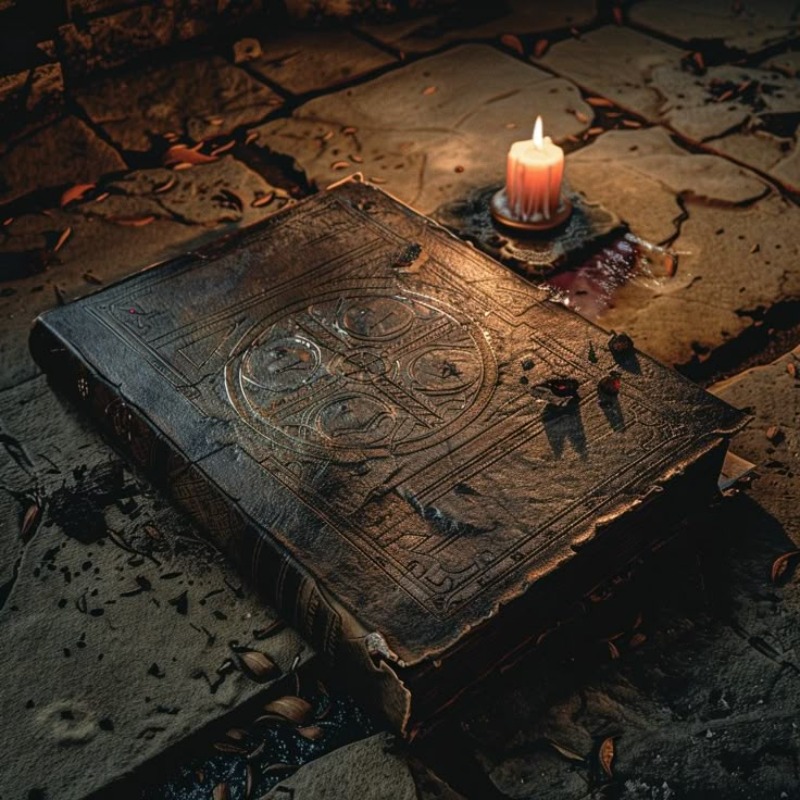
He was reorganizing the “Colonial Ghosts” shelf, memoirs of British officers, haunted mansions, and a very racist cookbook, when he saw it. A leather-bound volume tucked sideways behind a copy of Empire and Exhaustion.
“Songs of a Dying Raj,” said the cover.
Too poetic. No price tag. No memory of ordering it.
He opened it.
It smelled like old jasmine and firecrackers. The paper was browned and soft, like it had been read by time itself. On page 143, written in slanting ink that looked like someone escaping their own mind, was a message:
You’ve come late, but not too late.
The door still opens.
Turn the page only if you’re ready to lose something you didn’t know you still had.
~S.
He laughed. “Marketing stunt? Damn millennials.”
He turned the page anyway.
A photo.
Black-and-white. Slightly faded. But unmistakable.
A man stood in the center of the frame, holding the very same book. Same eyebrows, same nose, same regrettable posture.
Tapan Dutt. Calcutta. 1993.
But… he hadn’t been to Calcutta that year.
He’d almost gone. There’d been a woman. A poem. A plan.
Instead, he’d taken the government job and told himself poetry didn’t pay.
The page felt hot in his hands.
He tried to shelve the book. It reappeared on his pillow.
He tried to burn it. It refused. Instead, it released a scent—sandalwood and monsoon. The smell of a memory he hadn’t earned.
He gave it to the chaiwala boy. Ten minutes later, the boy came back pale, muttering, “Uncle, I saw my mother. She was reading me a story. She’s been gone ten years.”
Tapan clutched the book to his chest like it might explain itself.
And then, sensibly enough, he went to see an astrologer.
Pandit Hariram Sharma sat beneath a banyan tree near Lajpat Nagar, flanked by two parrots and an air of gentle judgment. He took the book, muttered Sanskrit, sprinkled something that smelled like fennel, and slapped Tapan lightly on the forehead.
“Problem is not the book,” he declared. “Problem is you.”
“How comforting.”
“You are leaking,” Hariram said. “Memories, regrets, possible versions. This book? It’s a kind of archive. Or infection. Or mirror.”
“Of what?”
“Of what you could have been. What you still might be. If you can remember what you chose to forget.”
That night, the book sat glowing faintly on his desk. When he opened it, the photo had changed.
Behind young Tapan, now visible, was a woman.
Parul.
Her blurry face still held the sharpness of her wit, the scar on her chin, and that reckless kindness he had once mistaken for a phase.
Below the photo, a new message:
She waited. You didn’t come. You remember it wrong.
He closed the shop the next morning for the first time in years. His niece texted:
Uncle??? Did the books unionize?
Just chasing a footnote, he replied.
He packed three kurtas, a bottle of antacids, and the book. Then took the first train to Calcutta.
The city hit him in the lungs.
He hadn’t stepped foot here since, well, according to his own memory, never. And yet everything felt familiar: the dust, the heat, the tram bells like faraway typewriters.
He found the street in the photo. Found the bookstore. Found the same old cat curled in the poetry section.
The owner examined the book and nodded slowly.
“This,” he whispered, “is the Guruji’s Book. It rewrites itself depending on who reads it.”
Tapan asked, “So it’s alive?”
“No. Worse,” said the man. “It’s honest.”
That night, in a hotel room with damp walls and loud curtains, the book presented him a new message:
She left you a poem. You never came.
She threw it into the river.
Go find what’s left of it.
The next clue: a puchkawala near the old church.
The vendor, white-haired and strangely alert, handed him a single puchka.
“It’s tamarind-heavy,” the man warned. “So’s memory.”
Inside the puchka: a note.
The city was a mirror,
Cracked and gold-edged.
I waited in its reflection
Until I faded like a whisper.
~Parul
He sat on the ghat, rereading the lines.
Had she waited? Had he truly not gone?
Or had he gone, and forgotten?
The book, that night, offered one last page:
Return one regret. Gain one memory.
And beneath that:
You were there, Tapan. But you chose to forget.
On the banks of the river, dawn pinking the sky, he saw him.
A younger version of himself. The same man from the photo. Holding the same book.
“You’re here,” the younger man said.
“Apparently.”
“You burned the poem once already. That’s how you forgot her. Do it again, and she’s just a ghost. Keep it, and she lives
but you’ll lose something else.”
“What?”
“The story where you get to be innocent.”
Tapan took the poem. It felt warm.
This time, he didn’t burn it.
He folded it gently, slipped it between the pages of the book.
Let memory stay.
Let regret have its place.
Back in Delhi, the shop was unchanged, but Tapan wasn’t.
The book was still there, but different now. Smaller. Quieter. Contained.
When he opened it, a new first page had appeared:
This story has been told. But you were not the hero.
That’s why it matters.
~S.
One afternoon, a girl came in. Bright eyes. Soft curiosity.
“Is it true your books talk back?” she asked.
Tapan smiled.
“They don’t talk,” he said. “But sometimes they remember what you forgot.”
She tilted her head. “Can I try one?”
He handed her a small, leather-bound volume.
“Page 143,” he said. “If you're ready.”






 React
React