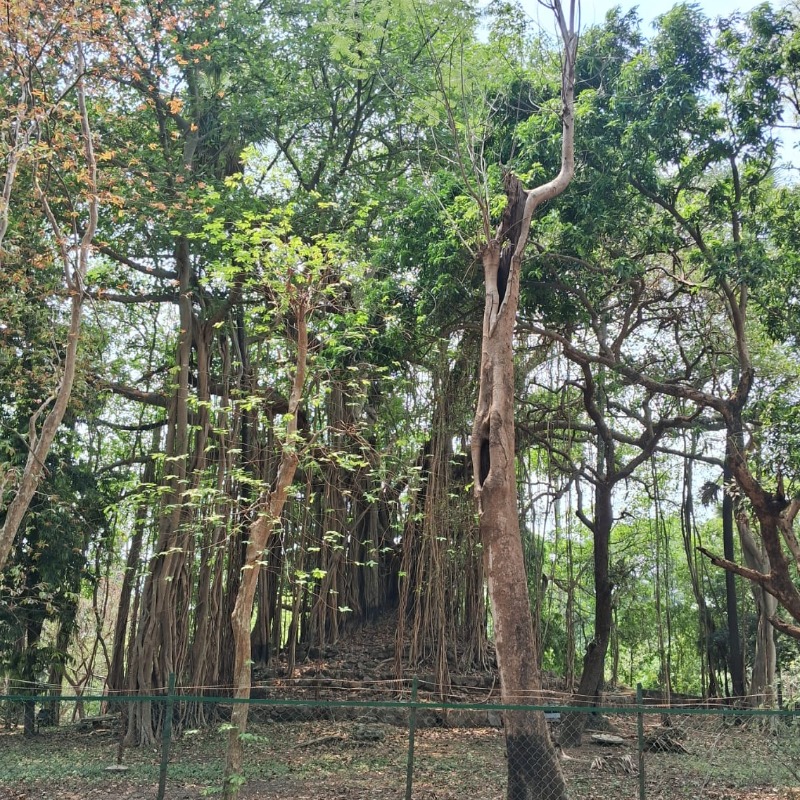
There is a spot in Santiniketan where time creases gently into the sound of leaves. Not too far from the classrooms where Rabindranath Tagore used to walk barefoot with students, there is a magnificent banyan tree — sprawling, earthy, patient. Several trees rise and fall, but this one has remained, as if planted not just in soil but in thought, in silence, in a way of life.
I first saw it on a peaceful visit one morning in December. The air was cool, the sky was blue, and the grounds were nearly still, save for the random spurt of laughter from kids playing. I wasn't seeking anything in particular. I had arrived more out of exhaustion than curiosity — the kind of exhaustion that seeps in when you've been ignoring your inner voice for too long.
The tree stood there — massive, arms spread wide like an old philosopher in thought. Its aerial roots hung like icy rain, descending into the ground as if they too were looking for something more profound. There were no plaques about it. No tour guides pointing it out. But it contained presence. It stood like a poem never read out loud — self-contained.
They tell us that Tagore would sit beneath this very tree. Not in pomp or ceremony, but with students and songs, with silence and sketches. It was there that he redefined what learning could be — organic, free, bathed in nature and humanity. Knowledge wasn't poured into the vessel; it was awakened gently, as one wakes a sleeping child.
I knew the tree previously, incidentally — in guidebooks, on the web. No one, though, had said anything about the tree's silence. No one had informed me that silence is so rich.
Standing under its canopy, something changed for me. The sun pierced through the thick leaves and cast golden patterns on the ground. A couple of students sat close by, notebooks open, some sketching, some writing. A teacher sat humming softly, immersed in a Tagore melody. I sat down in a quiet corner, resting my back against the thick trunk.
I had a notebook as well — half-full, largely forsaken. I hadn't written in months. Words once flowed so easily. But somewhere along the way of deadlines and letdowns, of checkboxes and icy rejection, the internal voice had fallen silent. I attributed it to life having happened. But the reality was, I had stopped paying attention.
But here, beneath this ancient canopy, something started to wake up.
The banyan never whispered solutions. It provided presence. Its silence was permission — not to create, not to demonstrate, but to be. In the midst of that stillness, this question arose:
What if I started anew?
What if I finally wrote what was real to me, and not what anyone else expected from me?
I glanced down at my hands and opened the notebook. No grand announcement. No elegant sentence. Just a line. Then another. I wrote of the wind in the branches and how it brought back memories of my mother's lullabies. I wrote of my grandmother's courtyard, and how tales sprouted there like jasmine in the evening. I wrote of my own silences — the ones I had guarded even from myself.
And somewhere among those silent scribbles, I discovered something astonishing.
I wasn't merely writing.
I was recalling who I was.
This was the moment — under the cover of Tagore's tree, in a landscape that would not divide learning from living — that I chose:
I would write my own story.
Not the one smoothed for public consumption. Not the one vetted for acceptance. But the rough, uncertain, searching tale that thrummed under my skin. A tale forged not by arrival, but by becoming.
It was then that I remembered a childhood memory I hadn't considered in years — sitting at a rain-speckled window, crafting a tale about a crow that refused to fly south for winter. My father had smiled when he read it and instructed me to "Write what only you can see." I had not known then. Now, beneath the boughs of a banyan that had seen more tales than I could ever tell, I did.
I shut my notebook quietly. Everything around me glided slowly. A kid rushed by with a flute carved out of his own hands. An elderly professor drank tea on the bench next to me, eyes shut, as if recalling an ancient memory. Two girls leaned against the tree, talking softly in Bengali about matters that would not be important in years to come — or maybe even more important than they yet realized.
It was all so mundane. And in its mundanity, it was holy.
Later, I went to the prayer hall, where light streamed in through colored glass and the silence vibrated like a low tanpura. I remembered Tagore's words — how he envisioned the divine not in far-off rituals but in the ordinary act of presence, of beauty, of creation. And I knew then that writing — my writing — did not require validation. It required only truth.
I went back to the banyan before I went away. I stood before it as one stands before a wise teacher — not in fear, but in awe. The wind had risen slightly, rustling the leaves into whispers of applause. I laid my hand on the bark softly. It was warm, alive, listening.
I breathed softly, though no ear heard:
Thank you.
For holding space.
For not hurrying.
For showing me what still lives inside me.
As I stepped back, the notebook was different in my hand. It was not paper any more — it sparked. A beginning.
And I wasn't going to be scared to see it through.






 React
React