Title: Maranathin Nool ("The Journal Beneath the Rain")
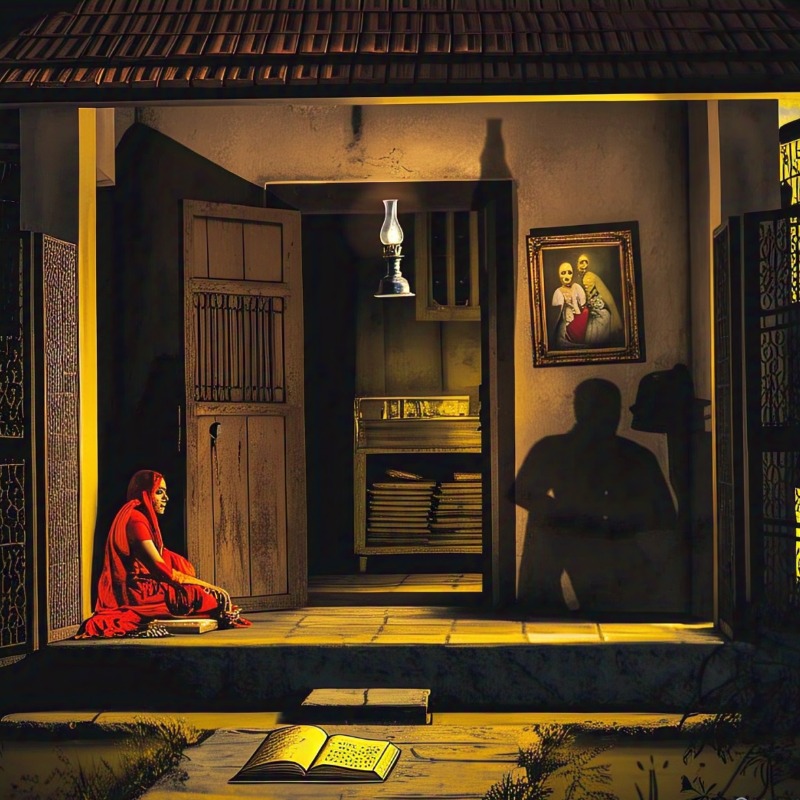
The monsoon had arrived in Aravam's village with an impatient fury. Rain lashed against the cracked tiled roof of his ancestral house, soaking the red earth until it turned into a thick brown paste. The house stood on the fringes of the village near an old, overgrown path lined with thorny karuvelam trees and rusted iron gates barely hanging to their hinges. Crows cawed from the broken gopuram of the nearby Amman temple, and frogs croaked from the flooded paddy fields. The air smelled of neem leaves, camphor, and old wet bricks. Aravam sat cross-legged on the thinnai, a dim hurricane lamp casting long shadows behind him. The scent of wet soil mixed with the lingering sambrani smoke from the morning pooja. Somewhere far off, temple bells rang softly through the storm.
Aravam was tall and lean, his skin dark like burnt bronze from years under the sun. His curly hair was damp, falling over his thoughtful eyes that seemed older than his twenty-eight years. A thin white towel lay draped around his shoulders, and he wore a faded veshti tied in a loose knot. His hands, rough from handling brittle manuscripts and old palm leaves, rested on his knees. He looked like a man plucked out of time—someone who belonged to another era, one where silence held meaning.
It had been ten years since his twin brother Aathavan had drowned in the village pond on an Aadi Amavasai night. They had gone to light diyas, and only one of them returned. Or so the story went. Aravam never remembered the night clearly. He remembered the lamp in his hand, the water’s surface like obsidian, and Aathavan’s voice calling out just once. Then nothing. Aathavan’s body was never found.
The village had offered its grief, then its whispers. And eventually, silence.
Aravam stayed back in the house once filled with the warmth of his paatti, Thangam, and the voice of his Appa reciting Kamba Ramayanam after dinner. Now, only termites and memory lived here. The rooms smelled of old paper, sandalwood, and dry tamarind. The walls bore portraits of ancestors with glassy, faded eyes. Aravam worked on restoring old books—his grandfather’s collection, temple manuscripts, palm leaves eaten at the corners by time. It kept him busy. It kept the voices quiet.
On the third night of heavy rains, someone knocked.
Not the sharp, demanding rap of a visitor. This was a slow, uncertain knock—like a question. Aravam rose cautiously, pulling the wooden bolt aside. The outer verandah was cloaked in rain and darkness.
At his feet lay a parcel. No one in sight.
Wrapped in old cotton, tied with coir thread, the bundle bore no name, no address. Just a wax seal marked with a suli, an old Tamil symbol for endings.
He brought it inside. Unwrapping it revealed a book—hand-bound in worn leather, stained and scratched, smelling of old smoke and something sweetly decayed.
Aravam’s breath caught.
It was Aathavan’s journal. His name carved in the inner flap in messy Tamil script: Aathavan, 2015.
But that was the year he vanished.
The first few pages were filled with scribbles, diagrams of the village, pond sketches, strange symbols Aravam didn’t recognize. But then the entries turned recent—describing Aravam himself. The way he sat near the thinnai lamp, the tune he hummed from paatti’s lullaby, even the words he muttered in his sleep.
His hands trembled. He slammed the journal shut.
That night, sleep didn’t come.
--
She appeared the next evening.
As the storm paused to take breath, a woman stood near the gate—still and silent, sari clinging to her from the rain. She looked no older than Aravam, with sharp features and long black hair braided tightly. Her skin was pale, as though she had not seen sunlight for years. Her eyes were dark, except for one—milk-white and unmoving, like a blind moon.
“I am Sangavai,” she said, voice low and wind-chilled. “I was with Aathavan before he crossed.”
Aravam stared. “Crossed what?”
She didn’t answer. Her gaze wandered to the lamp on the thinnai, then the door behind him.
“He asked me to return his words. You’ve received the journal.”
He didn’t invite her in. Still, she stepped across the threshold.
--
Inside, the oil lamp flickered wildly as Sangavai sat on the wooden chair Appa used to sit on during December margazhi bhajans. Her presence was quiet, almost weightless, but it filled the room like mist. She seemed familiar—not her face, but the way she looked at the walls, the books, the old black-and-white photos.
“You’ve been here before,” Aravam said slowly.
She nodded once. “Many times. With him.”
She told him stories—Aathavan’s life after the pond, how he hadn’t died but moved into a realm between memories and dreams. “Not everyone who dies is gone,” she said. “Some stay behind, caught in the gaps between breath and forgetting.”
Aravam didn’t believe her. But when she took out an old silver thandatti from her cloth bag—Aathavan’s favorite childhood toy, lost the day he vanished—he didn’t speak again for hours.
--
Days passed strangely after Sangavai came.
Aravam would wake to find pages in the journal had changed. New entries appeared, with descriptions of a woman singing in the pooja room, of hidden chambers inside the house.
He found one such room—behind the paatti’s wooden wardrobe. A forgotten store room with half-burnt photos, an oil painting of twins, and Aathavan’s childhood diary. Inside was a sketch—a house with its roof cut open, showing shadows moving inside.
In the kitchen, his grandfather’s uruli began to ring softly at night. The corridor near the tulasi maadam smelled of Aathavan’s old kasthuri soap.
And Sangavai—she never slept. She sat near the lamp and read the journal silently, eyes flicking across pages that only showed blankness to Aravam.
--
Then came the last entry.
In smudged ink, barely legible:
If you are reading this, Aravam, you have already let her in.
Don’t trust the one-eyed woman.
I never escaped the pond.
Aravam looked up.
Sangavai was gone.
The door still bolted. The lamp still burning.
--
He ran to the pond.
The rain had returned, a thin mist rising over the still water. Near the edge lay a sari. Wet. Red. He reached down—and saw his reflection split in two. A second face behind his own.
Aathavan.
Not aged. Not broken. Just… silent. And watching.
Sangavai stood beside a neem tree now, her white eye gleaming like a second moon.
“You tried to forget,” she whispered. “You buried him not in water, but in guilt.”
Aravam screamed. He remembered now. The fight. The push. Aathavan’s head hitting the stone slab.
He had run. Lied. Told the villagers Aathavan slipped. They believed him. Even Paatti.
--
The journal burned that night in the pooja fire, crackling as if screaming. The rain never returned after that.
Sangavai was never seen again. But her voice often echoed in the hallway—reciting Tamil verses only Aathavan used to say:
"Unmai enbadhu, ninaivugal than... aana unmaiyai marakkumbothu, uyir irukkaadhu."
(Truth lives in memory… but when you kill the truth, life becomes hollow.)
Aravam never left the house again. He restored books by day. And by night, he listened to footsteps that mirrored his own.
One day, the postman came to deliver a parcel.
No one answered.
Inside the gate, on the thinnai, lay a fresh journal.
Its cover read:
Aaravam - 2025.






 React
React