It was a cloudy Tuesday in early January. The sky looked bruised, heavy with rain, and the wind carried a sharp bite that reminded Arvind Sharma of winters spent in his ancestral home in Patna. He lived alone now, in a modest two-room flat in Rajendra Nagar, surrounded by books, broken memories, and a silence that never stopped humming.
His daughter, Aanya, was in Delhi for her postgraduate studies. His wife, Meera, had died two years ago after a prolonged battle with cancer, and since then, Arvind had aged faster than he could accept. Every day was a copy of the one before—tea at 6, newspaper by 7, and an endless stretch of time that refused to be tamed.
At 4:30 that evening, just as the electricity flickered due to an incoming storm, there was a knock on the door.
Three knocks. Steady. Calm. Measured.
Arvind wasn’t expecting anyone. The society’s security guard would usually call before letting a visitor in. He hesitated, slippers pausing on the mosaic floor.
Another knock. Firmer this time.
He opened the door cautiously.
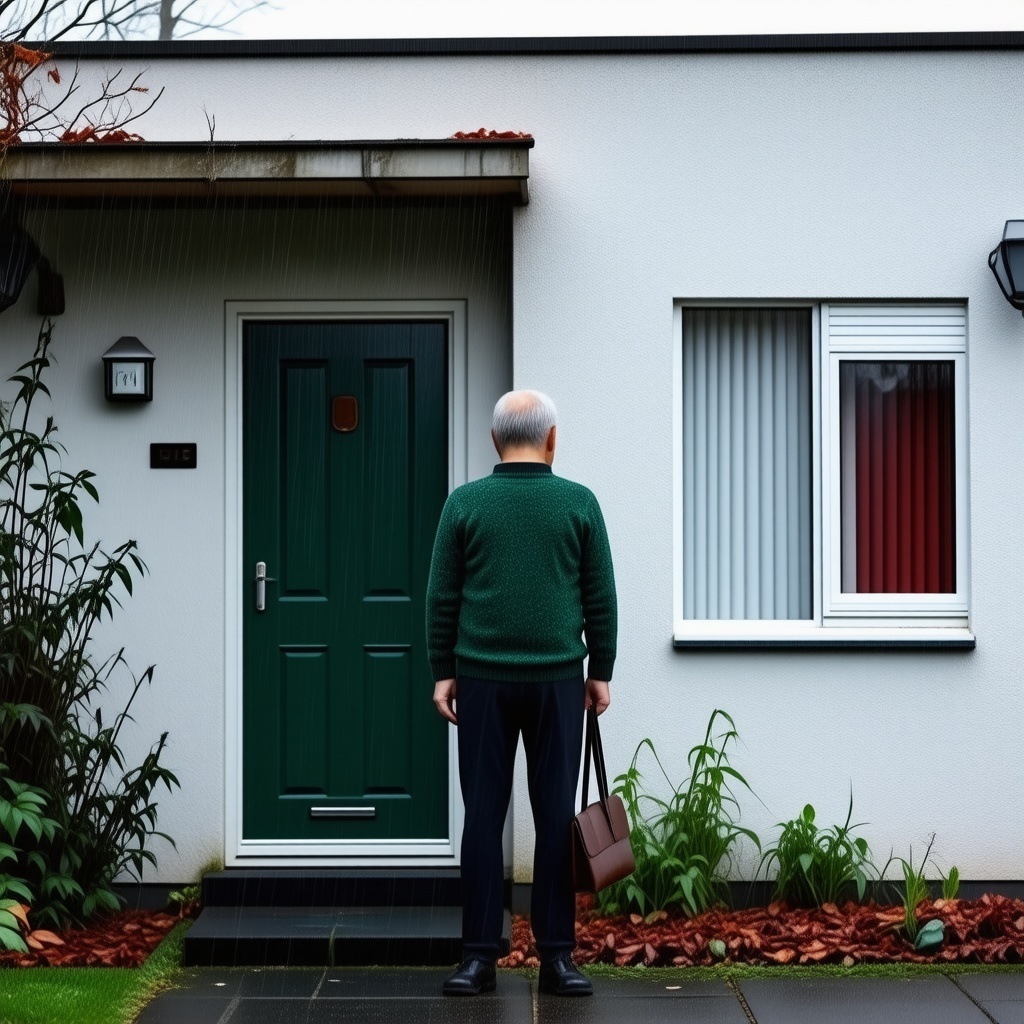
There stood a man in a green sweater. Mid-thirties, with a beard neatly trimmed, and eyes that seemed too familiar for a stranger. His shoes were dusty, and in his hand, he held a small leather bag.
“Namaste, Sharmaji?” the man asked, almost tentatively.
“Yes…?”
“I’m sorry to disturb you. I’m not selling anything. I was told—actually, it’s a bit strange—I was told I might find something important here.”
Arvind stared at him, unsure whether to slam the door or invite him in. “Who told you?”
“A woman I met at Gaya Junction. She gave me your name. Said you’d help me find answers.”
That name—Gaya—stirred something.
“Who was this woman?”
“She didn’t give a name. Only said, ‘Sharmaji knows.’ And then she walked away.”
Despite the oddity, something in the man’s eyes tugged at Arvind’s gut. Against all better judgment, he stepped aside. “Come in.”
The man entered, quietly removing his shoes.
“I’m Rohit,” he said, settling into the sofa, eyes scanning the room. “Rohit Saxena.”
Arvind poured tea, the ritual giving him a sense of control. He handed Rohit a cup.
“So, what are you looking for?”
“A story. Maybe a truth. Maybe my past.”
Arvind frowned.
Rohit pulled out an old, dog-eared photograph. It showed a younger Meera, holding a baby. A baby that wasn’t Aanya.
Arvind froze.
“Where did you get this?”
“She gave it to me at the station. Said, ‘Your father has been waiting too long.’ Sharmaji, I… I don’t know who my parents are. I was raised in an orphanage in Buxar. But last week, a man came to the orphanage, elderly, said he had wronged someone years ago. He gave me that photo, told me to go to Gaya Junction. I waited there two days. That’s when the woman found me.”
Arvind felt the world slip slightly beneath his feet. His hand trembled.
That photo… that child.
Back in 1992, there had been a fire. A baby rescued from a neighbor’s house. Meera had insisted on adopting him, but the courts never allowed it. They said the child had surviving relatives. One day, someone came and claimed the child. And Meera—she broke. She cried for days, inconsolable. And Arvind, helpless, never spoke of it again.
“You’re saying… you think you’re that child?”
“I don’t know. But I’ve followed the clues here. Something tells me I belong here.”
There was a long silence. The only sound was the rain, tapping the windows.
“I don’t know what to say,” Arvind finally said.
“I know it sounds absurd,” Rohit replied. “But everything in me says I’m supposed to be here.”
Arvind stood, walked to his bedroom, and returned with a small tin box. Inside were letters—yellowing, some torn. He handed them to Rohit.
“These are the only pieces left from that time. Meera wrote letters to that child… even after he was taken.”
Rohit opened one. The handwriting was elegant, careful.
“Mere laadle, jahan bhi ho, yaad rakhna, ek maa har roz tumhara intezar karti hai…”
His eyes welled up.
“I remember… a scent,” Rohit whispered. “Camphor. This room smells like it. Like my dreams.”
They talked until midnight. About lives that diverged. About memories shaped by loss. Rohit stayed the night.
Next morning, Arvind called Aanya. Told her everything. She was shocked but curious.
Over the next few weeks, they did DNA tests, traced records, spoke to old officials. The truth unraveled—slowly, painfully.
Rohit was indeed the child Meera had loved and lost. But more than that, he was the child Arvind had turned away from, thinking it would save them all pain.
Now, years later, that pain had come back to knock at his door, wearing a green sweater.
Rohit moved in. Not as a son. Not yet. But as someone who belonged.
And in time, he became a thread that stitched back what grief had once torn apart.
She stood in silence, the edge of her saree clutched tightly in one fist. Her eyes flickered between the worn green sweater and the man’s trembling lips.
“Who… who are you?” she repeated.
The man didn’t answer immediately. He pulled a photograph from his pocket — creased, nearly torn. He handed it over without a word.
Radha took it cautiously. It was a faded image of two young boys, grinning in the sunlight. One had a slingshot around his neck. The other had a scar across his brow. Her fingers trembled. She knew that scar.
“I am Vimal,” he whispered. “Maa’s Vimal. Your Vimal.”
Her world blurred. She blinked rapidly. “No,” she muttered. “No… he died in the floods. They never found his body.”
He nodded slowly. “I didn’t die. I ran.”
Silence.
“I was scared. Of father. Of his beatings. Of the debt collectors. I hid in the truck of a man who drove past the village… and by the time I realized I had left home forever, it was too late. I was ten. What did I know?”
Radha staggered back onto the chair. The room, moments ago filled with nothing but boiling lentils, was now saturated with twenty-seven years of absence.
“You expect me to believe you’re my brother?” she asked. “After all this time?”
“I don’t expect it,” he said. “I only came to return what I took from you.”
He placed a small packet on the table. She didn’t touch it. He opened it himself. Inside was a faded, silver anklet — one of a pair.
“You wore this when you were four. I remember… you cried when it fell off in the river, and I found it for you. I kept it in my pocket for days, waiting for you to notice.”
Tears sprang unbidden to her eyes.
She looked up at him. “Where have you been?”
“Everywhere. Construction sites in Mumbai. Saloons in Surat. Even sold SIM cards on trains for a while. I drank a lot. I was angry. Mostly at myself.”
“And now?”
He looked around the modest home. “Now I’m just tired.”
A loud thud interrupted them. Her son, Raju, now fifteen, had come home from school and dropped his bag on the floor. He stopped in his tracks, staring at the stranger in the room.
“Ma?”
Radha rose slowly. “This… this is your mama.”
The boy narrowed his eyes. “But I thought…”
“So did I,” she said softly.
⸻
That night, the house was quieter than ever. Vimal insisted on sleeping on the floor, next to the door.
“I’m used to it,” he explained. “I’ve slept under bridges colder than this.”
Radha couldn’t sleep. Her mind was a storm. Memories of her childhood, the silent dinners after Vimal vanished, the way her father’s temper grew colder, crueler. Her mother’s silent crying. All of it came flooding back.
At 2 a.m., she walked into the living room.
He was awake. “Can’t sleep?” he asked.
“No.”
They sat in silence for a moment before she asked, “Why now? Why come after all this time?”
“I found out I have cancer,” he said. “Stage four. Lungs.”
She gasped.
“I smoked everything I could find. Cheap bidis, leaves, even newspapers once. Just to survive.”
A long silence.
“I wanted to die somewhere familiar. Not under a bridge in Delhi.”
The room fell quiet again. Then Radha did something she hadn’t done in decades. She leaned her head on her brother’s shoulder.
He didn’t move.
⸻
Days passed.
Vimal began helping around the house — fixing broken hinges, making tea, talking to Raju about city life. Raju had never had a male figure who talked to him like a friend.
Neighbors began asking questions. “Who is this man?” “Is he staying long?” “Why now?”
One afternoon, Radha confronted Vimal again. “You came back to die, didn’t you?”
He nodded. “Yes. But I didn’t know I’d live again. Even if only for a few days.”
She walked over, handed him a letter. “Dr. Mehta. Oncology Department. Government Hospital.”
He looked up. “Why?”
“Because sometimes, even strangers deserve second chances.”
He held her gaze for a long moment. Then, tears filling his eyes, he whispered, “I never stopped being your brother, Radha.”
She smiled. “Then start living like one.”






 React
React