Ravi kumar Mishra
I don’t remember falling asleep.
One moment, I was lying on the ancient cot in my Nani’s ancestral haveli in Varanasi—the one with the peeling lime-washed walls and sun-stained courtyard where my childhood echoes still lingered. The ceiling fan above creaked with every turn, muttering like an old man who had seen too much and remembered too well. The air was thick with the mingled scents of jasmine, mothballs, and something else—older, more secretive—like forgotten incense. The windows were open, allowing in the faraway sound of temple bells and the occasional bark of a street dog echoing through narrow lanes.
And the next moment—I was here.
Not in a dream. I knew this instinctively. Dreams are fractured, weightless, transient. But this place... it pressed on me. It hummed with a presence too solid to be fantasy. The scent of wet earth and burning camphor clung to the air like ancient incense. There was silence, but it wasn’t empty. It was a silence filled with age, like an unsung note vibrating through time.
And then the eyes—hundreds of them. Hidden behind diaphanous curtains of mist. Watching. Not menacing, but curious. Like the gaze of something that had waited for centuries and was simply... patient.
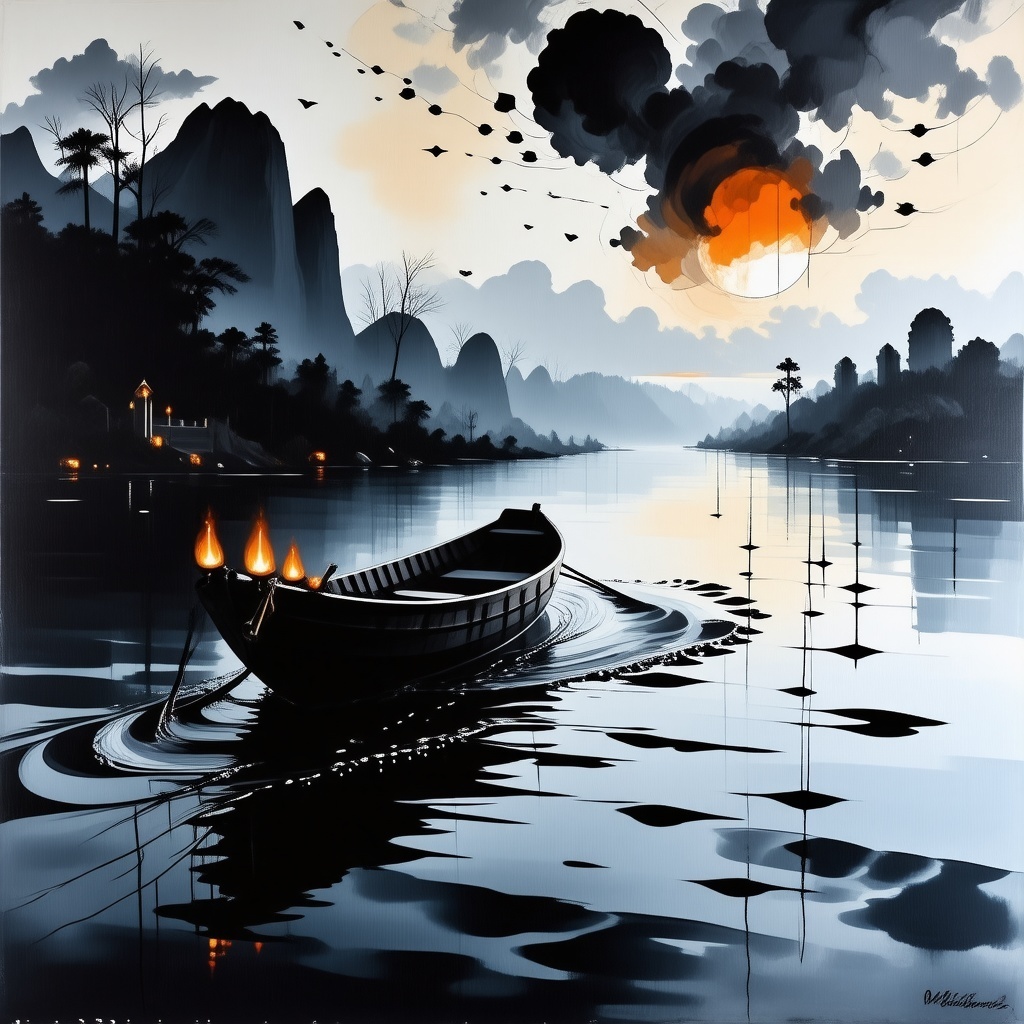
I awoke—or arrived—on a narrow wooden boat, drifting slowly down a river as black as ink, blacker than obsidian. It wasn’t water as I knew it. It shimmered like liquid shadow and seemed to hold within it the stars the sky above had forgotten. Because that sky was void—not a single star, not even the shape of the moon. Just a vast, infinite emptiness that felt too large to bear.
Yet the darkness was broken.
Hundreds of diyas floated—not on the water, but above it—suspended mid-air, glowing softly like memories refusing to die. Their golden light reflected off the water, off the boat, off me. Each one flickered with something familiar, something felt but not fully known. Like half-remembered songs from childhood.
Figures stood silently along the banks on either side of the river. They wore white robes, their faces obscured beneath veil-like hoods. They didn’t move. They didn’t speak. They just watched. I didn’t feel fear—only an intense, almost aching unease, as though I had stepped inside the story Nani used to whisper during monsoon evenings, when the power would go out, and her tales would take on a shape more real than the storm outside.
“Where... am I?” I asked, though my lips felt unmoving, like they were part of another body.
“You are between threads,” came a voice.
I turned.
The boatman stood behind me. Or had he always been there?
He was unlike any being I had seen before. His form shimmered like moonlight reflected in a moving pool—changing, elusive. His eyes glowed a dull ember-red, like coal buried beneath ash. His turban wasn’t cloth, but fresh marigold petals, vibrant and alive, shifting in hue though there was no breeze.
“Threads?” I asked, though the word felt ancient, older than speech.
“Every soul is stitched to a world,” he said. “Yours has come loose.”
“Loose?”
“You dream, yes. But you also walk.”
A chill surged through me, crawling up my spine like a forgotten truth.
Was I dead?
But no. This wasn’t death. I knew that. Death, I imagined, was colder. Quieter. This was something else. It felt older than death, like the humming base note of a tanpura beneath the song of life. It wasn’t an ending. It was a between.
I thought of Nani’s stories again. How she’d tell me, while oiling my hair, about the nadis—not the physical rivers, but the spiritual ones, the soul-streams connecting one life to another, one world to the next. She’d whisper, “Sometimes, a restless thread pulls you where you’re needed most. Or... where you left something behind.”
“You were called,” the boatman said. “Something here remembers you.”
The mist began to thin.
And then, I saw it—a structure emerging on the far bank of the river. A temple, unlike any I’d seen before, even in Varanasi’s thousand shrines. It was carved entirely of crystal, glowing softly from within like a lantern caught in a storm. Its spires floated above their bases, defying gravity. Bells rang inside, but there were no ropes. No hands. Only music.
The boat touched shore with a soft sigh. The boatman did not follow.
“Only one thing can return you to your thread,” he said. “But first—you must give something up.”
I stepped off the boat. The ground beneath my feet was warm, soft—like dust and memory mingled together. The temple’s great doors opened before I touched them, creaking with a sound like ancient paper.
Inside, the chamber was golden and vast. The scent of turmeric and rain, sandalwood and old grief, filled the space. In its center stood a mirror.
But it was not a mirror of glass. It reflected nothing of the world behind me.
Instead—it showed her.
Me.
But not quite.
She wore a plain white saree. Her hair was streaked with silver. She was kneeling in a dry, cracked field, planting saplings. Around her were children—barefoot, joyful. Some held books. Some carried chalk or wooden bangles. She smiled, though her face bore deep lines of sorrow and sacrifice. But her eyes—they blazed with quiet joy.
“She is who you could become,” said a voice—not the boatman’s, but something older, older than the river, older than this temple. A voice woven into the very fabric of the air.
“If you stay,” it said, “you must let go. Your name. Nani’s laughter. The monsoon on your skin. The neem’s bitterness. The stories. The fears. You must begin again. Whole—but altered.”
I stared at the woman. At me. At who I might be.
She looked... free.
I fell to my knees. The weight of that choice was too much. Could I start over? Could I truly let go of everything I had been—memories, stories, scents, songs?
And then—I heard it.
A lullaby.
Faint. Barely audible. But unmistakable.
Nani’s voice. Thin and aged, but steady. Singing the song she used to hum when I had nightmares. The one about the kite that always found its way home, even when its thread snapped.
Tears blurred my vision.
I remembered her hands—rough with age, always smelling of mustard oil. I remembered the crackle of her cotton saree as she passed by my room. The mango pickles drying on the terrace. The way she’d tell me, “Some things are more real than they seem.”
I opened my eyes.
“No,” I whispered. “I choose my thread. Even if it’s fraying.”
The temple groaned like a mountain exhaling. A warm wind surged through, scattering the marigold petals from the boatman’s turban. They swirled around me, glowing like saffron fire.
Then—
—I woke.
Back in the haveli.
The fan above spun slowly. The jasmine returned. The room was the same—but I was not.
My heart thundered. My palms were damp. I sat up and looked around. Everything was familiar. Everything was real.
And yet, in my palm—
—a single marigold petal.
Fresh. Fragrant. Dew-kissed.
I never told anyone what happened. Not even Nani. Some stories aren’t meant to be told. They are sewn into us, like sacred threads tied in silent prayer, known only to the soul.
But sometimes, when I close my eyes and sleep—I return.
To the river of ink. The watching eyes. The temple of crystal. The woman who plants in barren fields. She smiles at me, always.
And I know—our threads may tangle, stretch, or strain, but the ones stitched with love never truly break.
Note:
This story is for you, dear reader. Whoever you are, wherever your soul wanders. Perhaps your thread too shimmers between unseen worlds, waiting to be remembered. Or perhaps—you’ve already been called.






 React
React