One quiet afternoon, Cali was lying back in a suede chair, licking honey from his fingers, when he heard a sharp noise—like nails scraping a chalkboard.
He stopped. The sound came again.
He got up and walked down the spiral stairs. His boots clicked on the iron steps. The basement smelled like rust and wet cardboard. He lit a match and held it up.
Nothing. Just boxes full of junk—old batteries, broken speakers, tangled wires.
He turned to leave, but a cold breeze touched the back of his neck.
When he got back to his apartment, something was... different.
The bad smell was gone. The cracked ceiling had become polished wood with fancy carvings. Soft lights glowed from tulip-shaped lamps. He spun around like a kid, staring at the chandeliers above, the soft chairs, the embroidered cushions, and the shiny oak tables. Everything looked warm, clean, and perfect. Paintings in gold frames stared down at him—faces he didn’t know, but somehow looked like him.
He blinked. Once. Twice.
“No way…” he whispered, pinching himself until it hurt.
But the room didn’t change.
Cali stumbled back, his mouth open.
“This... this is mine?” he said, starting to laugh like someone in a fever. “I did it. I really did it.”
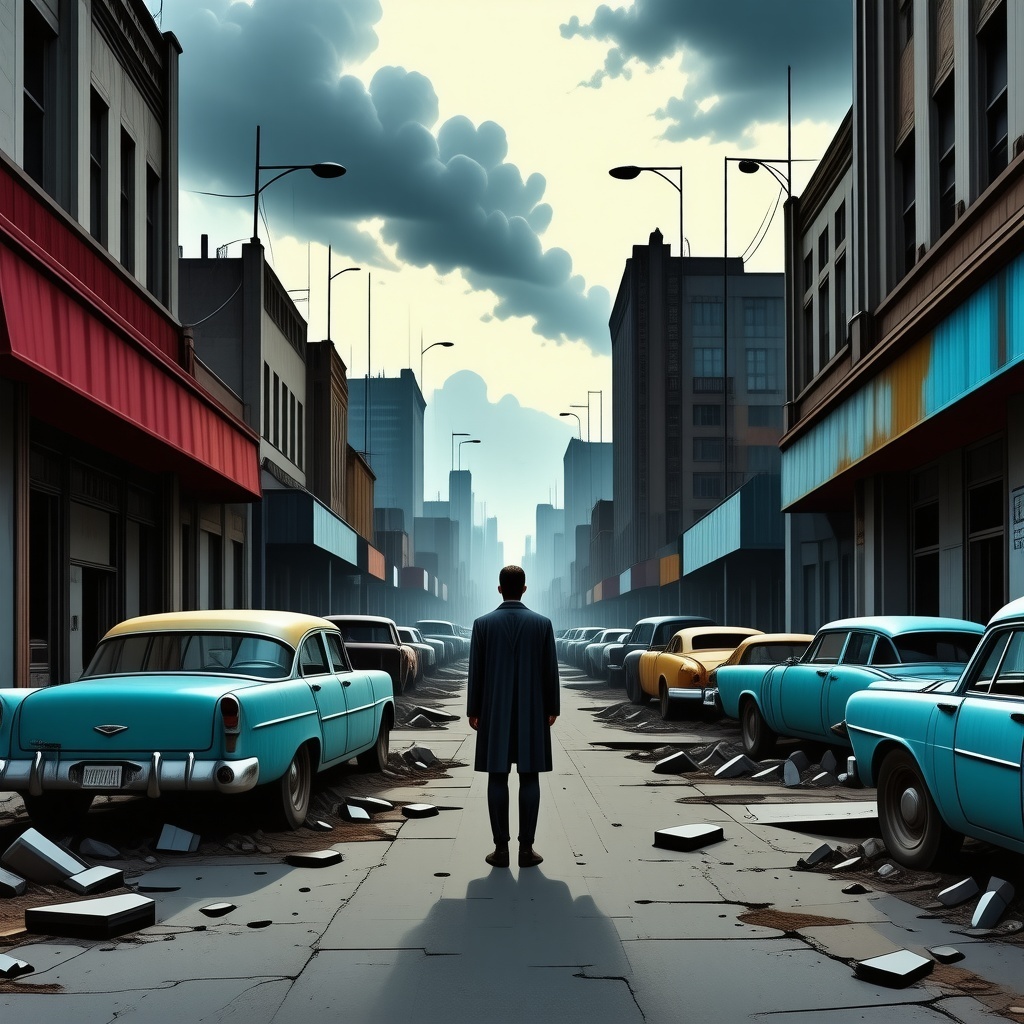
He stepped outside to feel the wind, to make sure it was real. But what he saw wasn’t the city he remembered. The streets were empty. Cars sat in place, rusted like shipwrecks. Stores were broken into, their windows shattered like gaping mouths. The sky was the color of ash.
He kept walking. His footsteps echoed. The air smelled like rot. Somewhere nearby, a fire crackled on its own.
“Where is everyone?” he said, but the silence swallowed his voice.
At the end of the road stood a child. She was barefoot, her hair messy, her clothes torn and stained with something dark. She looked at him, eyes wide with a sadness no child should carry.
Cali walked closer. “What happened here?”
She didn’t speak. She only pointed to the walls with markings, the broken shelters, the dead ground. And then to him.
He froze.
The symbols on the walls weren’t just graffiti. They were his—his logo, his slogan. He saw it clearly now. The dream he chased wasn’t just a dream. It was a curse. The mansion, the money, the power—it all came at the cost of his city’s soul.
He dropped to his knees. Ash fell from the sky like snow.
Once, people on the street called him Golem, a name spoken half with respect, half with fear. His body looked like it was carved from stone—big shoulders, thick limbs, and a neck like a tree trunk. At fifteen, while other kids were skating or fooling around, Cali was selling poison in plastic bags.
He lived in a two-room flat with his mother and older brother, Armin. The place always smelled like burnt onions and damp socks.
Armin did odd jobs—painting houses, delivering food on an old scooter, and when rent was tight, selling just enough drugs to keep the fridge running. He never made it sound cool. He said it like it was: “a knife you hold by the wrong end.”
Cali looked up to him. Armin once told him, “We don’t choose the world we’re born in, but we choose the one we leave behind.”
Now, the world seem far from the it.
The girl didn’t move for a while. Then she stepped forward, her voice barely above a whisper. “Do you have money?” she asked.
Cali blinked. “What?”
“Money,” she repeated, a little louder this time. “For my family. My brother’s sick. Mama said we need food.”
Cali looked down at his hands, calloused from the empire he built. “I... I don’t have anything on me,” he said.
She frowned. “But you’re rich. You have a big house. You made all this.”
“I didn’t know it would end like this,” he muttered.
She tilted her head. “You knew. You just didn’t care.”
“I cared,” he said quickly, then hesitated. “At least, I thought I did.”
The girl stepped closer, her voice sharper now. “We were just garbage to you.”
“I never meant to hurt anyone,” Cali whispered.
She stared at him, eyes full of fire and hunger. “Then why did you take everything?”
He had no answer. The silence between them was louder than any words.
One night, Armin warned him.
“Don’t go too deep, Cali. Think you’re smart? Smarter guys than you have drowned in this game.”
Cali shrugged. “Drowning’s better than standing around waiting for a miracle that never comes.”
The city didn’t offer miracles. It didn’t take much for Cali to cross the line. When hunger gets loud, even silence sounds like a deal.
Once in, he moved fast. Too fast. He wore his ego like armor. Soon, he wasn’t just selling—he was running the whole game. Giving orders to little kids who looked up to him.
“Someday,” he told them, “this city’s gonna wear my name like a badge.”
And it did—just not how he wanted.
Cali pressed his hands into the dirt, crushed under the weight of his empire. “What have I done?” he said.
In that moment, he closed his eyes. He imagines the mansion behind him flickering, like the world was correcting itself. He imagines his old apartment again: the leaking ceiling, the stench of failure, the truth.
He thought about the faces of the kids he dragged into this life, the families he broke, the streets he left in ruin. It wasn’t just the city that was broken. It was him. And now, all he wanted was a chance to take it back.
He thought, maybe he was the garbage—and he had only created more to try to hide his own.






 React
React