It was a cold December evening in the sleepy town of Rivermist, where the fog hugged the rooftops like a secret no one wanted to share. Eleanor Myers sat curled up in her armchair, a plaid blanket over her knees, sipping chamomile tea and listening to the soft crackle of the fireplace. The quiet was comforting. At seventy-two, solitude had become both her companion and her protector.
Eleanor had lived alone since her husband, Harold, passed away six years ago. Her days were filled with knitting, gardening, and tending to the same routines that brought her a strange sense of peace. Rivermist wasn’t a place where surprises happened. That’s why the knock on her door at 8:42 p.m. startled her.
She paused, cup in hand.
Knock. Knock.
It wasn’t frantic. It wasn’t timid either. Just… steady.
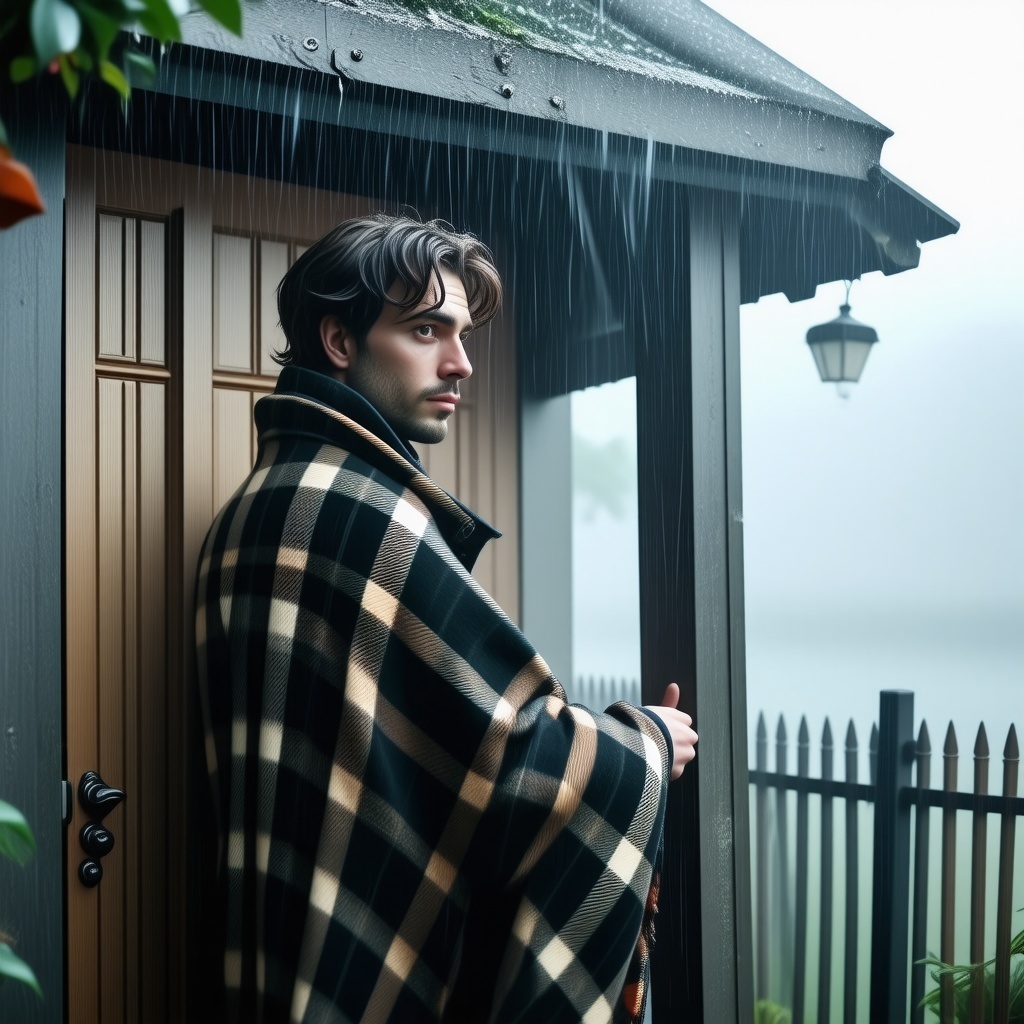
Eleanor stood, heart thudding louder than the knock itself. She glanced through the peephole, expecting perhaps a neighbor in need. But what she saw wasn’t familiar. A man, mid-thirties, unshaven and wearing a long coat damp from the fog, stood with his hands by his sides. His face held no expression, but his eyes—there was something strange about them. Calm, but watchful.
Eleanor hesitated.
The man didn’t knock again.
She opened the door slightly, the chain still on.
“Yes?”
“Ma’am, I’m sorry to bother you so late. My car broke down just down the road. No cell reception. I just need to use a phone to call a tow.”
His voice was polite, even, rehearsed almost.
Eleanor’s instincts wrestled with her manners. She’d been taught to help those in need. But the world had changed.
“I can call someone for you,” she said.
The man smiled, and that was somehow more unsettling than his blank stare. “Actually, it’d be better if I could speak to the service myself. It’s complicated. Please. Just a few minutes.”
She stared at him.
What harm could it do?
With a sigh, Eleanor closed the door, unhooked the chain, and opened it fully. “Alright. Just for a moment. The phone is in the hallway.”
The man nodded and stepped in. He didn’t smell of alcohol or smoke. Just wet wool.
“Thank you,” he said, walking in slowly. “You’re very kind.”
Eleanor pointed toward the landline on the wall. As he picked up the receiver, she noticed his hands were shaking slightly.
“Is everything alright?” she asked.
“Yes. Just cold,” he said. But he didn’t dial. He stared at the keypad for a moment, then put the receiver down.
“I’m sorry,” he said. “I didn’t come here for a phone.”
Eleanor felt her stomach tighten. “What do you mean?”
“I’m not going to hurt you,” he said quickly, seeing the fear flash in her eyes. “I promise.”
“Then what do you want?” she asked, slowly backing away.
He raised his hands. “My name is Daniel. I came because I think… I think you’re my grandmother.”
Eleanor stopped. “What?”
“My mother was Grace Myers. She died when I was little. She told me your name. Eleanor. She said you gave her up for adoption when she was a baby.”
Eleanor felt the room tilt slightly. She gripped the back of a chair for balance.
“I don’t… I don’t know what you’re talking about.”
Daniel reached into his coat pocket. Eleanor flinched, but he pulled out a small photograph. It was old, yellowed with age. A young woman with a soft face and Eleanor’s own eyes smiled back at her.
“That’s Grace,” he said. “And this—this was on the back.”
He turned it around. Written in faded ink were the words: To my darling Grace – Forgive me. Love, E.
Eleanor stared at the photograph, her mouth dry.
“I never thought anyone would come,” she whispered. “I thought it was over. Buried.”
“I only found out last year,” Daniel said softly. “I’ve been trying to find you since then.”
Eleanor sat down, the weight of old memories crushing her shoulders.
It was true. She had given up a child. At seventeen, unmarried and terrified, she had been sent away to a home for unwed mothers, forced to give up her baby before ever holding her. The child had been adopted out of state. Her parents never spoke of it again. She had never told Harold.
“How do I know you’re not lying?” she asked.
“I can prove it,” he said. “DNA, records… whatever you want. But I had to see you.”
Eleanor looked up at him. His eyes weren’t blank now. They were full of pain. Hope. Fear.
And something else—something she hadn’t expected.
Love.
Here's the next part of the story "A Stranger Comes to Your Door":
---
Eleanor's mind raced through decades of silence, a past so deeply buried it felt like someone else's story. She had imagined this moment in dreams and nightmares, but never like this—never with a man standing in her hallway with damp shoes and her eyes.
She motioned to the sofa. “Sit down, please.”
Daniel hesitated, then gently took a seat. His eyes roamed the room, taking in every detail—the dusty bookshelf, the framed wedding portrait of Eleanor and Harold, the knitted throw pillow with roses stitched in faded red.
“I don’t even know where to begin,” Eleanor said, almost to herself.
“You don’t have to explain anything if you’re not ready.”
“No,” she said. “You came all this way. I suppose I owe you the truth.”
She stood, poured another cup of tea, and brought it to him. Her hands were trembling. “You said your mother’s name was Grace?”
Daniel nodded. “She passed when I was eight. Car accident. I was raised by her sister—my aunt, Margaret.”
Eleanor closed her eyes. “Grace. I used to whisper her name every birthday. I never saw her, not even once. They said it was better that way.”
Daniel took a slow sip of tea. “She never blamed you, you know. She told me that you were young, and that the world was cruel back then.”
Tears welled in Eleanor’s eyes. She sat down again, the weight of time crashing over her like a wave.
“Does Margaret know you came?”
“She encouraged me. She kept your name a secret until she was diagnosed with cancer last year. Then she gave me that photo, and the truth.”
Eleanor looked at him. “You could’ve written. Or called.”
“I tried. But the address records were old. And I didn’t want to shock you over the phone. I wasn’t even sure I’d be welcome.”
She reached out and touched his hand gently.
“I don’t know how to be a grandmother,” she said.
Daniel smiled. “I don’t know how to have one.”
They both laughed, softly. The tension in the room melted just a little.
Over the next hour, they spoke like people trying to stitch together a broken tapestry. Daniel told her about his childhood, his job as a graphic designer, his recent engagement to a woman named Clara. Eleanor told him about her life with Harold, how they had always wanted children but could never have them.
“You were always there,” she said. “In the back of my heart. I used to wonder if you were out there somewhere, happy.”
“I was,” Daniel said. “Mostly. But there was always a part of me that felt… missing.”
They fell into silence.
Finally, Eleanor said, “Stay the night. The guest room hasn’t been used in years, but it’s warm.”
Daniel nodded slowly. “Are you sure?”
“Yes. I don’t want you walking back into the fog like a ghost.”
The next morning, sunlight filtered through the curtains as Eleanor brewed coffee for two. The air felt different—less lonely, more alive.
Daniel came downstairs, his hair still damp from the shower, wearing an old robe she had given him. It looked too short on him, which made her laugh.
“You look like a grown man borrowing a child’s costume,” she said.
“I feel like I’m playing house with someone else’s life,” he replied.
Over breakfast, Daniel asked, “Would you be open to meeting Clara sometime?”
Eleanor paused, the spoon halfway to her mouth. “Of course. If she’s part of your life, I want to know her.”
He beamed. “She’ll love you. She’s a schoolteacher. Gentle and smart. You remind me of her, actually.”
Eleanor smiled, and for the first time in years, her heart didn’t feel like it was carrying a secret.
—
In the following weeks, Rivermist began to thaw from its winter chill. Daniel returned twice more, each time bringing stories, old letters, and photographs. Eleanor opened drawers that had been untouched for years, digging through dusty keepsakes, as if reintroducing herself to herself.
When Clara finally came to visit, she brought flowers and hugs and kindness that made Eleanor cry in the kitchen.
“You have your grandmother’s strength,” Clara told Daniel later, as they walked around the frosted garden.
“She has more than that,” Daniel said. “She has room in her heart for a grandson who knocked on her door like a stranger.”
—
One evening, as they sat under the porch, sipping cocoa, Eleanor said, “You know, I sometimes wonder how things might have turned out if I’d raised Grace myself. If the world had been different.”
Daniel took her hand. “But then I might not have found you now. And this—right now—feels like a beginning, not an ending.”
Eleanor nodded, her eyes misty.
Yes. A beginning.
And sometimes, when a stranger comes to your door, they’re not a stranger at all.
They’re a piece of your soul coming home.
Spring arrived in Rivermist slowly, the way old people walked—deliberate, careful, full of memory. The snow melted in patches, revealing daffodils brave enough to pierce the soil. Eleanor found herself tending her garden more, as though preparing the earth for something new, something long overdue.
Daniel began visiting every Sunday. Sometimes with Clara, sometimes alone. They’d bring baked goods, help with repairs around the house, or just sit and talk. Each visit was a thread weaving them closer together—two generations once separated by silence, now learning how to belong.
One Sunday, Daniel brought a small wooden box. Inside were papers, photographs, and a sealed envelope.
“I found this in Margaret’s attic after she passed,” he said quietly. “It’s from Grace. A letter to you. She wrote it, but never mailed it.”
Eleanor took the envelope with trembling hands. Her name—Eleanor Myers—was written in faded, looping handwriting. She sat by the window, sunlight spilling across her lap, and opened it slowly.
> Dear Eleanor,
I don’t know if this letter will ever reach you, but I hope someday it does. I’ve carried your name with me all my life like a locket with no chain. When I learned I was adopted, I didn’t feel angry—just curious. My adoptive parents were kind, but there was always something in me that felt unfinished.
When I had Daniel, I understood. I knew how hard it must’ve been to give me up. But I want you to know something: I don’t blame you. I love you. I’ve imagined your face more times than I can count. And if somehow, in this world or the next, we meet—I’ll know you.
Thank you for giving me life. And thank you for giving Daniel the courage to find you. He has your eyes.
With love,
Grace.
Eleanor pressed the letter to her chest. Her eyes blurred with tears, but her heart felt strangely lighter—like a wound finally allowed to breathe.
—
That summer, Daniel and Clara were married. The ceremony was held in a field just outside town, beneath a canopy of wildflowers and blue sky. Eleanor wore a pale lavender dress and walked with Clara’s mother down the aisle as an honored guest.
During the reception, Daniel made a quiet toast, his voice thick with emotion.
“I spent years wondering who I was, where I came from. And now, because of one knock on a door, I’ve found the missing piece of myself. I found family.”
He turned toward Eleanor, who smiled through her tears. “Thank you,” he said simply. “For opening the door.”
—
Eleanor’s life changed in small ways, then in great ones. She began teaching knitting again at the community center, started writing letters to Clara, and even took her first trip outside Rivermist in over two decades—to see Daniel and Clara’s new home near the coast.
Photos of Grace now sat on the mantle, beside Eleanor’s wedding portrait. The past no longer haunted her—it lived with her, peacefully, like an old friend who finally returned.
And sometimes, on quiet mornings, she’d sit by the window with her tea, listening to the birds, and think about how everything had started.
A stranger had come to her door.
But he wasn’t a stranger at all.
He was her blood. Her legacy.
Her redemption.
---






 React
React