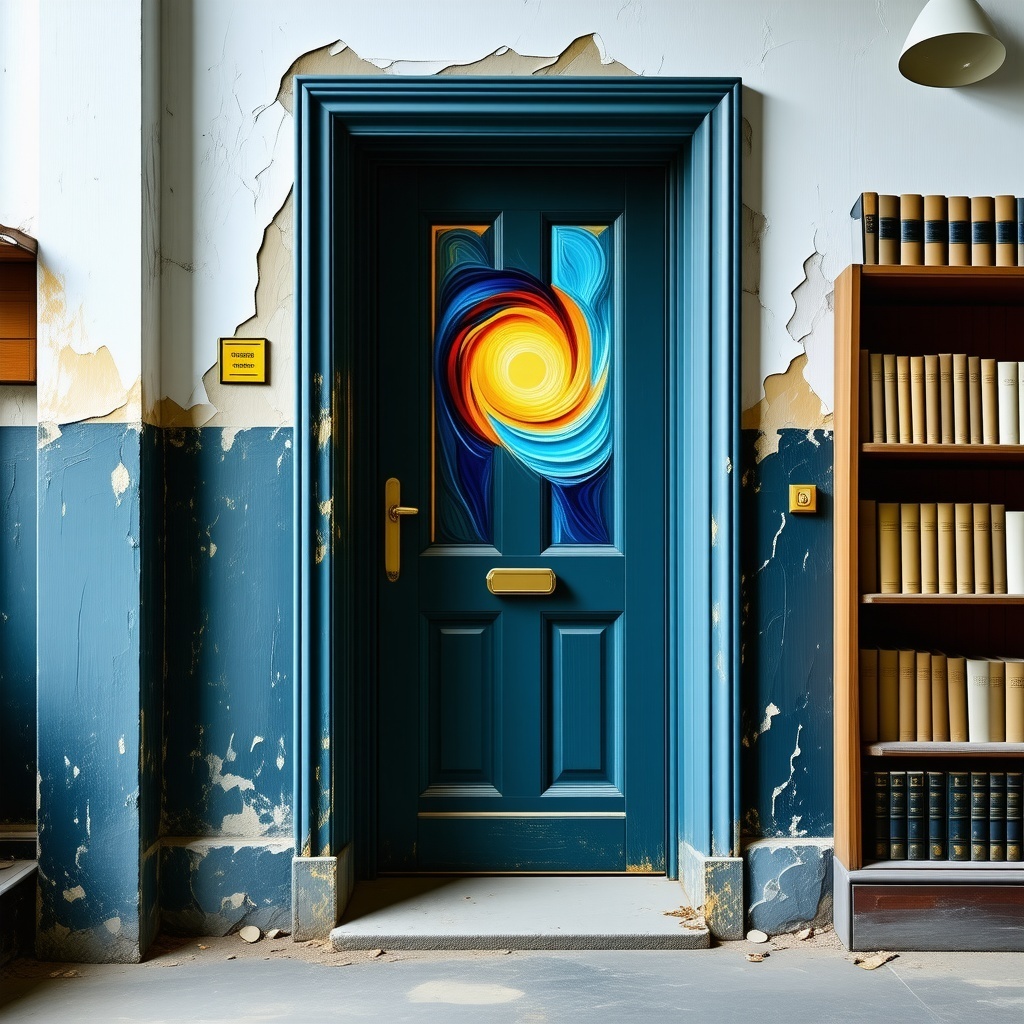
I never intended to enter another realm. All I did was open a door. It so wasn’t special—just an old, nearly forgotten door tucked behind a dusty shelf in a neglected corner of the library. The paint was chipped, the wood worn thin, and the handle cold and dull like aged brass. But when I turned it, a strange kind of light spilled out. Not sunlight. Not any artificial glow.
It shimmered and pulsed—like the world had been painted in motion.
Warm colors of sunflower gold, amber, and cobalt blue seemed to radiate to me, not as beams of light or reflections, but more like the brushstrokes had taken on existence.
They wrapped around my arms and pulled me forward before I could resist.
And then I wasn’t myself anymore. I looked down and gasped. My hands had no depth. I was now part of this painted world—drawn in outline and filled in with color and light. My skin was no longer flesh but pigment. The air pulsed with invisible rhythm, humming like a gallery alive with memory.
I had stepped into a painting.
The sky above churned with spirals of vibrant blue and white. Beneath my feet stretched a golden field, not of real wheat but thick, expressive strokes. Trees loomed nearby, bent by emotion rather than wind. Every element was unmistakably Van Gogh.
This was not imagination. This was his vision made real.
As wonder took root in my chest, so too did a quiet fear: this world felt like it was fading. The strokes were not wet—they were stiffening, cracking. The painting was losing its motion. The artwork was drying. This place, this miracle, would not last.
I needed to find him.
There was only one place I could think of—the café in Arles, the one he immortalized under a star-struck sky. I ran toward it, guided more by instinct than direction.
When I arrived, the atmosphere was calm. The café was not bathed in the famous yellow and blue glow of night, as I had imagined. It was daytime. The shutters were drawn; the street was empty. The magic of that starry evening had not yet arrived.
Even so, the place felt sacred. To see something I had only known through books and museums come alive—dimensional and intimate—was overwhelming.
But Van Gogh was not there.
Turning to the painted people around me, I pleaded, “ What year is it ? Do you know where I can find Vincent Van Gogh?”
They looked at me with puzzled eyes—soft, blurred, but deeply expressive. Finally, an elderly woman pointed down a narrow street. “It’s May of 1889. He lives down there in The Yellow House,” she murmured.
I hurried through Arles’ winding alleys, their buildings slanting inward, casting long shadows. The city breathed around me in earth tones and warm light, every surface touched by his brush.
Eventually, I stood in front of it: the Yellow House. It radiated a vivid lemon hue, its green shutters like watchful eyes. This was not just architecture. This was memory. The walls felt alive, humming with the ghost of the man who once called it home.
Inside, sunlight filtered through the windows like liquid paint. The first thing I noticed was a painting—a vase of sunflowers. It was propped on an easel in the window, yellows so vibrant they nearly sang. The petals thick with paint, curling and twisting as if reaching for the sun. I held it gently, feeling the texture beneath my fingers. In the gold of these sunflowers, he tried to bottle warmth. I could see that he had kept on repainting the petals, as if trying to stop them from wilting. But the flowers wilted, and so did the dreams.
In a quiet hallway, another painting hung: Almond Blossoms. Pale white blooms stretched across a sky-blue canvas. The branches reached outward like hands—fragile, trembling, beautiful.
Then, his bedroom. It was simple. A wooden bed, a small table, a pair of chairs. And on the wall, a painting of this very room—his room—captured forever. The brushstrokes were neat, almost restrained. Yet, the space felt lonely. Too tidy. Too quiet. I understood then: this painting was not about comfort. It was about yearning. It depicted loneliness, and it screamed to be comforted.
I moved into the workspace and froze.
There, leaning against the wall, was his Self-Portrait with Bandaged Ear. I had seen it many times, but never like this. This canvas doesn’t flinch. He painted himself not just as broken, but enduring. His ear is gone, yes, but his eyes remain—the haunted blue wells of pain and unflinching resilience. His eyes stared back—not just with sadness, but with defiance. He looked exhausted, but alive. His pain was visible, unapologetic, and yet… he painted through it. That resilience. His coat is thick, as if to warm a soul chilled by abandonment, psychosis, and silence. But no matter the pain, he is still standing, he is still painting. That quiet survival. It shook me.
I wandered the house for hours, breathing in his world. It was not a tour. It was a communication. As darkness set in, I set out from Arles along the road to Saint-Rémy-de-Provence. He had once been in the asylum there, I knew, and I had a conviction—irrational and firm—that I would be able to find him there.
The road was long and twisted, passing over peaks and broad plains. The sky from above became violet, orange, and deep indigo. When the sun began to set, a palpable silence descended on the environment. The trees cast long shadows along the road, and the lavender fields absorbed the cool wind. Eventually, night fell completely.
Too tired to continue, I lay down in a grassy meadow under the open sky. It wasn’t silent. The stars weren’t dots. They spun and twisted, glowing with an intensity I had never imagined. The heavens were alive. Spirals of starlight and wind painted the sky above me in thick ribbons. The night sky wasn’t dark—it was full of movement, color, fire.
I stared up in awe.
This was The Starry Night. Not a reproduction, but the moment itself. A masterpiece in motion. The wind howled in invisible strokes. The stars burned, not gently, but wildly. It was nature through his eyes—unrestrained, beautiful, terrifying.
At that point, I understood that the world has a majesty that generally surpasses our perception. Besides, through Van Gogh's vision, we had a better view of it. I fell asleep under the stars with that thought.
Sunlight woke me, warm on my face. The air smelled of fresh earth and distant blossoms. I stretched and smiled. I would find him today. I was certain.
Then it hit me—I had forgotten something very human. I hadn’t eaten. At all. No water. No food. Somehow, in the whirlwind of crossing dimensions, of collapsing realities, I had lost the very sense of bodily need. Now it returned—with a growl.
I walked until I found a small café just opening. I smelled it before I saw it—croissants, fresh from the oven. Butter. Flour. Warmth. And coffee—rich and earthy.
The croissant was curled like a sunflower petal, flaked and layered in ochre and gold. The crust was cracked like dried paint, jagged, imperfect, torn slightly at the edge. It rested on a cerulean blue plate. The cup of coffee was served in a porcelain cup, chipped, painted thick with heavy whites and sun-touched yellow. The rim darkened from use. Inside, the coffee was not black, but a storm of burnt amber and swirling sienna—a sky in miniature, just like The Starry Night, but inverted. The steam rose in spirals, dancing like souls above cypress trees. For a moment, I felt I was eating inside a still life.
Renewed, I walked toward Saint-Rémy. The road was lined by cypress trees that stretched towards the sky, their black silhouettes resembling night watchmen. Olive trees with silvery leaves rustled softly in the wind. The sun ascended, casting mottled shadows on the road.
Then, at last, I saw it.
The asylum. A quiet building of pale stone, old and serene. Once a monastery, it now stood wrapped in the scent of lavender and the color of silence. I stepped through the garden. Irises bloomed in violet waves, their petals like silk. Bees moved lazily between blossoms. The place felt… healed.
And there, standing alone in a field, was a man.
He wore a straw hat, his red hair visible beneath the brim. He stood perfectly still, facing the landscape. A canvas rested before him. In one hand he held a palette. In the other, a brush.
Vincent Van Gogh!
I froze.
His clothes were simple—beige shirt, sleeves rolled. A pencil was tucked behind his ear. He was painting, but not like someone working. He painted like someone breathing. Each stroke slow, intentional. He was completely absorbed. I dared not speak. I watched, not as a tourist, but as a witness.
He was painting ‘Wheat Field with Cypresses.’ The brush moved, paused, continued. The field bent in invisible wind. The cypresses spiralled. The sky above spun with movement. It was as if he was pulling the soul from the land and placing it gently on canvas.
Time blurred. I stood in silence, watching. The moment felt infinite. Then, he stopped. Placed his brush down gently. And turned to me. His eyes—oh God, his eyes. Luminous. Ancient. Kind.
“You’re not from here,” he said.
“No,” I whispered. “But I’ve been looking for you.”
He tilted his head. “Then speak.” And so, I did.
“You are—whether you believe it or not—the finest painter of them all. Certainly, the most beloved. You never lived to see it, but your work… it touched millions. It still does. Not because it’s perfect, but because it’s real. Because it’s you. Your colors—no one else has ever used them like that. They aren’t just mere pigments on a canvas; they’re feeling. Fire. Breath. Life. You took the torment of your life—the loneliness, the rejection, the confusion—and instead of letting it destroy you, you poured it into every canvas. You turned pain into light. You gave beauty to despair. So many artists show suffering, but you… you did something no one else dared. You used your suffering to show joy. You used it to paint the ecstasy of simply being alive—of looking at a star-filled sky, or a windblown wheat field, or a café terrace at night—and feeling that the world, even in its sorrow, is still magnificent. Maybe no one told you in your lifetime. Maybe they mocked you, ignored you, dismissed you. But Vincent, the strange, gentle man who wandered the fields of Provence—you weren’t just a painter. You were a mirror for the soul of the world.”
His face broke.
Not in pride. Not in awe. But in disbelief.
He laughed. Not cruelly—but like someone who had never heard kindness spoken in his name. He wiped his eyes and trembled. “No one has ever said anything nice about my paintings,” he whispered. “Never once.”
“You deserved to hear it,” I said.
He looked at me like I was a dream. Maybe I was.
He turned back to the canvas.
“Stay?” he asked, quietly.
God, I wanted to.
But behind me, the door—my door—was fading. The brushstrokes of this world were drying. The sky no longer swirled. The fields were still.
“I can’t,” I said. “But I’ll carry you with me. Always.”
He nodded once. A single tear slipped down his cheek, catching the sunlight like a stroke of titanium white. Then he lifted his brush again. The next masterpiece had already begun.
And I stepped back through the door, the last edge of his universe brushing across my fingers like a gift.
I opened my eyes in the old library. The door behind me was gone. But the world looked different now. The sky outside the window swirled slightly. The sun seemed brighter. The cracks in the wall looked… like art. I smiled. I hadn’t just seen his paintings. I had walked through his pain, his passion, his eternity. And I would never look at a canvas—or the world—the same way again.
When the world overwhelms me, I close my eyes and remember what it felt like to stand in his light. In his lines. In his love for a world that never loved him back the way it should have.
And I say it again—to the wind, to the sky, to anyone who will listen:
He wasn’t just the greatest artist. He was one of the greatest men who ever lived.






 React
React