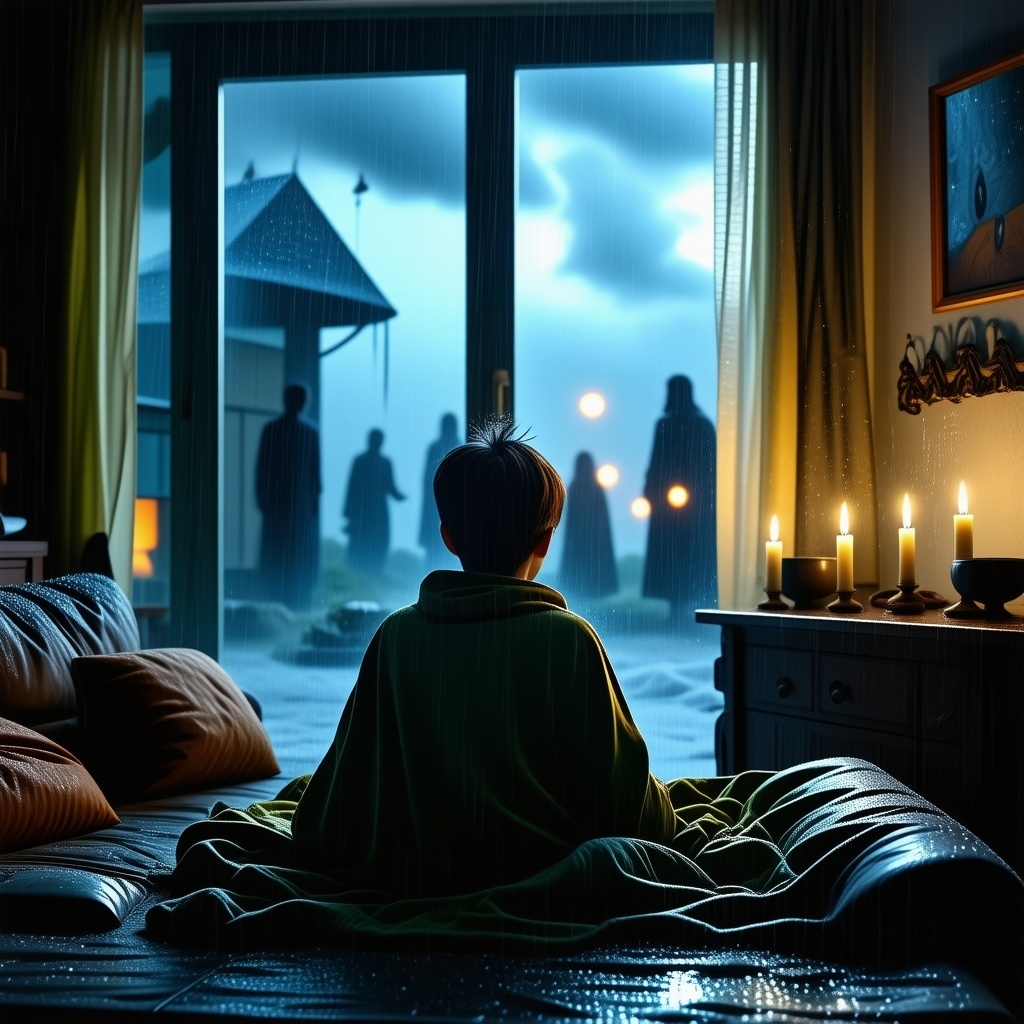
The clock struck 12:17 AM. Outside, the storm had reached its peak—thunder growled across the skies, and rain lashed the earth like nature was angry. Aarav sat curled in a blanket, half-asleep on the couch, an old thriller novel resting on his chest. The power had gone out half an hour ago, and the room was lit only by the faint flicker of a candle on the side table.
Just as he began to doze off, there was a knock.
A soft but firm tapping at the door.
His eyes snapped open. He sat still for a moment, wondering if it had been the wind. Then came another knock—slightly louder this time, more deliberate.
He stood, heart beginning to race, and crept toward the door. Through the peephole, he saw two figures—a man and a woman, both drenched, their faces pale and exhausted.
Aarav hesitated. Who would be out at this hour, in this weather?
He cracked the door open an inch. “Yes?”
The woman stepped forward. “Please… our car broke down on the road. Can we use your phone?”
The man behind her didn’t speak. He just stared at Aarav with an oddly blank expression.
Aarav glanced past them, but the darkness and rain made it impossible to see if a car was indeed there.
Still, something about the woman’s voice tugged at him. It sounded genuinely desperate.
“Alright,” he said slowly. “Just to use the phone. Come in.”
He opened the door wider and stepped aside. The two strangers entered silently, dripping water onto the floor. The woman smiled faintly in gratitude. The man remained quiet.
Aarav pointed to the landline on the side table. “There. You can call from there.”
The woman walked toward it, but paused halfway, turning to look at him. “There’s no dial tone,” she said softly.
Aarav blinked. “That’s not possible. I used it earlier today.”
He walked over, picked up the receiver—and sure enough, dead silence. He frowned. Must be the storm.
“I’m sorry,” he said. “The power’s out too. Maybe I can give you a ride once the rain eases.”
The woman nodded. “Thank you. You’re very kind.”
Her voice was soft, almost melodic, but it sent a strange chill through him.
The man, still standing by the door, finally spoke.
“It’s the same house.”
Aarav turned sharply. “What do you mean?”
The man didn’t reply. His eyes roamed the living room slowly, like he was trying to remember something.
“Do you need to sit down? I can make some tea—well, if the stove works.”
The woman smiled again. “No need. We won’t be long.”
Suddenly, the candle flickered violently, then went out, plunging the room into darkness.
Aarav fumbled with his phone flashlight. When the beam cut through the gloom, he was alone.
The couple had vanished.
Panic seized his chest. He ran to the door—still locked. He checked the kitchen, the bedroom, even the bathroom.
Nothing.
No footprints. No wet puddles. No sign anyone had ever entered.
Just silence.
Aarav sat down heavily, trying to calm his racing mind. Had he imagined it? Had he fallen asleep and dreamt the whole thing?
He glanced at the old fridge. A yellowing newspaper clipping pinned to it caught his eye.
It had been there since he moved in—something the previous owner left behind. He’d never read it properly before. Curious, and needing a distraction, he stood and peeled it off the magnet.
His breath caught as he read the headline:
“Young Couple Dies in Tragic Car Crash Near Shivpur Highway Bend – Locals Speak of Ghost Sightings”
Below it was a grainy photograph.
A man and a woman. Pale, soaked. The same faces he’d just seen.
According to the article, their car had crashed during a storm five years ago, not far from the road behind Aarav’s house. A local resident claimed he had seen “a couple knocking on his door for help” days after the accident—only to find no one there.
The candle flared back to life without warning, its flame steady now.
Aarav sat frozen, eyes locked on the photo. It was them.
He glanced at the door again, half expecting another knock.
But nothing came.
The house was silent. The storm began to calm. Somewhere far away, a dog barked.
And yet, the chill remained. A heavy stillness hung in the room—like a story left unfinished.
He looked down at the clipping again. The article ended with a line that chilled him more than anything else:
“Witnesses say the couple returns each year during storms, still seeking help, still trying to find a phone line that works… still knocking on the same door.”
Aarav folded the paper slowly and placed it back on the fridge.
He didn’t sleep that night.
And every year after that, on the same stormy night, he left the phone off the hook and a candle by the door—just in case they returned.






 React
React