The sky outside his thirty-second-floor office shimmered in shades of metallic grey. Rajesh leaned back in his Italian leather chair, the heels of his polished Oxford shoes resting on the edge of his designer teakwood desk. The room smelled of polished wood and ozone from the central air. It was silent except for the hum of the city below and the soft whirring of the air purifier.
He tapped his fingers on the armrest impatiently as his executive assistant entered, holding a portfolio.
“Here’s the land acquisition proposal, sir. Four hundred acres, mostly untouched forest,” she said cautiously.
“Untouched,” Rajesh said, a half-smile creeping onto his face. “That’s the best kind. Virgin land. Ready to be reborn.”
“There might be tribal protests,” she added hesitantly. “And the environmentalists—”
“Let them protest,” Rajesh cut her off. “They live in fantasy. This world runs on profit. Emotion is for those who don’t know how to win.”
He waved her away and turned to the file. Satellite images of dense forest, mineral-rich terrain, rivers that glinted like veins of silver. It would all fall to make room for his new empire: rare-earth mining, polymer research hubs, an industrial zone. “It’s just trees,” he muttered. “They’ll grow back somewhere else.”
That evening, a storm rolled in. The sky cracked with thunder, and the air turned heavy. Rajesh sat alone in his penthouse, whiskey in hand, watching the lightning strike over the city skyline. He hated the rain. It slowed production. Delayed shipping. Messed up supply chains.
He was about to turn in when a strange current passed through the room. The lights flickered. In the window’s reflection, just for a second, he saw a figure—hooded, ancient, staring back at him. Then, nothing.
He laughed nervously. “Too much stress… or too little.”
But as he lay down, something snapped.
His head hit the pillow and then—darkness. Not the darkness of sleep, but of deep space. He felt as though he was falling and rising at the same time. Sound disappeared. Light turned inward. His body was spinning through a tunnel of water, fire, wind. A heartbeat echoed in his ears—but it wasn’t his.
Then—silence.
The first thing he felt was warmth. Not the artificial warmth of thermostats, but the living heat of the sun.
He opened his eyes. The ceiling above him was thatched with palm fronds. The air smelled of sandalwood, salt, and fresh earth. Birds chirped—exotic and strange. He sat up in a bed of soft rushes. His body felt heavier, broader. He looked down. Robes of deep indigo wrapped around his frame. Bracelets of beaten gold coiled around his wrists.
There was no confusion. No panic. This was his life.
It was a normal morning.
A servant entered, bowed low, and offered him a bronze basin of water. “Good morning, my lord,” he said, avoiding eye contact. “The sun waits for your blessing.”
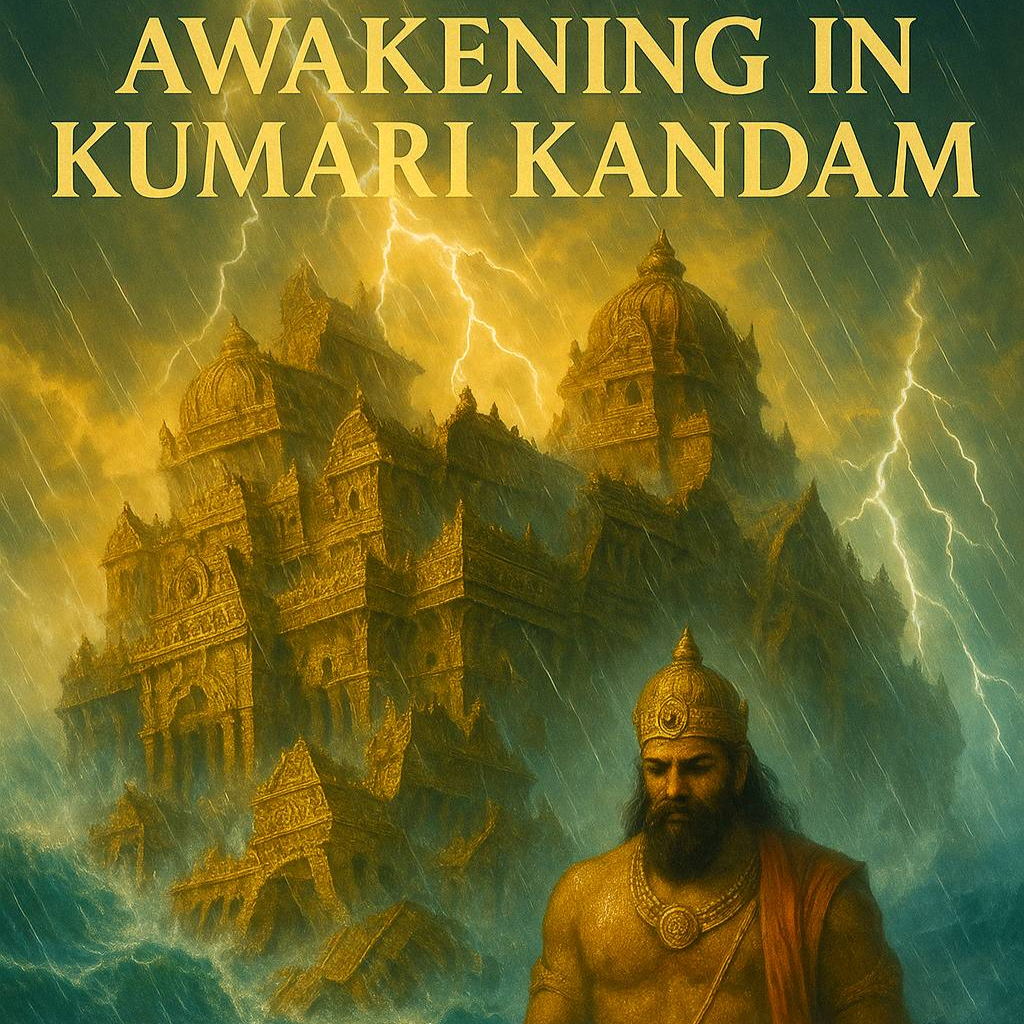
Atri rose smoothly, barefoot, and stepped onto the stone balcony of his chamber. Below him lay Kumari Kandam—a kingdom suspended between ocean and eternity. Forests rolled into distant cliffs. River deltas shimmered. Palm groves danced in the morning breeze. Far off, fishermen sang as they paddled out. A cowherd blew a conch to signal sunrise. The temple bells of Kotti rang faintly in the east.
He was king. Atri, ruler of the southern sea.
And today, he had plans.
At court, his ministers gathered in a respectful half-circle. Robed in white, they greeted him with folded palms.
“My lord,” said Thayanban, the military advisor. “The tribes in the northern hills seek protection from the seasonal floods. They bring pearls, bananas, and woven mats as tribute.”
Atri nodded. “Give them shelter. And send masons to map the highlands. There may be stone for our construction.”
“Construction?” asked Malarvan, the chief builder.
“Yes,” Atri said, turning toward him. “We will build anew. A palace, a fort, a throne that touches the sky.”
Malarvan swallowed. “Where, my king?”
Atri led him out, down a stone path through banana trees and overgrown groves. They reached a high ridge. Below lay a dense stretch of mangrove forest, its roots tangled in sacred mud, its trees gnarled and watchful.
“There,” Atri said, pointing. “That is where our future rises.”
Malarvan hesitated. “The mangroves are ancient. They hold back the sea. They’re protected by the elder clans.”
Atri smiled thinly. “Protected trees do not build kingdoms. And I will not have our palace hemmed in by mud and roots. Cut them.”
“But the spirits—”
“Let them speak to the waves. I speak to the living.”
The ambition burned in his voice. Something in him—modern, sharp-edged—yearned for stone walls and spires. Though he had never seen steel or concrete, he imagined them. Though he did not know the word “plastics,” he believed in bending nature to vision.
That evening, under firelight, he summoned the scribes.
“Send word to the coastal clans. All timber is now under the king’s seal. Begin clearing the mangroves. Map the teak reserves. I want the first foundation laid within this moon.”
The court bowed. Some whispered among themselves. But Atri’s word was final.
As he returned to his chambers, the wind picked up. A strange rustling in the mangroves below sounded almost like a whisper. Something old, something displeased.
But Atri didn’t hear it.
He was already dreaming of towers.
The air was thick with the scent of rain-drenched earth and crushed hibiscus. A faint golden hue touched the thatched eaves of the palace, filtering through banana leaves and latticework carved from sandalwood. Somewhere in the distance, conch shells blew—three long notes—announcing dawn.
Atri awoke not with confusion, but with clarity, as if this world had always belonged to him. The cot beneath him was firm, padded with layers of woven reeds and soft cotton. The walls of his chamber were smooth stone, polished with river-pebble grit. Two oil lamps still flickered in the corners, though the sun had begun its slow rise.
A young boy entered quietly, head bowed, a copper basin of water balanced in his hands.
“My king,” he whispered, not daring to meet Atri’s eyes. “The waters for your ablutions. The goddess awaits your gaze.”
Atri sat up, broad-shouldered and calm. His voice was deep, with an authority that didn’t need to raise itself. “Has the mist lifted from the hills?”
“Yes, my lord. The fishermen say the sea is tame today.”
“Good,” Atri replied, running his fingers through his thick, oiled hair. “Then we begin.”
As he stepped out onto the stone terrace, a soft breeze lifted his robes—dyed the deep blue of indigo, embroidered with gold thread from the southern rivers. Below him, the kingdom of Kumari Kandam stretched into eternity. Coconuts swayed atop tall palms. Thatched huts huddled around temple spires. Smoke curled from outdoor kitchens. White birds circled above a market already alive with traders bartering in singsong voices.
The land was wild and rich, clothed in green. Rivers braided themselves through forests. Mangroves grew thick along the coastline, their tangled roots holding the earth together like fingers gripping a prayer.
Atri breathed in deeply. “She sleeps under our feet,” he murmured.
“Who, my lord?” asked Malarvan, who had just arrived at his side.
“The land,” Atri said. “She sleeps like a serpent coiled in shadow. And we—we must awaken her, shape her into glory.”
Malarvan bowed respectfully, but his face showed concern. “There is glory in patience too, my king. The mangroves below have stood for generations. They protect the shore from the wrath of the sea. Elders say—”
“Elders cling to the past because they fear change,” Atri interrupted, his tone sharpening like flint. “But I do not. I dream of a city of stone. Roads wide enough for a hundred chariots. A palace with walls so high they catch the stars.”
He stepped closer to the ridge, pointing down toward the lush mangrove belt. Birds scattered as his voice rose with conviction.
“There. That forest must fall. I will not rule from a hill shack while the world remembers us as fishermen and farmers. We are more. I will make sure history knows it.”
Malarvan was silent for a moment, then spoke carefully. “Shall I prepare the royal seal, then? To mark the timber?”
“Yes,” Atri said without hesitation. “Begin with the mangroves. Then move to the teak forests beyond the eastern gorge. I want the first granite stones laid before the next monsoon.”
A gentle cough came from behind. It was Valli, the high priestess, her robes dyed with turmeric and vermilion, her hair coiled with jasmine. She bowed, her eyes steady.
“My king, you summon the future with fire,” she said. “But fire, if left untended, consumes all. The mangroves hold the sea. The old ones say they are guardians.”
Atri turned slowly to her. “And I say that a king guards his people with fortresses, not myths.”
Valli didn’t flinch. “Then may your walls hold against the tide, my lord.”
He nodded curtly. “They will.”
As she left, Malarvan turned to Atri. “The people love you, sire. They will obey. But some may question…”
“Let them,” Atri said with a smirk. “They will live long enough to see what power looks like.”
That afternoon, royal guards, scribes, and engineers marched into the mangrove swamps. Axes were oiled, chisels sharpened. The forest floor, once sacred and silent, echoed with the first cracks of tree trunks splitting. Crabs scuttled into the water. Birds rose in alarm. Old fishermen who lived near the coast watched in silence, their faces drawn like dry bark.
“The sea remembers,” one of them whispered.
But Atri didn’t hear them. He was in the royal courtyard, pacing beside a table covered in drawings—temple domes, battlements, marble terraces. His fingers traced the line of a spiral tower that would rise above the rest, a symbol of his rule.
“This… this will be my echo,” he said to himself. “Let the earth quake. Let the sea howl. When I build, it is forever.”
The first flood was not violent. It came silently, like a thief in the night.
Two moons had passed since the mangroves were felled, their roots left to rot in the brackish sludge. In their place, stone masons laid thick foundations, and oxen carts hauled granite from distant quarries. The palace’s skeleton had begun to rise—arches, carved columns, and wide steps leading to nowhere, yet full of promise.
Atri stood atop the construction platform, arms crossed, as the wind whipped at his robes.
“It is taking shape,” Malarvan said, his voice barely audible over the clang of hammers.
Atri nodded. “It will outlive me. That is the goal of any ruler worth his salt.”
Down below, workers toiled in the muddy flats where the mangroves had once grown. Children carried clay bricks on their heads. Sculptors chiseled divine figures into stone.
Just then, a young soldier came running up the slope, panting.
“My lord! The river Vaikai has breached the southern embankments.”
Atri frowned. “Flooding?”
“Yes, sire. Several fishing huts have been swept away. The granary in Kottiyaru is underwater.”
“How far from the palace site?” Atri asked.
“Seven furlongs, my lord.”
Atri turned to Malarvan, unbothered. “Nothing we cannot redirect. Send the engineers. Build a retaining wall.”
“But my king,” Malarvan said gently, “that lowland is fed by sea tides. Without the mangroves—”
“I said build a wall,” Atri snapped. “The land bends to will. Not the other way around.”
That night, thunder rolled in. The sky lit up in violent purples. Rain fell in sheets, pounding the earth like war drums. In the darkness, villagers huddled together on temple steps, watching their fields dissolve into swamp.
Valli stood barefoot in the temple courtyard, her saffron robes soaked, her eyes closed in prayer.
Inside the palace compound, Atri paced irritably, the floor beneath his feet slick with rainwater.
“This is temporary,” he said to Thayanban. “Let the priests chant. Let the fools pray. But bring me reports. I want to know how many stones we lost to that damn river.”
Thayanban hesitated. “They say the goddess of the sea has stirred.”
Atri turned, face thunderous. “Then chain her.”
The second flood came a fortnight later.
This time, the sea itself surged inland. The port at Nalloor was swallowed in a single tide. Ships were found capsized miles from the dock, their masts snapped like twigs. Fishermen spoke of seeing silver serpents rise from the deep. Temples were submerged to their spires.
Atri summoned the court.
The atmosphere was tense. Wet footprints smeared the stone floor as messengers rushed in from every direction. Scribes scribbled furiously. The council looked grim.
“My lord,” Valli said, standing tall despite the chaos, “the sea is not angry—it is grieving. You cut her roots. The mangroves were her hair. Her shield. You exposed us.”
Atri’s voice cut through the room like a blade. “I exposed nothing. This is seasonal madness, nothing more.”
“The stars do not lie,” she said, holding up a tablet etched with lunar symbols. “The third tide will not recede. It will consume.”
Atri laughed, hollow and sharp. “You think I fear prophecy? I do not bow to superstition. I command stone. Iron. Manpower. I will raise this city above the waters!”
Malarvan stepped forward. “With all respect, my king, we are losing lives. The walls are not yet high enough. The trees we cut—there is nothing now to hold the flood.”
“You were born in huts,” Atri said coldly. “I’m giving you citadels. Trust me—or be swept aside.”
But that night, as the sky tore open and lightning struck the western ridge, Atri stood alone on the palace balcony, staring into the black sea. His dreams of towers now shimmered in puddles below, fragile as reflections.
Then came the third flood.
It did not knock. It devoured.
A deep rumble woke the island at dawn. Not thunder—but the groan of something ancient breaking. The sea rose not in waves, but in a wall. A dark, roiling wall that shimmered with foam and fury. The forest that had once broken the wind was gone. The coast lay naked.
Villagers ran, screaming, carrying children and gods in their arms. Elephants broke their tethers and stormed inland. Temples crumbled like sand castles. The fortifications Atri had built cracked like dry clay.
He ran out into the open court, rain slicing his face. The tower he had dreamed of—split in half. Bodies floated where courtiers had once stood.
Valli appeared, her voice barely audible over the roaring sea.
“She warned you,” she said. “The land spoke in dreams. But you only listened to stone.”
Atri stared at her, face drenched, eyes wide—not with fear, but disbelief. “This can’t be. This was my legacy…”
“You chose to silence the forest,” she said, voice calm, even as water surged at their feet. “Now the sea sings your requiem.”
And then, silence.
As the palace walls buckled and the ocean swallowed the last of the citadel, Atri was pulled into darkness.
His breath caught. A roar filled his ears—then a sharp, sudden silence.
And he opened his eyes.:
As the waters rushed over the broken stones of the palace, the island itself seemed to cry out. The once-fertile lands of Kumari Kandam, carpeted with dense forests and tangled mangroves, were now swallowed by the relentless sea. Great rivers that once sang through the valleys turned to silent currents beneath waves. The coastline, jagged and alive with coral reefs, was now nothing but a memory drifting beneath endless blue.
Villagers who had fled inland could only watch as their homes, their temples, and their lives vanished, swallowed by the rising tides. The mighty forests—homes to countless birds, insects, and animals—disappeared beneath saltwater, leaving no trace but drifting logs and shattered dreams.
The sea reclaimed everything, erasing the footprints of kings and commoners alike. The sunken ruins became the whispered legend of a land lost to time. Kumari Kandam, the great myth of an ancient civilization, was no more than a name murmured in the winds and the waves.
Old fishermen told tales of islands glimpsed in the fog, glimpses of stone walls and half-buried statues beneath the waves. Some claimed the gods had sunk the land as punishment for human arrogance, others said it was simply the earth’s slow reclaiming. But all agreed: Kumari Kandam was gone forever.
Atri’s citadel, his mighty fortress, lay in ruins beneath the sea. The great trees he had felled to build it—mangroves that once held back the tides—were now drowned, their skeletons visible beneath clear waters, a haunting reminder of what had been lost.
And yet, somewhere beneath the ocean, the spirit of Kumari Kandam waited — silent, deep, and eternal — a warning etched in time for those who would listen.
A sharp gasp tore through the darkness as consciousness clawed its way back. Rajesh’s eyes snapped open. His breath came in ragged gasps, the stale scent of his modern bedroom replacing the salt and decay of the ocean. His heart hammered as if chased by some unseen predator.
For a moment, he was lost between worlds—was he still the king of Kumari Kandam, standing amidst the ruins? Or was he Rajesh, the ruthless plastic magnate in his sleek penthouse?
His mind raced. The vivid memories of mangroves felled, the angry sea rising, the screams of villagers—all burned like fire behind his eyes. He saw the flooded streets, the toppled pillars, the despair in Valli’s gaze. The haunting silence after the final wave.
“No,” he whispered hoarsely, clutching the bedsheets. “It can’t be real. Just a dream.”
But the dream was more real than anything he had felt in years.
His phone buzzed on the bedside table—an email about another expansion plan, another permit to clear forest land for mining.
His fingers trembled as he reached for it.
Suddenly, the past and present collided in his mind. The arrogance of Atri, the king who thought he could conquer nature with stone and steel—his own arrogance mirrored in Rajesh’s greed and blindness.
“I ignored the warnings,” Rajesh muttered, voice cracking. “Just like him. Cutting down mangroves, chasing profit while the earth begged me to stop.”
He pressed his palms to his face, the weight of guilt crushing down. “How many more floods will it take? How many lives destroyed before I learn?”
Outside, the city hummed with oblivious life—cars honking, people rushing, machines roaring. The plastic mountains he had created piled higher every day, choking the rivers, poisoning the air.
A memory surfaced: Valli’s words, “She warned you... now the sea sings your requiem.”
He looked out the window at the concrete jungle stretching endlessly. For the first time, Rajesh saw the fragile web of life beneath the chaos.
His phone buzzed again. This time, he silenced it.
He whispered to himself, “There has to be a way to fix this. To change.”
But change was never easy. The shadows of the past lingered, and the future was uncertain.
As dawn broke, painting the sky in pale gold, Rajesh made a vow: to listen to the land, to protect what remained, and to honor the lessons of Kumari Kandam—before it was too late.
Because true power isn’t in conquest or greed—it’s in the courage to change before the last wave drowns us all.






 React
React