Once upon a time, in the warm and colorful kingdom of Surajgarh, there lived a kind and intelligent princess named Meera. She was known for her love of books, animals, and her deep care for people. One day, she met Prince Arjun from the neighboring kingdom of Chandrapur. He was brave, gentle, and always ready to help others. Their friendship turned into love, and soon, the whole land was celebrating their wedding.
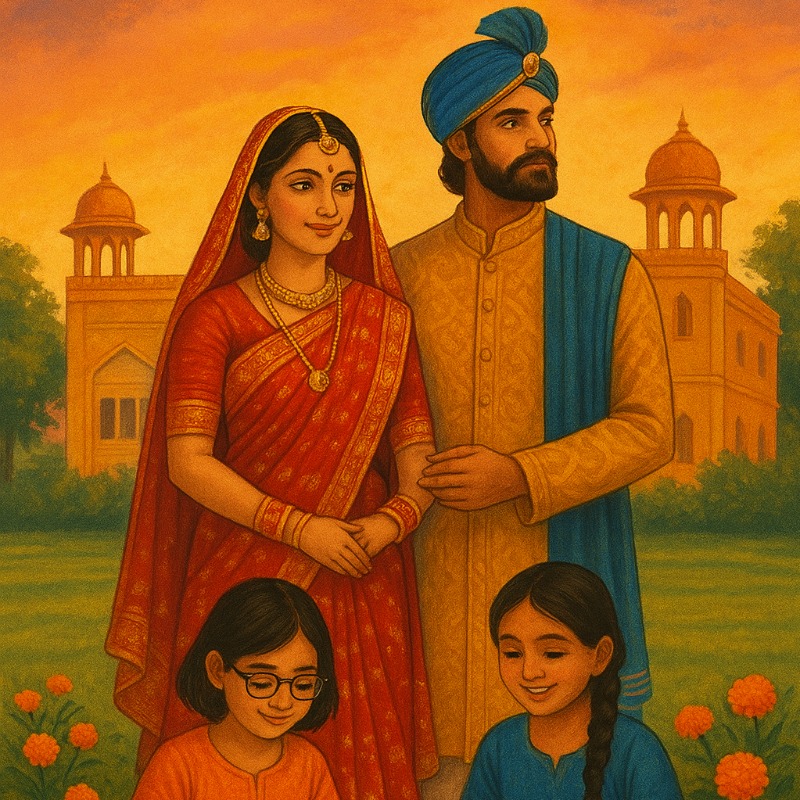
The wedding was a grand festival. The palace was decorated with marigold garlands and fairy lights. Musicians played the sitar and tabla. Guests danced in colorful clothes, and the smell of sweets like gulab jamun and rasgullas filled the air. On the wedding day, Meera wore a red silk saree with golden borders, and Arjun rode in with his baraat on a decorated white horse.
Everyone said, “This is a perfect match!” And when the wedding ended, the story closed with the famous line:
“And they lived happily ever after.”
But t in real life, “happily ever after” is only the beginning.
"Adjusting to Married Life"
After the wedding, Meera moved to the grand palace in Chandrapur with Arjun. The palace had tall carved pillars, huge chandeliers, and a garden full of mango and neem trees. The first few weeks felt like a dream. Meera and Arjun spent time walking in the garden, visiting temples, and talking under the stars.
But slowly, responsibilities started knocking on the door.
Arjun, now the future king, had to attend meetings with ministers and village leaders. People came with complaints about broken roads, dry wells, and problems in schools. Meera, now the queen, was expected to join him in solving these issues. She could no longer spend hours reading books or painting in the royal courtyard.
They both realized that marriage wasn’t just about fun — it was about sharing duties and supporting each other.
"Understanding the People"
One morning, Meera decided to visit a nearby village named Bhavanipur. She saw people struggling with water problems. Women walked for hours carrying heavy pots, and children skipped school to help their parents. Meera felt a deep sadness.
When she returned to the palace, she spoke to the ministers. “We need to build proper wells and water tanks. These people need clean water.”
Arjun supported her. Together, they created a plan, hired workers, and built a new water system for Bhavanipur. When it was completed, villagers clapped, sang folk songs, and blessed Meera and Arjun.
That was the first time Meera felt the joy of real leadership — not through power, but through service.
"Facing Conflicts"
Even though they worked well together, Arjun and Meera didn’t always agree.
One time, Arjun wanted to build a new horse stable with royal funds. Meera believed the money should go toward fixing village schools. “Education is more important than new stables,” she said firmly.
“But we need the stables for royal visitors,” Arjun replied.
They had a long, quiet evening where neither spoke. But the next morning, after a simple breakfast of poha and chai, Arjun smiled and said, “Let’s build the school first. Horses can wait.”
They both laughed. Over time, they learned that compromise, patience, and respect were the real ingredients of love.
"Celebrating With the People"
As rulers, Meera and Arjun made a big change — they celebrated every festival not just in the palace, but in the streets with their people.
On Diwali, they didn’t just light diyas in golden halls; they also distributed lamps to poor homes and helped sweep the village roads. On Holi, they wore white cotton kurtas and danced with everyone — from farmers to palace guards — smearing colors and laughing together. On Eid, they joined their Muslim friends for prayers and shared delicious sewaiyaan and biryani.
These moments of joy and togetherness made the people love them even more. They weren’t just royal rulers — they were friends, protectors, and part of the people’s daily lives.
"Building a Better Future"
Meera always believed that education could change the world. So, she started a girls’ school called Prerna Vidyalaya. Many villagers were unsure at first — “Why do girls need to study?” they asked.
But Meera explained gently, “An educated girl becomes a strong woman. And strong women build strong families and a strong kingdom.”
She visited the school every week, spoke to the girls, listened to their dreams, and encouraged them to become doctors, teachers, and leaders. Slowly, the thinking of the kingdom began to change. Parents proudly sent their daughters to school. Some girls even taught their mothers how to read and write!
At the same time, Arjun worked with farmers, helping them learn new methods, giving them better seeds, and building cold storage for their crops. The harvests improved, and people had more food and money.
Together, Meera and Arjun built not just a happy palace, but a stronger kingdom.
"Raising a Family"
After a few years, Meera and Arjun were blessed with two children — a daughter named Charvi and a son named Vihaan.
Charvi had Meera’s quiet strength. She loved reading, caring for animals, and asking deep questions. Vihaan was more like Arjun — curious, active, and always running into the village to talk to people.
Meera and Arjun didn’t raise them like royals. They raised them like good humans.
“You are not special because of your crown,” Meera said. “You are special if you are kind.”
The children grew up playing with village kids, visiting schools, and helping with small palace tasks. They learned the value of honesty, simplicity, and love.
"Hard Times"
Not everything was easy.
One year, a long drought hit the land. No rains came for months. Rivers dried. Crops failed. People became restless and afraid.
Arjun held meetings day and night. Meera opened a food kitchen in the palace courtyard, where anyone could come for a free meal. They brought water in from nearby kingdoms, saved every drop, and supported farmers with food and seeds.
It was a difficult year, but they didn’t give up.
And finally, when the monsoon clouds arrived and rain poured down on the dry land, people cried tears of joy.
That year taught everyone — even a kingdom built with love must be ready for storms and struggles.
"The Real Happily Ever After"
Years passed. The school grew into a college. Farmers sold their produce to faraway cities. Girls became village leaders. And the palace became a place of learning, helping, and joy — not just shining gold.
One evening, after all the day’s work was done, Meera and Arjun sat under the neem tree. The sky was full of stars, and the air smelled of earth and jasmine.
“Do you remember the day we got married?” Meera asked with a soft smile.
Arjun nodded. “Everyone thought our story ended there. But it only started.”
Meera looked around. She could hear children laughing in the distance and bells ringing in the temple.
“I think I’ve found the real meaning of ‘happily ever after’,” she whispered.
“It’s not about being perfect. It’s about growing together, caring for others, and building something that lasts.”
Arjun held her hand and said, “And we did that — together.”
"A Lasting Legacy"
When Meera and Arjun grew older, they passed the crown to Charvi and Vihaan — not because of tradition, but because they believed their children were ready.
Charvi became a doctor, helping women in rural areas. Vihaan became an expert in farming and worked with young villagers to improve the land. They followed their parents’ path of service.
In the center of Surajgarh, the people built a statue of Meera and Arjun — not in royal robes, but in simple clothes, standing side by side with books, tools, and children around them.
A sign below the statue read:
“They taught us that true royalty is not in power, but in kindness.






 React
React