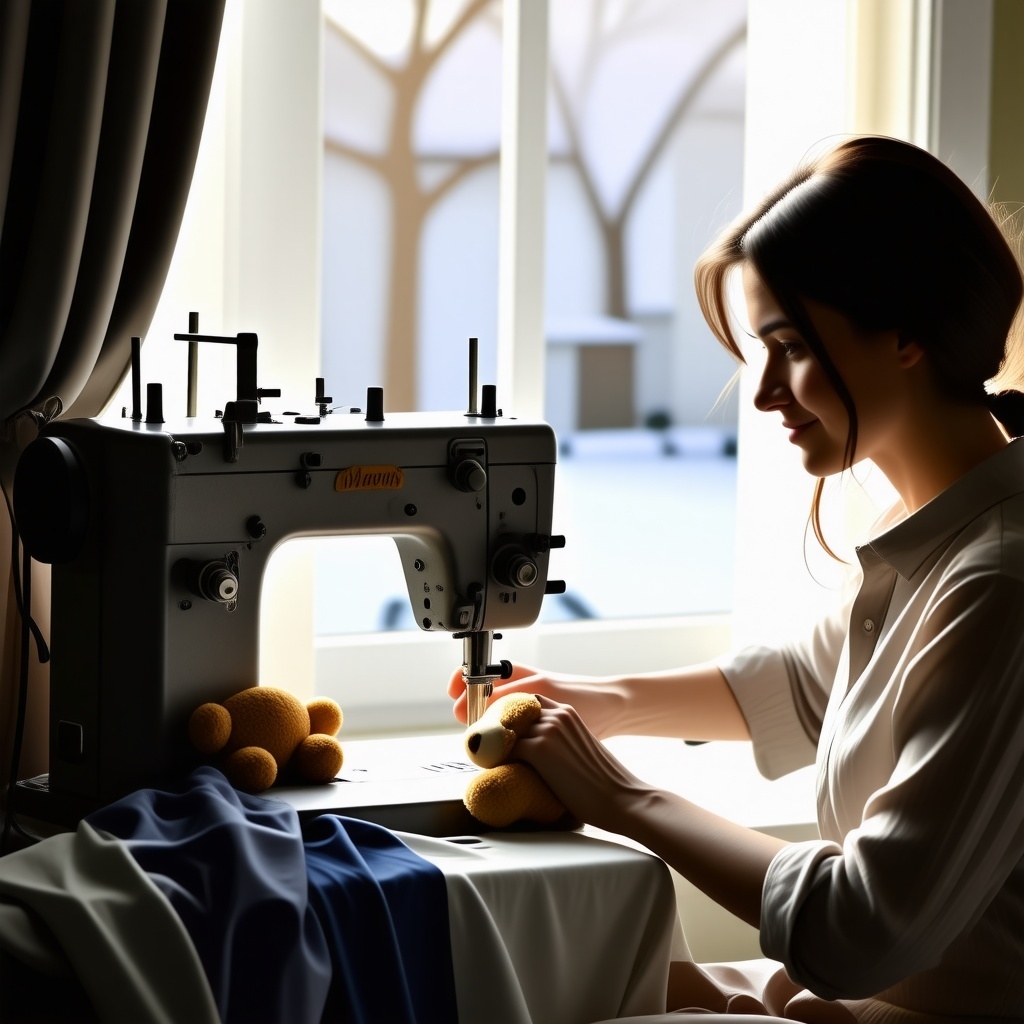
For the past two or three evenings after work, I've been trying to make a 'memory bear' using my father's brand-new blazer that he never wore.
No matter how much effort and embroidery work I put into it, the bear's face couldn’t capture a charming expression. It still resembles a wild beast rather than a lovable teddy bear. Even after redoing the sewing and embroidery, the bear's face appears increasingly stern. If the bears intended as gifts for children aren't soft and cute in appearance, they won't be interested in playing with them.
Children love smiling faces only.
The first time I heard about memory bears was from my co-worker, Sandy. She told me about the tradition of creating cute little memory bears using babies' first clothes and the clothes of their grandparents. Using the clothes of late grandparents could give children tangible memories of a generation. Although many other animal shapes are made, the bear is the most popular.
I learned to cut and stitch the fabric with my sewing skills and interests and make it soft and thick by filling it with poly-fiber. I transformed old clothes into new play toys. Charming toys were ready after minor ornamenting work, and the kids loved them. But this time, I was frustrated. No matter how hard I tried making the bear from my dad’s blazer, it didn't seem to work. I've made 'memory bears like this for others, and everyone says the bears made by ‘Janaki’ are adorable. But why do the memories of my father go awry when I sew them together?
It was the first time in my memory that I entered my father’s room without fearing his yelling for messing up his things. When I opened the closet, I found a blazer hanging from the steel rod across the closet. I had never seen my dad wear a blazer or a coat. I took the blazer in my hand. My mother was with me, and she said.
"Your dad bought this, intending to wear it when he traveled to your place, but he never got the chance to travel or wear it,"
My mother said her eyes were moistening as she spoke. I took the blazer in my hands and smelled it. The fresh scent of new clothes still lingered on it.
There was a time when I longed for the smell of fresh clothes. However, I always ended up with the used clothes of my sister, who was two years older than me.
“Why does she need a new dress?
Where else is she going other than school?
She just needs school uniforms.
Too many here don't fit her older sister,
So why should we waste the money?"
My family had no financial problems, but if I asked for a new dress, that was my father's decision.
Where did I go during those days?
After school, home was my world.
When going out or attending weddings in the village, my mother dressed up my elder sister in colorful attire and took her along as a companion. My mother was proud to have my elder sister accompany her because she had a fair skin tone and was beautiful. I spent time playing alone, using pebbles in the courtyard of our house. I played hopscotch by myself, drawing the grid on the sand of the yard using a stick.
Later in my childhood, I disliked the smell of new books and new clothes every kid had at the beginning of the school year. I always wore my sister's used dresses and used her stained textbooks. I lost the freshness of life right from the beginning of my life. I retreated into solitude and then even further into complete isolation. If I saw someone's shadow on the threshold, I would often quickly pull my legs back inside. Life was bleak within the four dull walls. People still joke that I have an 'inferiority complex.
"What are you thinking?"
My mother's question interrupted my thoughts.
"Nothing,"
I replied, although my mind was busy.
"Anyway, Dad bought this coat to come to me. I thought I'd take it with me."
A Lie effortlessly came out of my mouth.
"That's good,"
Mother said, seeming relieved.
It had been more than a month since I arrived in the country. There was no more leave from my job, and I had to go back. So, I didn't wait until the completion of the obsequie’s ceremonies and rituals, which usually concluded a week after the cremation and were observed with offerings to the ancestors.
"Dear, aren't there crows there?"
"Yes, there are. Why do you ask, mom?"
"I know you have to go. Even if you go from here, do you think offering sacrifice to Dad is possible?"
"Um... I can do that."
Another lie slipped out to avoid upsetting Mom.
I felt relieved when packing the luggage for the return trip was all set.
I stepped into the backyard's southern side and glanced at where my dad was buried.
Dad rests under a freshly made mud hut on the southern side of the house. It's a ritual to bury the deceased in the south, on a piece of land usually located at the southern side.
Home, without our father, who once dictated to everyone in the house.
I felt more relief than worry when I contemplated my father's absence. It was as if the weight of a childhood-harrowing chain had loosened from my legs.
How many more times would I return to this land? Maybe until my mother's time is over.
After that, there might be no more coming back.
None of my children want to visit my childhood home.
There is a pang in the mind when such thoughts pass through.
But why should I be sad?
Isn't life slowly walking toward its end?
Death is the same everywhere.
Once the link, my mother, who connects me with home, is broken, there might be no return.
Is Janaki in the epic the daughter of King Janaka or the daughter of King Ravana, who is half Brahmin and half demon?
The epics have conflicting information, and the stories and legends often pose the same question without consistent answers.
For me, Janaki,
My dad was not just a human but a demon.
Every time I was in front of my dad, I felt fear, like prey in front of a hound.
The happiest days of my life were when my father was away on business and never came home.
Had my father ever looked at me and smiled?
There might be no such memory. The day I returned home for a vacation after years of leaving the country for work, my dad laughed at me while sitting in a chair on the veranda.
But in that smile, I melted, feeling exposed and vulnerable.
Janaki grew pale in the presence of Ravana's laughter. I didn't know what my father's smiling face looked like.
The whistle sounded even more ominous, as if mocking laughter from a lascivious person. I wouldn't have been concerned if it were my father's serious face.
"Dad, how are you doing?"
I asked but couldn't bring myself to look him in the face. Without waiting for an answer, I hurriedly entered the house under the cover of my mother.
Until the end of the vacation, I tried to avoid situations where I had to meet my dad one-on-one. I always sought the company of my mom or sister whenever I was at home.
As my father started forgetting his way home, I realized his memories slowly faded. There were a couple of instances when Dad got confused and didn't know the way back. Someone from the village had to bring him home. People remarked that Narayanan, my dad, who always wore neatly stretched and pressed khadar dhoti and shirt, had even forgotten how to put on his clothes.
I grew up witnessing my mother curse my father, saying that even when he had his memories, he used to lose his way home. At that time, I didn't understand the true meaning of my mother's words. It wasn't until later, as I grew older, that I comprehended the depth of my mom’s frustration. My father, with good looks, had affairs with some women in the village. Many said my dad was a village, Romeo.
"It happens with men, don't make a big fuss about it,"
My grandmother always sided with my father.
When his memory failed him, he began to recognize me. During my visits after that, my father called me by my name and affectionately referred to me as 'Mol' (a term of endearment for daughters). I can't recall my father ever addressing me by name or using 'Mol' before. I had always been afraid of him.
I was always afraid and overwhelmed in front of my dad. I did my best to avoid being around him.
It must have been during second grade. While walking to school, my seven-year-old eyes always catch at the green plastic toy car hanging in the roadside shop. Some children in my class had such toys, and I longed to have one too.
"Mom, can I get a toy car?"
I asked hopefully.
"Get lost, you little devil, without bothering me,"
My mother scolded me sharply.
I felt a wave of sadness and began to cry loudly. When Mom saw my tears, her tone softened slightly.
"Ask your father when he comes,"
she said, her voice was less harsh. But the idea of asking my father was inconceivable to me.
"Mommy, could you please tell Dad to buy one?"
I begged her.
"Come on, girl, just shut up and stop bothering me,"
My mother shouted again. When my father came in the evening and saw me crying, he asked,
"What the heck, why is she crying like a dog?"
"I don't know, ask her yourself,"
Mom shouted back from the kitchen.
"Um, what do you want?"
Father grunted. I stopped crying out of fear.
"Dad, she wanted to buy a toy car from the roadside vendor. Don't buy it, Dad. She'll just want to take it to school and show it off in front of the kids,"
My sister, who stood next to me, said to my father. I got angry and pinched her leg with my nails.
"Oh, Dad, she pinched me!" she cried.
"What did you do, you little devil?"
My father scolded me.
Dad was furious.
Like picking up a cat by holding its neck, he lifted me from the ground and threw me into the yard. I landed like a cat on all fours and fell on the gravel. The skin on my hands and knees was abrased and bleeding. I cried loudly in the courtyard, but no one looked back. I called for my mother, crying, but she didn't turn around. Grandma was in the inner room and scolded loudly, saying that it would bring bad luck to the home if someone cried in the evening; that time is considered auspicious for chanting prayers.
After that incident, I never dared to ask my father or mother for anything.
Why did my father dislike me? Was my birth not wanted by my parents? I don't know. If I think about it, I can recall many incidents.
When his memories faded, hunger began to trouble my dad. He couldn't remember what he had eaten. Dad walked around complaining that he never got anything to eat. My sister's house was in the same compound as my father's. He had forgotten the way out or that there was an outside world. His itineraries, which used to cover various places, narrowed down between the two houses in the compound.
"What do you want?"
I playfully asked my father, standing by the door with his neck tilted to one side, gazing into the kitchen.
"Mol, I am hungry,"
he replied.
"No one has given you anything yet?"
I inquired.
"No,"
he said, his confusion apparent.
I saw my father eating rice a little while ago, but he had forgotten everything about it.
"Okay, what do you want?"
I asked.
"Give me rice and fish curry,"
he replied.
I gave him some rice and fish curry on a plate. He hurriedly ate it and prepared to walk away.
"Dad, wash your hands before you leave,"
I called out, but Father had already left.
My dad, with no memories, didn't scare me anymore; he didn't feel like my father. The next time I went home, he was bedridden and couldn’t recognize anyone.
But in my memories, my father kept throwing me into the yard.
After some days of my father's death, I returned to the United States. Then, I started paying attention to crows. I had mentioned them to my mother, but it became complex when I returned home. There are two species of crow-like birds: the raven and the crow, both belonging to the same family. Eventually, I learned to distinguish between ravens and crows based on their appearance and cawing. In my mother's home, crows come to the trees in the backyard and caw. But here, in my home, I rarely notice a crow in my backyard. Sometimes, I would spot a crow that would come and then quickly fly away.
I noticed the presence of a crow that stood out from the rest. Occasionally, I began to see the crow perched on the mulberry tree in the yard. An occasional squirrel and some small birds were usually seen on the tree, which bore many ripe, black mulberry fruits. The color of the crow is not a glossy black but a dull black. It sat alone and did not associate with other crows. In its eyes, there was no malice or cunning but full of mercy and kindness. If I went out, it would capture my attention by cawing softly. It perched on a tree branch and gazed toward the kitchen door. The crow didn't eat anything from the mulberry tree, nor did it go anywhere near the yard.
I placed some rice and fish curry in a bowl. The crow flew down and ate everything before flying away, only to return the next day. Although I didn't believe in the idea of souls returning as crows, I began to feel something special about that crow. Later, the feeding spot moved to the veranda. Even then, the crow fearlessly came to the veranda and ate.
My neighbor Catherine observed me feeding the crow suspiciously. In many stories, witches are depicted as befriending crows, with the birds often perched on their shoulders. Perhaps she thought I knew some magic from India, the land of hermits and sorcerers. Many people were intrigued by the idols placed inside Indian cars and the religious rituals such as hanging silk pieces on the roof rail or radio antennae, viewing them with curiosity and some with fear.
It had been forty-one days since my father passed away. The crow sat on the mulberry tree in the yard and cawed. When I opened the door, the crow was staring at me. I had prepared rice and fish curry in a bowl, and a cup of water was placed in the veranda, a small pot.
"Listen, don't go away. Isn't it Father's 'Shraddha' today?
I made sweet rice pudding and will bring it for you,"
I said to the crow before going inside the house.
As I walked to get the sweet rice pudding, I saw the crow fly down from the mulberry branch to the yard and then walk to the veranda where I had placed the food bowls.
I heard the steps; they were not like those of a crow. It was as if someone was walking up and down, making the sound of sandals.
I again took the bear shape in my hand during that week's holiday. As a final attempt, I unstitched it and separated it into pieces, draping them over the table as I pondered what to do next. That's when I noticed the movement of the mulberry tree's branches in the yard through the window.
My hands and sewing machine moved swiftly. I finally finished the shape. Its eyes shone with compassion. When the final touches were done, I looked at it for a while, and my eyes filled with tears.
"Wow, Mom made a beautiful raven!"
The children exclaimed happily.
"No, children, this is not just a crow figure. It's your grandfather's memory,"
I explained to them.
Then, I heard the impatient cawing from the branch of the mulberry tree; it sounded like a reminder. I took some rice and fish curry and put it on a plate. The crow flew down to the plate, picked up the rice, and began to eat it.
"Don't go away. Today is a special day. It's my daughter's birthday. I have made a special rice pudding with Indian Jaggery. I will bring it quickly,"
I called out to the crow. It turned its head toward me as if listening to what I said and then resumed eating from the plate.
When my neighbor Catherine saw me speaking to the crow and going inside, she closed her window. Upon seeing this, I laughed out loud.






 React
React