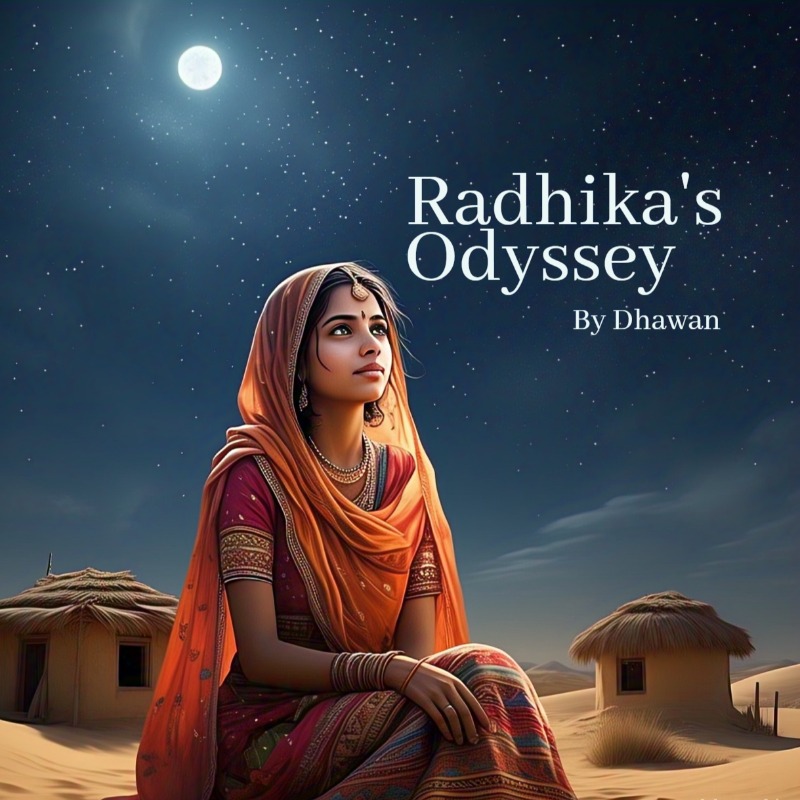
In the heart of Rajasthan’s golden desert, where sand dunes stretched endlessly and the sun painted the sky in hues of amber, Radhika was born into a humble family. Her father, Thakur Baldev Singh, toiled on a small patch of land, while her mother, Savitri, spent her days cooking, cleaning, and weaving dreams for her children amidst their poverty. Radhika, the youngest of three siblings, grew up in a world defined by scarcity—cracked mud walls, a single kerosene lamp, and the rhythmic hum of her mother’s spinning wheel. Yet, her eyes sparkled with an insatiable curiosity, even as a child.
At five years old, Radhika first gazed at the moon from beneath the sprawling branches of an ancient banyan tree. Sitting beside her mother, she listened to tales of the lunar goddess who lit up the night. “Can anyone go to the moon, Amma?” she asked, her voice trembling with wonder. Savitri chuckled, “Oh, my silly girl, the moon is too far. No one can reach there.” But Radhika’s heart refused to accept this. That night, she whispered to herself, “I will go to the moon one day.” It was an impossible dream, a flicker of ambition in a life where survival was the only goal, but it ignited a fire within her.
However, life had other plans. Poverty loomed large over her family, and education was a luxury they couldn’t afford. At ten, her fate was sealed when her parents arranged her marriage to a boy from a neighboring village. The tradition of child marriage was deeply entrenched, and with three mouths to feed, her father saw it as a way to lighten his burden. Savitri protested tearfully, but the village panchayat’s decision was final. At twelve, Radhika was draped in a heavy ghunghat, her face hidden as per family custom, and sent to her new home. The veil became her prison, muffling her voice and dimming her dreams.
In her in-laws’ modest house, Radhika’s struggles intensified. Her husband, Gopal, was a kind but uneducated man ten years her senior, running a small grocery shop. Her father-in-law, Thakur Raghuveer Singh, was a stern patriarch who revered tradition above all. He expected Radhika to conform, to cook, clean, and bear children silently. The ghunghat weighed on her soul, and one day, as she struggled to breathe under its layers, a realization struck her: a woman bound by a ghunghat could never dream of the stars, let alone outer space. The moon seemed further away than ever.
Yet, hope flickered in an unexpected place. Gopal, noticing her quiet sorrow, began to ask questions. One evening, as they sat under the stars, Radhika shared her childhood dream. To her surprise, Gopal didn’t laugh. Instead, he said, “If this is your heart’s desire, I will help you.” Unlike his father, Gopal saw potential in her spirit. He saved every spare rupee from his shop and enrolled her in a local school, defying the family’s norms. Radhika studied tirelessly, her ghunghat lifted only when she was alone with her books. She devoured stories of Kalpana Chawla, the first Indian woman in space, and Sunita Williams, whose spacewalks inspired her to dream bigger.
Years passed, and Radhika’s determination bore fruit. She completed her schooling, then pursued a degree in astrophysics through correspondence courses, balancing her studies with household chores. Gopal supported her every step, ensuring she attended science camps and workshops. At twenty-two, her hard work caught the attention of the Indian Space Research Organisation (ISRO). Against all odds, she was selected for astronaut training. The ghunghat was a constant battle—she wore it outside but shed it during training, feeling the freedom of her ambition.
Her success, however, brought tension. Thakur Raghuveer Singh grew ashamed of her “rebellious” nature. “A woman’s place is in the home, not chasing the skies!” he thundered, forbidding her from pursuing further dreams. Radhika’s heart sank as she saw her lunar aspirations slipping away. She longed to train at NASA, where advanced programs could bring her closer to her goal. An ISRO senior, impressed by her resilience, recommended her for an exchange program, but Raghuveer's opposition loomed like a dark cloud.
One night, as Radhika stood alone in the courtyard, her eyes fixed on the moon’s silvery glow, a resolve hardened within her. The clock was ticking—her NASA opportunity was slipping away with each passing day. She couldn’t wait any longer. That night, she packed a small bag, her heart pounding with fear and determination. She woke Gopal, whispering, “We must go. I can’t let this dream die.” Gopal, ever her ally, nodded silently, gathering his own belongings.
The next morning, Radhika confronted her father-in-law. Her voice trembled but grew steady as she spoke. “Pitaji, I know you see my dreams as defiance, but they are bigger than me, bigger than us all. I want to touch the moon, not just for myself, but for every girl bound by tradition.” Raghuveer’s face hardened, but her words pierced through his pride. He saw the fire in her eyes, a reflection of a dream that transcended their small world. After a long silence, he sighed, his expression softening. “If this is your destiny, I won’t stand in your way,” he said, pulling out a bundle of money saved for family needs. “Go, and make us proud.”
Tears welled in Radhika’s eyes as she hugged him, gratitude overwhelming her. With Gopal by her side, she left for the United States, her ghunghat left behind as a symbol of her past. At NASA, she immersed herself in rigorous training—simulations, zero-gravity exercises, and spacecraft systems. Her story of overcoming poverty, child marriage, and tradition spread like wildfire, inspiring millions. Young girls in Rajasthan and beyond began to see the moon not as a distant myth, but as a reachable dream.
Years of dedication paid off. Radhika excelled in her training, earning accolades from her instructors. Her journey from a veiled child bride to an astronaut trainee became a beacon of hope. Now, she waits for her chance—a mission from NASA or SpaceX that will take her closer to the moon. Each night, she gazes at the lunar surface, knowing that her impossible dream is no longer just a whisper in the desert wind, but a promise she is determined to keep.
As she prepares for the day she might step onto the moon’s dusty plains, Radhika’s story resonates globally. She speaks at schools, urging girls to break free from societal chains, much like she did. Her husband, Gopal, stands proudly by her side, a testament to the power of support in the face of adversity. And Thakur Raghuvier Singh, now a changed man, shares her tale with pride, realizing that sometimes, the greatest traditions are those of courage and dreams.
Radhika’s journey is far from over. With every step toward the stars, she carries the weight of her past—poverty, the ghunghat, and the struggles of her marriage—but also the strength she gained from overcoming them. The moon, once a distant fantasy, now feels within reach, a testament to the indomitable spirit of an underdog who dared to dream beyond the horizon.