In the sultry afternoon hours of an October day in the year 1968, I, Mr. Anirudh Sen, senior clerk to the Department of Postal Records, Faridabad Division, found myself buried ankle-deep in a mound of what the newer boys call “dead letters.” They were no more dead, I mused, than the brittle leaves of an old banyan—curled, faded, but never without some whisper of life, if one cared to listen.
Faridabad, then, was a town neither wholly rural nor resolutely urban. Dust-choked bullock carts trundled beside rattling Ambassador cars, and the shriek of steel mills from the industrial sector mingled curiously with the plaintive songs of street hawkers selling kulfi and guavas. Rows of red-bricked government quarters lined the residential sectors like half-forgotten dreams from Nehruvian idealism, orderly yet worn at the edges. My own quarters—modest, but adequate—lay behind a tamarind grove near the dispensary, where my evenings were spent in relative solitude, sipping sweet tea while scribbling numbers on scrap paper, more for comfort than necessity.
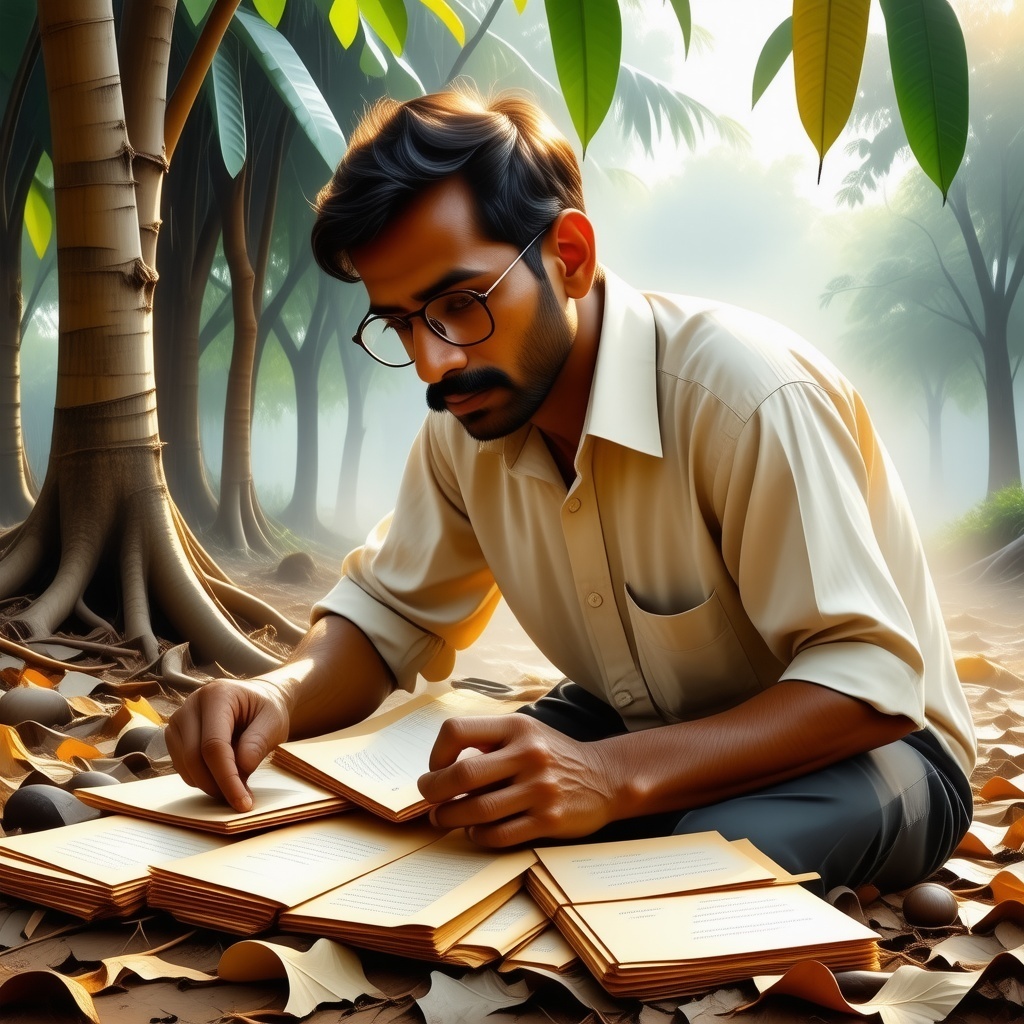
I was, by then, in my forty-sixth year. A man of routine, disciplined and deliberate in action. My lineage was that of Kayasthas—scribes and administrators by long-standing tradition—though I made little of that. In the new India, names and castes no longer held the same weight, at least not in writing. My spectacles were always sliding down my nose, and I wore my shirts buttoned to the throat, more out of habit than modesty. People considered me quiet and dependable—like a cupboard full of files: not particularly exciting, but reliable in a storm.
It was in this spirit of unremarkable duty that I approached the bundle of "Return to Sender" envelopes in the old records wing—an annex that smelt of mildew, rust, and camphor. The envelopes were a brittle congregation of forgotten intentions—letters addressed to homes that no longer stood, names that time had erased, dreams too fragile for delivery.
But one such envelope arrested my hand.
The ink, though faded, bore a distinct familiarity—my own handwriting, unmistakably so. The name scrawled in blue fountain ink was Roshanara Malik, and beneath it, an address in Hyderabad I once knew by heart. The date in the corner: March, 1949.
My pulse quickened. I knew that letter.
I had written it during a period of acute disillusionment, some nineteen years prior, in the aftermath of Partition—a season when the streets of Calcutta wept crimson and the soul of the country was split like brittle glass. I had been a lad of twenty-seven then—young, hesitant, and love-struck beyond wisdom.
And Roshanara.
Ah, Roshanara.
She was the daughter of Dr. Yusuf Malik, a prominent homeopath in central Calcutta. Their family lived in a whitewashed haveli near the Shaheed Minar, with jharokhas overlooking a rose garden, and a veranda always shaded by the cloth awnings of summer. She was educated at Bethune School, fond of Ghazals, and known to frequent the old tea house near College Street, where Urdu poets debated the immortality of sorrow.
I had met her, as all great calamities begin, by sheer accident. A quarrel over a book—Faiz Ahmed Faiz—at the secondhand stall near the tram depot. She had the book in her hand; I claimed I had reserved it. She smiled, but did not relent. “Poetry belongs to no man,” she said. I was taken aback, and then taken entirely.
We met again, and again, always in public places, always under the shadow of caution. She wore handwoven sarees and jasmine in her braid. Her laugh was like the delicate crack of glass—beautiful, sharp, and far too rare.
Our companionship grew, as such things do, not in declarations, but in small confidences—books exchanged, silences shared. She once recited Ghalib to me under a gulmohar tree, and I, too foolish to reply in kind, merely nodded as though words might ruin the moment.
But history, like the monsoon, has little regard for the affairs of the heart. The riots of 1947 struck with ferocity. Streets we had walked turned into corridors of fire. She and her family fled to Hyderabad. I remained.
I wrote to her months later, though I never sent it. The contents of that letter were raw and inelegant—a confession of love, a lamentation, a clumsy farewell. I folded it into a blue envelope, intending to destroy it.
But here it was, in my hand, sealed and stamped by the Indian government, with a mark that clearly indicated it had passed through official channels.
I pressed it to my chest, as if trying to confirm its weight against memory. Who had sent it?
Later that evening, in the dim lamplight of my quarters, I slit the envelope open with a trembling hand. My own words greeted me like long-lost ghosts. “Forgive the cowardice of my silence. If this reaches you, know that I thought of you not just in moments of pain, but in every instance when beauty passed me by.”
Sleep came only in fragments that night.
The next morning, I visited the home of Dev Kumar, my closest companion from that era. He had been the only one I trusted with the letter, asking him to destroy or deliver it, as he saw fit. We had lost contact shortly after he took up a post in the postal department, transferred to Bombay.
His younger brother, now a schoolteacher, received me with a solemn expression. Dev had perished in a rail accident near Itarsi in 1951. “He carried a satchel of letters that day,” the brother said, “and some say he protected them with his body in the crash.”
A chill passed through me.
The question lingered like an unwelcome guest in the parlour of my mind—had Dev dispatched the letter ere his own departure from this mortal world? Or had it, perchance, lain dormant amidst his effects until some unseen hand consigned it to the government mailbag?
In truth, I knew not the answer, and perhaps it no longer mattered. What did matter was the weight it bore—the ghost of an affection unresolved, resurrected now, long after its time.
I sought a week’s leave from the Postmaster General, citing “personal cause.” He granted it without delay, noting perhaps the uncharacteristic tremor in my usually steady voice. Thus armed with a small valise, a cotton shawl, and a battered leather diary, I boarded the Howrah-Hyderabad Mail, my heart tethered somewhere between memory and uncertainty.
The train moved with a languorous grace, as though unwilling to hasten the unravelling of fate. Compartments clattered with the rhythm of iron and steam; the windows were little squares framing parched fields, banyan trees, and occasional village children waving at the passing world.
Across from me sat a gentleman clad in white muslin, his beard dyed with henna and his eyes wise with time. He was a Muslim cleric, travelling to a relative's house near Nampally. Beside him, a widowed schoolteacher, her saree plain and her forehead bare, crocheted a doily with fingers that trembled slightly. We exchanged pleasantries, and then, as journeys often demand, spoke of the past.
The cleric, stroking his beard, said, “Letters are not merely ink upon paper, sahib. They are spirits—wandering until read by the one for whom they are intended.”
I looked away, my gaze drawn to the flurry of birds above a tamarind grove. “But what of those read too late?” I asked.
The schoolteacher, her voice soft as a sigh, replied, “Even late answers are answers. Sometimes, they are the only ones that matter.”
Their words settled upon me like the dusk creeping through the cabin. I thanked them in silence, and when sleep arrived, it did so with the uneasy grace of half-remembered dreams.
I arrived in Hyderabad at dawn, the station echoing with porters’ cries and the hiss of boiling milk from tea-stalls. The city had changed since last I knew it—a strange mingling of ancient minarets and concrete ambition. The air was spiced with cardamom and coal smoke, and the sky hung low with a grey unease, as though monsoon lingered indecisively.
Clutching the envelope, now creased and faintly aromatic with time, I made my way through alleyways veiled in the shadows of bougainvillea and flaking plaster. At last, I reached the address I had once memorised like a verse from scripture.
The haveli stood still—but only in bones and stones. Its ornate jharokhas now stared blankly over a courtyard littered with wrappers and dried leaves. A placard, crooked and weary, announced its new function: Hyderabad Girls’ Anglo-Urdu School. The past had been turned into curriculum.
An elderly gardener, his hands blackened from soil and betel, offered me water from a brass lota.
“Do the Maliks reside here still?” I asked.
He shook his head, wiping sweat from his brow. “Left long ago, sahib. After the troubles in ’52. There was a daughter... Roshanara Begum. Never married. They say she taught poetry in the city.”
“Do you know where she is now?”
He spat red betel onto the stone. “Only Allah and the wind know where old hearts wander.”
Armed with this sliver of news, I spent the next two days scouring civil records, school archives, and hospital registries. The bureaucracy resisted as only Indian bureaucracy can—shuffling papers with infinite dignity and no haste. Most leads led to dead ends. The clerk at a school claimed she remembered a “Miss Malik” who taught briefly, but could not place the year.
It was at a local women’s NGO, a modest bungalow with jasmine vines curling up the grille, where a young social worker finally lifted the veil.
“Yes, we know her. She is in our hospice. Old city quarter, near Falaknuma. Poor health these days. But her mind—sharp as ever.”
My feet turned to clay.
“And her name is...?”
“Roshanara. Roshanara Malik.”
The hospice was humble, painted in lime and shaded by neem. The corridors smelt of soap, starch, and forgotten perfumes. I was led through a sun-drenched courtyard where an old radio crooned Lata Mangeshkar, the notes blending with birdsong in a strangely comforting dissonance.
And there—under the arc of a frangipani tree—I saw her.
A woman in her early forties, guiding a wheelchair with quiet care. Slender of frame and possessed of a natural grace, she moved with the unhurried composure of one long accustomed to bearing burdens invisible to the eye. Her sari, simple yet elegant, caught the breeze in soft folds, and the faint scent of rose attar lingered in her wake.
Her features bore the refinement of a bygone age: a high brow, delicately arched eyebrows, and cheekbones like carved ivory—firm and proud. Her skin, dusky and unpowdered, held the glow of a woman who had weathered sorrow, not succumbed to it. Thick hair, still mostly black with the barest touch of silver at the temples, was coiled into a measured chignon, practical yet becoming.
But it was her eyes that arrested all thought—almond-shaped, alert, and glistening with a lucidity that hinted at poems once memorised beneath lamplight, of pages turned with reverence, of losses endured without spectacle. There was no bitterness there, only a kind of soft defiance, as though she had refused to let life’s cruelties steal her capacity for wonder.
She was not a shadow of youth, but its enduring echo—a woman untouched by vanity, and all the more luminous for it.
She looked up.
And in a voice tempered by time and tenderness, she said,
“So the letter finally returned to you?”
I stood still, undone by the simplicity of her greeting. “Roshanara...” I whispered.
She smiled—a quiet, knowing smile that needed no explanation. The young woman excused herself, and for a moment, time folded neatly upon itself.
“I had entrusted it to Dev,” I said, voice cracking.
“I know,” she replied, her gaze steady. “He altered the address—changed a line, a number. Said he would send it when the world was safer. He feared it might bring us harm.”
I looked at the letter in my trembling hands. “But it returned.”
“Two years ago. Misaddressed, rerouted, and finally... here.”
She tapped her heart.
“I have waited,” she continued. “Not in hope, not in bitterness. Simply waited. I knew if you ever found it, you would come.”
Silence hung between us, but it was not uncomfortable. It was the silence of two pages that had been separated for decades and now found themselves in the same book once more.
We sat thus, beneath the frangipani tree, two souls marked by history, speaking in the language of glances, half-sentences, and shared silences.
“I still recite verse,” she said at length, her voice scarcely louder than the rustle of leaves overhead. “Mostly for the women who reside here. Their hearts lean toward film songs and popular melodies, but I persist with the old ghazals. Some words, you see, are meant not for fashion, but for remembrance.”
I smiled faintly. “I remain at my old desk in Faridabad,” I said, gazing at her face in the waning light. “The young clerks, they call me a fossil.”
She laughed—soft, like the turning of a page long closed. “You always were fond of fossils,” she said, eyes gleaming. “You once told me that old stamps were like tiny biographies. Quiet witnesses. Silent messengers.”
From within her shawl she withdrew a small folded slip of paper, yellowed and tender as an autumn leaf. “My reply,” she whispered. “Penned the day I read your letter. But I had no address, no means to send it forth. So I kept it... as one keeps a promise made to the wind.”
I took the paper, my fingers trembling—not from age alone, but from something deeper, older. A reverence. A recognition.
The sun now hung low over the minarets, and the muezzin’s call wove through the air like a thread of prayer spun from dusk itself. I stood, reluctant yet resigned.
“I do not know what the future holds,” I said, voice unsteady.
She lifted her gaze to mine—clear, unwavering. “Then let it hold only this moment,” she replied. “A moment where a letter, long delayed, found its rightful reader.”
We stood thus—two souls no longer bound by expectation, nor undone by what never came to pass.
For what is love, if not this? A presence without demand. A patience that outlives separation. The world may conjure its barriers of name and nation, custom and creed—but true affection asks for naught, saves remembrance. It is not a cry to possess, but a vow to remain.
We may part, as earth and sky part—but like clouds, our spirits shall meet and mingle, above all boundaries. For some unions are not of this world—but of time, silence, and the eternal echo of love unanswered, yet not unlived.






 React
React