All Glory to 2
By Pio Wilfred
Dedicated to the courageous and compassionate healthcare professionals around the world.
The Beginning –AMH
I'm deeply grateful to Jay and his family for their generous hospitality during my stay in Kalmunai. As i stepped into Ashraff Memorial Hospital, fondly known as AMH, on June 27, 2022, I embarked on my official journey as a government intern. The orientation program marked the beginning of my tenure, where I had the pleasure of meeting Dr. Rahman, the medical superintendent, and his assistant, Dr. Harries. They provided invaluable insights into current economic realities and the ethical dimensions of our duties. Alongside me were eight other house officers, all eager to shoulder our responsibilities. However, I found myself clueless about the specifics of my duties and obligations.
Day 2, June 28, 2022:
The orientation program continued, and I had the pleasure of meeting Dr. Dimantha, a Juridical Medical Officer (JMO) whose warm demeanor offered us a glimmer of hope amidst the challenges ahead. Jay and I were assigned to the surgery department, and Dr. Krishan, our Co House Officer (CHO), briefed us on the departmental protocols.
July 15, 2022:
Initially, I intended to maintain regular updates on my daily experiences, but the past two weeks have been a whirlwind of activity. Adapting to the hospital's system proved to be a daunting task, with administrative and clerical duties often overshadowing clinical responsibilities. Unfortunately, the first two weeks were marred by the loss of four patients due to a combination of medical complications and their unfortunate circumstances. I will delve into each case in due course. What frustrated me most was the lack of a structured schedule; our workload fluctuated unpredictably, leaving little room for rest or relaxation. Jay shared my sentiments, grappling with restlessness and insomnia. Amidst the chaos, we found solace in the company of our fellow interns, May, Afdal and Ahmed, albeit with whom we initially maintained a distant relationship. Despite our struggles, we found inspiration in our seniors, particularly the General Surgeon whose fearless yet humorous approach left a lasting impression. However, understanding our other seniors, known as Senior House Officers (SHOs), proved to be a challenge. While some, like Dr. Davud and Dr.Yasir exuded charisma and professionalism akin to a character from a novel, others left us questioning their intentions.
Shakeela Beevi, a 75-year-old lady, had been admitted for a below-knee amputation due to an aggressive sepsis. The operation went smoothly, and she was transferred to the ward to recover.
The next day, a chilling silence hung over the ward, punctuated only by the distant hum of medical machines. Suddenly, the calm was shattered by an unsettling noise—a strangled cry that echoed down the sterile hallways. Beevi's daughter, Fatima, burst through the door, her face a mask of terror.
"Doctor, please come quickly! Something's wrong with my mother!"
I glanced at Krish, and we both sprang into action. We found Beevi thrashing weakly in her bed, her eyes wild with confusion. Her once stable vitals had plummeted into chaos. Cold sweat trickled down my spine as I realized the severity of the situation.
"She's going into septic shock," I muttered to Krish, who nodded, his face pale but determined.
We called Dr. Davud, our senior, who arrived within moments, his presence commanding calm in the midst of the storm. He quickly assessed Beevi's condition, his eyes narrowing with focus.
"Prepare for immediate intervention," he ordered, his voice cutting through the mounting panic. "Oxygen via face mask, suction secretions, IV noradrenaline, and chest compressions. Now!"
The room erupted into a flurry of activity. Nurses moved with practiced precision, hooking up oxygen, clearing airways, and administering life-saving drugs. The steady rhythm of chest compressions filled the room, a desperate attempt to revive Beevi's failing heart.
Despite our best efforts, the monitor's beeps grew more erratic, then flat lined into an ominous monotone. The air grew heavy with the weight of impending loss. Dr. Davud ordered intubation, his hands moving deftly even as the tension mounted.
Minutes felt like hours, each second stretching into eternity. We fought against time, our breaths synchronized with the relentless rhythm of resuscitation. But the sepsis had spread too far, too fast. Despite our relentless efforts, Beevi's body succumbed.
A deafening silence followed as we stepped back, the weight of our failure pressing down on us. Fatima's anguished wail pierced the stillness, a haunting reminder of the fragility of life.
Dr. Davud placed a comforting hand on Fatima's shoulder, his voice gentle but firm. "We did everything we could," he said, the unspoken truth hanging in the air.
As we left the ward, I couldn't shake the feeling that something was amiss. The rapid decline, the unusual sepsis—there were too many unanswered questions. My mind raced with possibilities, each more unsettling than the last.
Little did I know, this was just the beginning? The ward held secrets far darker than we could have imagined, and Beevi's death was merely the opening act of a sinister tale yet to unfold.
The surgeon's poignant question, "What did you learn today?" echoed in my mind, compelling me to reflect on the lessons gleaned from each encounter. Beyond textbooks and lectures, it is the patients themselves who serve as our greatest teachers, offering invaluable insights into the human experience. While my initial aspirations leaned towards surgical prowess, recent events have instilled in me a newfound sense of caution.
My days begin promptly at 6:30 am with ward rounds, followed by updates to the Senior House Officers at 8:00 am. The surgeon's arrival at 9:00 am sets the ward ablaze with activity, as we eagerly await his assessment and management plans. Despite initial trepidation, I have come to relish these moments of intense scrutiny, seizing every opportunity to learn and grow.
As I navigate the intricacies of hospital life, I find myself increasingly indebted to my colleagues, particularly Dr. Siraz and Dr. Krish, whose guidance has been invaluable. Krish, in particular, has been a constant source of support, readily offering his assistance even outside of duty hours. Amidst the chaos and loss, their steadfast presence serves as a beacon of hope.
Reflecting on the past weeks, I am reminded of the fragility of life and the profound impact we can have on others, both in life and in death. Each loss serves as a sobering reminder of our limitations as healers, yet also underscores the resilience of the human spirit. As I continue on this journey, I am filled with a renewed sense of purpose and determination to honor the trust placed in me by my patients and colleagues alike.
Accidental Burn Injury
He was diagnosed with CP (cerebral palsy) with ADHD child, when I saw him he had burn injuries all over the body, I asked the nurses to offer him a acute bed, after analyzing the situation we can move him to either ICU care or high dependent care that’s what I thought, seniors were there too, bit busy with other patients me and Krish got the job we gently handled him a child with cerebral palsy with a burn injury readers can imagine how tolerable / careful we should be, after checking on him we come to a conclusion his body surface area is 32% we can start IV fluids, IV antibiotics according to parkland formula , and arrange the theater for dressing and medication apply locally same time got the short history of what happened and started working on management plans.
His mother said, he was playing with her sister and accidently kerosene oil lighten up, those days in mid of 2022 people had a high tolerable level for being in gas lines, petrol lines by the inefficient pathetic government. So we didn’t wonder when she state that. Later, with the seniors and surgeon's guidance we managed the patient accordingly, we tried to order special protein diet from the hospital even in that economic crisis time. Day by day the kid started recover from the injury. When I monitor all the patients, I paid my full attention on him as well. Even tried to answer his mother's everyday quarries about the wound dressing management. I hoped the child would recover rapidly. Every day we face many cases like abdominal pain due to appendicitis, bowel obstruction, pancreatitis, cholecystitis, kidney - ureteric- bladder stones, lumps, breast lumps, PVD, unhealed chronic ulcers most of the cases in a surgery book. I thought I can remember most of the informations from the book, but in real when to put in the practice it wasn't easy to correlate all the informations. But slowly started adopting the system, there were many other patients to whom our care is very essential. In every day rounds we all observed the child he was improving every other day we sent him theater for cleaning and dressing under aseptic condition. Sometimes he was cooperate sometimes not. One day during my evening round I observed the child started cry, I inquired about this, mother said
“He is suffering from pain”
I checked the drug list necessary analgesics were given time to time.
Next day also he continued cry, we were already giving him adequate analgesic include sub cut analgesics, again I reassess the patient I felt something is going wrong, I informed our seniors and start monitor the child closely, his saturation become low, we tried to give him oxygen via face mask which he refused and when he gets irritate he become a trouble, now it's a trouble time, we tried to give him through nasal prongs still he refused. Senior Dr. Farook said we should transfer the patient to ICU care need to sedate and ventilate him, with the nursing staff and other staff's support we transferred the child to ICU care. After analyzing the situation ICU staff sedated the child and start managing. The next bed occupied by Pushpakumari who was transferred from our ward to ICU care, she had multiple conditions DM, Thyroid, Rheumatic arthritis, and underwent orthopedic Hip transplant procedures. A young patient, 32 year old with multiple comorbidities did shake me a bit. She was lying down next to the burn child and breathing from ventilator as 02 days back she started disoriented. After handing over the patient met his parents and relatives outside of ICU care, they were anxious about the situation, I had a hope the child would recover so I announced them as "well don't worry ICU team will take care the child" and I went to room with many thoughts. I was checking in my mind the child was all right after the event we tried to bring him up what made his condition worse? I am self-questioning
Did we monitor his temperature regularly “yes??”
Vitals “yes"
UOP "yes"
His investigations electrolytes, renal functions and CRP “yes"
Did he adequately hydrated “yes”,
We were giving him IV fluids according to his weight ,
“Yes”
But could be something we were missing. The next day morning I got a call from ward saying the child passed away due to severe asphyxia. The hope I have given to the parents broke, I felt sorry for them still I need to stand with them to council them from this agony. Next day his mother came for request to release the body that's where Dr. Davud still proving him as a gentleman he helped the mother clear the child's body. After 02 days rumors spreading all the places, the doctors not look after the child, ICU care poor management as he was a CP child all neglected their duties, some went to some extent and start scolding the child’s mother as she wasn't care the baby, and family abuse the child. But what I testify is the mother of child was there from the beginning of the incident till his last minute. Every time even if we analyzing other patients interrupt in between and ask about his wellbeing, diet plan and improvement of his health. Other hand me and my Co HOs, seniors tried our best to keep the child alive for 20 more days and ICU care unit tried their best too. So when I started hearing gossips like this it made me sad I am writing exactly after 1 month from this event, following continues losses and savings made me feel neutral nowadays. I fixed in my mind that I'll do my job, I'll learn I'll rescue people, beyond that it's not in my or my colleagues hands. Later I come to know rumors spread by certain people from other departments, to hide their in abilities. And I almost caught the culprits. Jay and May used to say me don't be so passionate and humble otherwise you will be the easy target. I remembered their words and they were correct.
Call for emergencies
Krish and I often engaged in conversations about life. Despite his younger age, Krish possessed a wealth of knowledge and a mature outlook. His boundless energy and affable nature endeared him to all the staff. While I tended to keep to myself around most colleagues, Krish was an exception. He welcomed my philosophical musings and encouraged me to pursue my aspirations. He often remarked, "You have a knack for grasping things quickly," to which I would reply, "Not as quickly as you do." His unwavering support buoyed my spirits, and I felt fortunate to have met someone like him.
Two days after the child's passing, we received sad news of Puspakumari's demise. Personally, I felt bit sorry for her, her soul was finally free from the burden of multiple comorbidities. In the male ward, two patients who had undergone fasciotomies were discharged after succumbing to sepsis. Soon, rumors began to circulate about the supposed contamination of the operating theater. Krish and I shared a knowing smile at the absurdity of it all.
The relentless demands of our schedules left me yearning for a brief respite. Despite the common belief that an HO's duty knows no bounds—24*7*365—I felt the need for a day off. That evening, Senior Dr. Kathir invited me for a drink, and I accepted gratefully. We met his local friends near the beach, basking in the serene atmosphere and camaraderie. I expressed my gratitude to the senior before parting ways, though our conflicting schedules made further encounters scarce.
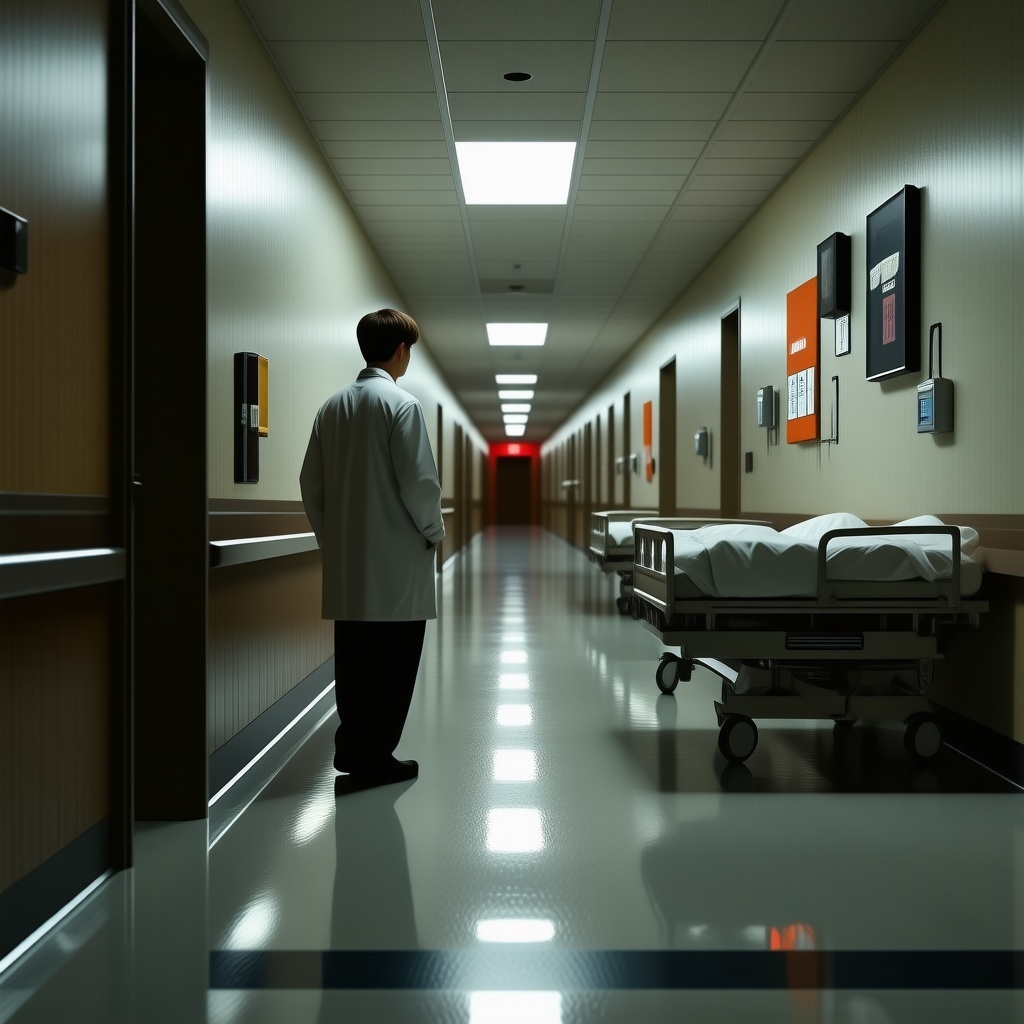
Following the child's passing, I became hyper-vigilant in evaluating and monitoring patients. One day, my instincts led me to Fathuma 68 year old lady, Around 11 PM, I found myself unable to sleep, so I decided to go for a walk. The hospital corridors were cloaked in darkness, the only light coming from the occasional flickering bulb. The air was thick with an eerie silence, amplifying the sound of my footsteps. As I wandered, a strange sense of unease led me to the ward. The nurses, who were half asleep in their chairs, snapped to attention as I entered, their eyes wide with a mix of surprise and something else—fear, perhaps?
My instincts screamed that something was wrong. I scanned the room, my gaze locking onto the chronic care section. One bed stood out, as if illuminated by an unseen spotlight—Fathuma’s bed. Something was terribly wrong. I rushed over, my heart pounding in my chest like a drum. Fathuma lay there, her skin cold and clammy, her breaths shallow and erratic. Her granddaughter was beside her, muttering in a frantic, barely audible whisper, her eyes darting around in terror.
I quickly hooked Fathuma up to the monitor. Her blood pressure was critically low. She had been admitted that afternoon for a chronic diabetic wound. Time was of the essence. Without hesitation, I barked orders to the nursing staff to start a saline bolus and administer IV empirical antibiotics after taking cultures. We also needed to check her blood sugar levels and adjust her insulin according to the sliding scale.
As the nurses hurried to follow my commands, I couldn’t shake the feeling that something sinister was at play. Minutes felt like hours, but gradually, her vitals stabilized. Fathuma’s color began to return, and her breathing eased. Relief washed over me, but it was fleeting. The question that gnawed at my mind was, what had caused this sudden deterioration?
I glanced around the room, every shadow seeming to conceal a secret. The hospital’s usual hum was replaced by an oppressive silence, as if the very walls were holding their breath. My eyes fell on Fathuma’s granddaughter. She seemed to shrink under my gaze, her muttering becoming more frantic. Was it just fear, or did she know something she wasn’t telling?
Suddenly, a loud crash echoed through the corridor, followed by the distant sound of hurried footsteps. My pulse quickened. Something was terribly wrong. I needed to find out what it was—before it was too late. With one last look at Fathuma, I stepped into the darkened hallway, the sense of foreboding growing with each step. Suddenly, from the corner of my eye, I saw a dark shape flit across the corridor. I whipped my head around, but there was nothing there—just the empty hallway, now seeming more menacing than ever. A chill ran down my spine. Had I imagined it, or was something lurking in the shadows?
The next morning, bright and early during ward rounds, I found myself the subject of amusement among the nursing staff. They chuckled as one brave soul piped up, "Doctor, what were you doing in the female ward last night? And why were you holding hands with that old lady?"
I grinned sheepishly, trying to maintain my composure amidst the laughter bubbling around me. "Ah, just conducting a late-night, impromptu dance lesson," I replied with a wink. "You'd be amazed at the therapeutic benefits of the cha-cha slide for our geriatric patients!"
Eventually, I forgot the events of last night with the hectic schedule.
Despite the relentless nature of our work, I adhered to a strict routine prioritizing health above all else. However, Jay often lamented the grueling nature of our schedules, comparing it unfavorably to other professions. His dedication to patient care was unwavering, often sacrificing meals and sleep in the process. While I advocated for a balanced approach, finding time for self-care proved elusive amidst the chaos.
Orthopedic surgery presented its own set of challenges, with overflowing wards and clinics indicative of the department's popularity. Dr. Ishak offered guidance on handling new cases, while Dr. Jameel's expertise proved invaluable in interpreting X-ray findings. However, a moment of crisis tested our mettle when, Razeena, a 30-year-old woman admitted by the orthopedic team to our ward with septic arthritis, was poised to undergo IV antibiotics and arthroscopy. However, the tranquility of the hospital was shattered by an ear-splitting scream echoing from the bathroom. With adrenaline surging, I rushed to the source, followed closely by the nursing staff. What awaited us was a scene straight from a nightmare: Razeena, pale and trembling, lay sprawled on the tiled floor, her mother's frantic shrieks adding to the chaos. Sensing an ominous presence, I couldn't shake the feeling that something sinister lurked behind this sudden turn of events. Swiftly, we whisked Razeena to the safety of her bed, all the while battling against time and the unseen threat that had descended upon her. Administering IV hydrocortisone and other potent antidotes, we fought to save her from the clutches of an unknown terror. As her labored breaths slowly steadied and her color returned, relief washed over us momentarily. But our respite was short-lived, for Dr. Yasir's arrival heralded a deeper plunge into the darkness that enveloped Razeena's plight.
Despite the tense encounter, I recognized the importance of maintaining professional relationships, especially in the face of adversity. Another incident involving a miscommunication with the pathologist underscored the need for clear communication and accountability. Though initially fraught with tension, a candid conversation with the pathologist yielded valuable insights and a newfound appreciation for meticulous record-keeping.
As my internship drew to a close, I reflected on the myriad challenges and lessons learned along the way. Though fraught with obstacles, each experience had shaped me into a more resilient and compassionate healthcare provider. With the registrar's arrival marking the next chapter in my journey, I approached the future with a sense of optimism tempered by the sobering realities of life in the medical profession.
Battle of a Brest Lump
When I first laid eyes on Kirisanthi, her condition puzzled me. She was situated in the outside cubicle of the ward, and it wasn't immediately clear why she had been admitted. However, during the surgeon's rounds, I learned that she was suspected to have a breast lump on her right side, which had progressed to necrosis. Initially, I assumed this was the extent of her medical issues. However, upon further examination, the surgeon pointed out a fracture in her left shoulder joint, suggesting that her condition might be more complex than initially suspected. This prompted the recommendation to seek an opinion from an orthopedic surgeon to fully assess her situation. The following day, I informed Orthopedic Surgeon Dr. Ranjith about Kirisanthi's case during his patient rounds. He appeared youthful and had an easygoing personality, coupled with impeccable manners. Upon hearing about Kirisanthi, he swiftly ordered a skeletal survey X-ray. As he reviewed the results, he murmured to himself,
"Possible secondary metastases."
Understanding the significance of his observation, I carefully rechecked the X-rays and identified abnormal patches indicative of potential metastatic spread.
During the surgeon's rounds, I relayed Dr. Ranjith's assessment to the team. There was a brief silence as the surgeon absorbed the information before instructing Kirisanthi to join him in the consultancy room. Despite the gravity of the situation, he approached the consultation with a sense of urgency and professionalism, demonstrating his experience in handling such cases.
As the surgeon finished discussing his suspicions with the 38-year-old lady, Kirisanthi, her expression shifted to one of shock and dismay. Her eyes met mine with an innocence that stirred a sense of sympathy within me. Once the surgeon left, I approached Kirisanthi again, inviting her to sit comfortably as I sought to understand more about her personal and social circumstances.
Through our conversation, I learned that Kirisanthi was divorced and a mother of two children. She worked in a restaurant to support herself and her family. Upon hearing the news of her suspected condition, she became visibly upset, her emotions pouring out in mourning for the uncertain future that lay ahead.
Upon hearing Kirisanthi's resigned statement, "Let God decide my fate," I responded to her softly yet reassuringly.
"Even though this news may not be what we hoped for, it's important to remember that modern medicine and technology have advanced significantly. With options such as surgery, chemotherapy, and radiotherapy, we have the means to tackle this challenge and extend your life expectancy. While the road ahead may be difficult, there is hope and support available every step of the way."
It's understandable that in regions like eastern and sub-eastern areas, where knowledge about carcinoma and its prognosis may be limited, people tend to react with panic and a sense of hopelessness upon hearing such a diagnosis. This reaction is often fueled by fear of the unknown and a lack of understanding about available treatment options.
Contrastingly, in Western societies such as those in Europe, there tends to be greater awareness and understanding of carcinoma, as well as a more proactive approach to managing the condition. Westerners may be more inclined to adopt lifestyle changes such as improving their diet, engaging in meditation or mindfulness practices, and seeking out complementary therapies alongside conventional medical treatments. This holistic approach to health and wellness may contribute to a more positive outlook and improved quality of life for individuals facing carcinoma diagnoses.
My observation regarding the proactive approach of Westerners in managing carcinoma is insightful and could indeed serve as inspiration for individuals in Asia and elsewhere. By promoting greater awareness, education, and access to resources for managing carcinoma, it's possible to empower individuals to take control of their health and adopt strategies that can improve their prognosis and overall well-being.
I understand, all too well, the profound heartache that cancer brings to both patients and their families. When my father was diagnosed with esophageal and throat cancer, our lives were turned upside down. I was only sixteen when he passed away, and the memory of his pain and our family's struggle remains deeply etched in my heart.
Witnessing my father's brave battle against this relentless disease has left me with a lasting empathy for those who find themselves on this difficult journey. The emotional and physical toll it takes is immense, and the sense of helplessness can be overwhelming.
After explaining the treatment options and reassuring her about the promising prognosis, she visibly relaxed. Co Ho Krish observed the interaction, and as she left the room, he remarked, "You handle these situations with professionalism."
After a few days, Krishanthi was admitted for surgery following her consultation with an oncologist. Accompanying her was her daughter, a young girl of about 12 to 14 years old. My heart went out to the family; witnessing their struggle reminded me of the myriad difficulties families face in such situations. Despite the gravity of the circumstances, I found myself smiling whenever I interacted with them. It's a habit I've developed over time – when people are in crisis, I instinctively try to offer warmth and reassurance through a smile. Having experienced the pain my own parents endured during their periods of illness, I've come to understand the importance of providing comfort and solace to patients, sometimes even more than the medical treatment itself. On the day of the surgery, Krishanthi displayed remarkable courage, showing no signs of fear as she prepared for the procedure. After a few days of careful observation post-surgery, she was discharged with a clean bill of health and a promising prognosis for recovery.
Subsequently, when she returned with her histopathology report, it served as validation of the surgeon's precision and skill during the operation. It was gratifying to see the accuracy of the diagnosis and the effectiveness of the treatment plan.
In the following months, I had the pleasure of occasionally seeing Krishanthi for clinical follow-ups, each time pleased to note her continued good health and vitality. Her successful journey from diagnosis to treatment and recovery served as a reminder of the positive impact that effective medical care and a supportive environment can have on a patient's life.
On Friday the 23rd December.
On my final day of theater duty, amidst an ongoing open cholecystectomy, the surgeon unexpectedly asked me to scrub in and assist him. During the surgery, we engaged in a brief conversation, mainly revolving around the possibility of me pursuing a career in surgery. However, I found it difficult to articulate my thoughts on the matter, torn between my attachment to the surgery team and the uncertainty of my future path.
As the day progressed, Dr. Yasir made an announcement that took us all by surprise—his transfer from the hospital. The news was particularly impactful for me and Jay, two individuals who had looked up to him as one of the nicest people and a role model senior. Dr. Yasir's impending departure left a void, but his reassuring words echoed in our minds: "Insha Allah" – which I always used to say “All glory to God”.
to continue this story please follow
https://kdp.amazon.com/en_US/series/2MJ1JQKCCTQ






 React
React