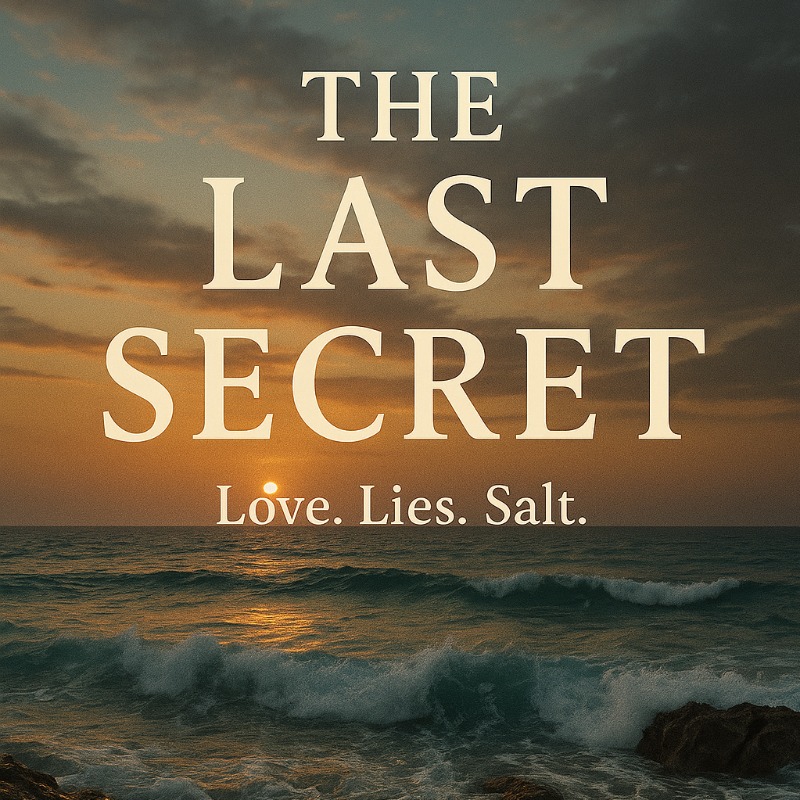
“Love. Lies. Salt.”
When I first met Lucas, he was standing alone under a streetlamp, the mist curling around him like a secret. We were both at the edge of something then — me, at the edge of admitting who I was; him, at the edge of the world he’d been trying to outrun.
I wasn’t looking for anything more than a warm cup of coffee and a place to rest my head. The city outside was drowning in rain, the streetlights shivering in puddles. I had just finished my shift at the bookshop — that cramped secondhand hole on Mariner’s Lane, where the dust outnumbered the customers.
Inside the Café Meridian, the smell of burnt espresso and old vinyl wrapped around me like a blanket. I always sat in the corner, behind a leaning tower of mismatched chairs, where I could watch the door without feeling like I was waiting for someone.
I noticed him right away — how could I not? He stood at the threshold like someone not quite sure he wanted to come in. He had this kind of restless grace — damp hair pushed back, collar turned up against the night, eyes scanning for exits even as he stepped forward.
He caught me staring. He smiled. And just like that, something shifted.
When he asked if he could sit with me, his voice was low, hesitant but warm. He didn’t ask my name. He didn’t have to. We didn’t talk much that first night. We didn’t need to. I remember thinking: This is someone who’s running from something. And for some reason, I wanted him to stop running — if only for the time it took us to share a pot of bad coffee.
It was just past midnight in the old part of town, where the cobblestone streets hold stories, they never confess. I had ducked into a café that stayed open all night — a refuge for insomniacs and ghosts like me. There are some things that hum beneath the skin, waiting to be recognized.
We talked about nothing at first — the music, the smell of rain, how the waitress always looked like she was about to cry but never did.
When the dawn crept in, Lucas said, “Walk with me?”
I did. And somewhere between the café and my apartment, we stopped pretending. His hand found mine. The night was so quiet I swear I heard our hearts collide.
By spring, we were inseparable. He moved in — a duffel bag and a box of records were all he brought. He never talked about where he came from. I never asked. Some things, I thought, were better left folded inside silence.
We found joy in the smallest things — cracked vinyl playing Whitney Houston while we danced barefoot in the living room, ramen at 2 a.m., making love as if the walls might collapse around us and we wouldn’t mind if they did.
Sometimes, I’d catch him staring at the door as though he was waiting for someone to break it down. When I asked, he’d kiss my neck and say, “I’m here. That’s all that matters.”
And I believed him.
It was late July when the heat turned cruel. The city was sticky with secrets. That night, I came home early from work. I planned to surprise him with tickets to a small concert — an excuse to be just us again, to drown out whatever was growing restless behind his eyes.
I heard voices before I reached the door — Lucas’s voice, sharp and low. Another voice, unfamiliar, cold like metal scraping stone.
I stopped just before the hallway corner. The door was cracked open. I leaned in.
“—We can’t do this here, Lucas,” the stranger hissed.
“I don’t have a choice,” Lucas snapped back. “He can’t know. He can’t.”
“You’re slipping. They’re watching. He’s a liability.”
My heart slammed against my ribs. My palms went slick. I should’ve walked in. I should’ve announced myself.
Instead, I listened.
“Pero doesn’t know anything,” Lucas said, softer now. My name in his mouth made my knees buckle. “He’s clean. Leave him out of this.”
“You know the rules.” There was a silence so dense I thought it would choke me.
Then the other man said, “You know what you have to do.”
I stumbled back down the stairwell, each step hammering the same word in my skull: What, What, What!!
I waited at the corner store until the lights in our apartment went out. I didn’t go back in. I didn’t know how to look him in the eyes and pretend I hadn’t just heard him weigh my life against whatever the hell he was running from.
When I walked in, Lucas was making coffee, humming to himself. He looked at me like he always did, like I was the only thing real in his life. I told myself it didn’t mean he hadn’t already decided what had to be done.
We didn’t talk about it. Instead, we clung to normality like it could save us. But the walls were thinner. His eyes darted to the windows more often. Sometimes he’d touch my face as if memorizing it for when he wouldn’t be allowed to touch me anymore.
One night, I asked him directly. “Who was that man?”
He froze. His thumb brushed my jaw. “No one.” I pressed harder. He kissed me instead.
I let him. I let him lie. Two weeks later, it all broke open.
I came home to find Lucas gone. The apartment door hung open. The coffee table overturned. A single sheet of paper lay on the floor: Stay away tonight. I love you.
I called him. Straight to voicemail. I waited an hour before I did the thing, I swore I’d never do — I went looking.
By morning, I had convinced myself I’d imagined it. I wanted so badly for it to be a dream — or a lie, a bad joke.
The Slow Becoming
Lucas became a habit. At first it was small — a text at midnight: You awake? A knock on my door when he knew I’d be too polite to turn him away.
I never asked what he did for work. He never asked why I lived alone with a bookshelf for a best friend. We invented excuses to stay up till dawn — card games, bad horror movies, half-finished bottles of cheap whiskey.
One night, sprawled across my floor, he said, “Do you ever wish you could just vanish?”
I looked at him — at the flicker of something haunted behind those green eyes. “Sometimes,” I said. “But then who would find me?”
He didn’t answer. He just leaned in and kissed me — soft, like a secret he didn’t want to say out loud.
Next day evening, I found him near the wet docks. He was arguing with the same man — the one with the cold voice. They didn’t see me. I stayed in the shadows, the mist curling around my ankles. This time I heard everything.
Lucas had been part of something bigger than us — bigger than love. Something about moving people, secrets, debts paid in blood.
They wanted him to disappear. They wanted me gone too — loose ends.
“You were supposed to kill him yourself,” the stranger said.
Lucas laughed, bitter. “I’d rather die.”
I stepped on a piece of broken glass. The sound cracked the night. Both heads turned. I saw Lucas’s eyes widen — the smallest, most shattered moment of fear and relief.
He didn’t call my name. He just mouthed it: Run. But I didn’t.
I wish I could say I was brave. I wasn’t. My hands trembled as the stranger pulled a gun. Lucas stepped in front of me. “Don’t,” Lucas said. “I’ll come with you. Just — don’t touch him.”
“Too late for that.” The gun lifted.
Time folded in on itself. I remember three things:
The way Lucas’s hand found mine.
The click of the safety.
His whisper: “I love you. Forgive me.”
Then he lunged.
There was a shot. Another. The night fractured.
When it was over, Lucas lay crumpled at my feet. The stranger was gone — maybe dead, maybe not. It didn’t matter.
I pressed my hands to Lucas’s chest. Warm blood. His eyes found mine, unfocused but sure.
“You should’ve run, Pero,” he rasped.
I shook my head. “Don’t you dare — you stay with me —”
He smiled. There was blood on his teeth. “It had to be one of us.”
I think I screamed. I don’t remember.
All I remember is him pulling my hand to his lips, one last time. “You were the only true thing,” he breathed. “Live for both of us.”
When he went still, the night swallowed every word that hadn’t been said.
Before Lucas met me
I wouldn’t learn the truth about Lucas until much later. But pieces slipped through.
In the middle of the night, he’d wake gasping, eyes wild like an animal cornered. He never said what he dreamed about. Once, half-asleep, he murmured a name: Ilya.
When I asked the next day, he laughed it off. Said it was a song lyric. A joke. A lie, I know now.
The truth was this: Before he found me, Lucas was Ilya. Ilya Mirov, son of a man whose name still made men whisper in dark corners. He grew up in Odessa, smuggled from dock to dock alongside crates marked with false manifests. His father’s trade wasn’t drugs or weapons — not at first. It was people. Information. The black market of secrets.
Lucas — Ilya — was the insurance policy. A boy who watched his father trade lives like poker chips until one night he decided he wouldn’t be a chip anymore. He fled across three borders with forged papers and a handful of cash.
But you don’t outrun men like his father’s men. You only buy time.
The Other Side of Love
We fell in love like people who didn’t believe in consequences. And maybe that was our sin.
Lucas liked to trace the lines of my palm. He’d tell me stories about the future — how we’d have a little shop by the coast, maybe sell books and coffee, keep the door open for stray cats and old friends. He painted a life where no one knew our real names because we wouldn’t need real names anymore.
And I let him. I let myself believe it because I wanted it to be true.
I didn’t notice the calls he’d take on the balcony, speaking in a language I didn’t understand. I didn’t ask about the nights he’d slip out after I’d fallen asleep, returning before dawn with salt on his skin and lies on his tongue.
I thought love would protect us. But love, I learned, is just the soft spot they aim for.
The Whisper
The night I overheard him, everything shifted. I know now that the man at the door — the one with the cold voice — was called Dima. He was more than just an old contact. He was family — the brother Lucas betrayed when he ran.
Dima had followed him across an ocean, pulling the leash tighter each time. He’d promised the family that Lucas would make good on the debts left unpaid. That he’d deliver one final name. One last betrayal.
Only Lucas refused. He gave them lies instead of names. He gave them me instead of compliance — my ordinary, boring life, a shield made of borrowed time.
When Dima came to collect, Lucas knew what it meant.
And when I heard the truth — that he had been ordered to kill me — I understood how much it cost him not to.
The Wet Docks
The confrontation at the wet docks wasn’t an accident. Lucas called Dima there. He planned to buy my freedom with his life. I see that clearly now — how he pulled me into the shadows of his war, hoping I’d never see the battlefield.
But true love is a battlefield too. And sometimes you stand your ground, even if you’re outmatched.
When I stepped out from hiding, Lucas’s face broke — this flash of terror and tenderness all at once. He knew then that the choice was made for him.
He’d been prepared to die for me.
He hadn’t been prepared to do it while looking into my eyes.
What Came After Lucas death
The bullet tore through him before I could move. Dima fell too, but I don’t remember seeing him hit the ground. All I saw was Lucas — gasping, clutching my hand like it was the only thing anchoring him here. He asked me to live. It wasn’t a request. It was his final command. I’ve kept it, mostly.
I told the police a version of the truth. A robbery gone wrong. No one asked too many questions. Dima’s body vanished before dawn. Lucas’s records, his forged passports — all gone. Like he’d never existed. But I know better.
He exists in every corner of my new life. In the smell of salt when the wind shifts. In the crackle of vinyl when Whitney Houston sighs through old speakers. In the hush before I fall asleep — when I swear, I feel him lie down beside me, whispering that final promise:
Live for both of us.
Interlude — Odessa, 1998
Before he was Lucas, before he crossed oceans and buried his name under a mountain of forged passports, he was Ilya Mirov — small for his age, wiry, with eyes too sharp for a child.
Odessa was a city of grey salt and rusted ships, where cargo disappeared and reappeared under different flags, and fortunes changed hands in backrooms that smelled of sweat and cheap cologne.
His father, Sergei Mirov, was not the kind of man who needed a title. People called him Batya — the father — not for warmth but because he could give your life or take it away with a nod. The docks were his cathedral. The customs officers, the dockworkers, the street kids who vanished into shipping containers bound for cities they’d never learn how to pronounce — all part of his congregation.
Lucas alias Ilya learned early that secrets were worth more than gold. He’d sit at his father’s knee while the men talked. Smugglers. Fixers. Couriers with trembling hands. He memorized routes and code words. By twelve, he could read the weight of a container ship by the bow’s dip in the waterline.
At night, he’d lie awake listening to the sea pound the dock pilings, wondering if he’d ever see what was beyond that black horizon.
He loved his mother the way a boy loves a ghost — fiercely and helplessly. She was the only softness in that hard-edged world. When she died of an infection too small to care about power, Ilya stopped asking permission for anything.
One winter, when the snow fell like ash, he found papers hidden in his father’s office — manifests, payoffs, names that should have stayed buried. He understood then that his father’s trade wasn’t just guns or stolen art or rare minerals.
It was people.
That was the first night he ran. He made it as far as the Moldovan border before his father’s men dragged him back. He came home with a split lip and new lesson: next time, he wouldn’t come back.
Dima’s Syndicate
Dima was older by two years — Ilya’s cousin by blood, brother by necessity. Where Ilya was all twitching nerve and restless plans, Dima was calm as a blade. Even when they were boys, Dima was the one who found the exit, made the bribe, silenced the guard dog.
When Sergei Mirov was arrested — betrayed by someone he’d once called son — Dima rose from the shadows. He took the scraps of his uncle’s empire and stitched them into something leaner, meaner. He didn’t just smuggle goods. He moved people — witnesses, defectors, children with no papers but priceless DNA. He sold secrets to governments and rebels alike. For the right price, he could make you disappear or make you matter.
When Lucas fled to the West, Dima didn’t chase him at first. Let the boy think he’d escaped. But syndicates don’t forget. They wait for debts to mature like bad fruit.
Lucas’s debt was simple: he knew where the bodies were buried — sometimes literally. He knew every drop point, every bribe, every name that could unravel the syndicate’s protection.
So, Dima made him an offer: return, hand over the loose ends, become the inside man in a new country. In exchange, freedom for the one soft thing Lucas had left — Pero.
But Lucas lied. He gave them false trails. He stalled. He built a tiny life with Pero like it might hold back the tide.
It couldn’t.
After Lucas died..
After the wet docks, after the shot that ended everything, I stayed in the city for a while. I told myself it was to sort out the paperwork, the lease, the final bills that come with death. Really, I stayed because I couldn’t make myself leave the last place; I’d seen him alive.
I slept on the couch because the bed was too full of him. I played his records at dawn and dusk — the same song on repeat until the needle scratched through silence. I read the books he left dog-eared on the nightstand, trying to find a note in the margins, a goodbye he never had time to write.
Eventually, the city turned cold. Faces blurred into strangers who asked if I was okay, and I lied, because grief makes you a good liar. I packed up what was left — the duffel bag, the box of records, the cracked mug with his lipstick stain on the rim.
I moved to the coast. Opened a secondhand bookshop just like we used to dream about. Some nights I think he’d hate it — so small, so quiet, so far from the restless, wide world he wanted. Other nights I think maybe he’d sit behind the counter, feet on my desk, humming along to Whitney Houston, telling me to lock up early so we could go dancing in the dark.
I still see him, sometimes. A shape in a doorway. A voice behind my shoulder. Maybe that’s how I know I haven’t forgotten how to love.
When I heard Lucas’s hiss Run. I didn’t run at first. I didn’t freeze in the shadows; didn’t break that brittle line he’d drawn between me and his war. But after, I ran down the pier and never looked back, even when the gunshot cracked the night in half.
I booked a bus before the sun came up. I left behind the apartment, the records, the memories we’d built like fragile glass towers. I changed my name in a city that didn’t know how to pronounce my old one. I found a tiny flat above a pawn shop. Learned to sleep with the door triple-locked. Learned to stop dreaming about Lucas — mostly.
Sometimes, when I see a man standing alone under a streetlamp, I think it’s him. Sometimes I wish it was. Sometimes I wish it wasn’t.
In this version, I lived. But I lost something bigger than life.
Some debts, you see, don’t get paid in blood. They get paid in memory — in what you’re willing to give up so the worst things don’t find you again.
I wonder which version Lucas would’ve chosen for me – the one where he dies for me or I run and he becomes the ghost at my shoulder. Both feel true and feel false. Toxic.
Maybe love is just the thing we choose to keep alive when the rest of the story is too heavy to carry alone.
The Letters by Lucas
It was three months after Lucas died that I found them.
I’d been too afraid to dig through his last things — his few shirts still folded the way he liked them, the duffel bag tucked under the bed, the half-burned passport hidden under a false name.
But the day I decided to leave the city for good, I found the envelope wedged behind the record player — four letters, tied with twine, my name Pero in his handwriting on each one.
The paper smelled faintly of smoke and him — cigarettes he never fully gave up, cheap cologne he stole off my dresser, the salt of our shared sweat.
I sat on the bare floor and read them one by one.
Letter One — If You Ever Find This
Pero,
If you find these, it means I didn’t keep my promise. Or maybe I did, depending on how you look at it. I don’t know how to say this without sounding like I’m trying to be forgiven. I’m not. You shouldn’t forgive me. I lied to you every day. But every day I lied; I loved you honestly. Does that count for anything? I hope so.
You made me want a life I’d already ruined before I met you. A life where I could buy milk at the corner store and complain about the neighbors playing music too loud. A life where we could grow old without looking over our shoulders for shadows with knives.
You gave me that — even if it was pretend. Even if it was stolen time. I don’t know how to thank you for that, so I’ll just say: I love you.
Yours — the truest lie I ever told,
Lucas
Letter Two — What You Don’t Know
Pero,
I want you to know the truth. I was born Ilya Mirov. My father owned half of Odessa’s underworld and thought he owned me too. He taught me to read ledgers before I read fairy tales.
I watched him break men with a word and promise heaven with the same mouth. I ran because I didn’t want to be him. Dima followed because he wanted to be better at being him than he ever was. They wanted me back because I know too much. Because I’m the one loose thread in a tapestry they need to keep looking perfect from far away. They asked me to trade your name Pero, for my freedom. I couldn’t. I wouldn’t. That’s why this ends the way it does.
Don’t blame yourself. Please, if you do nothing else — don’t turn your heart into my grave.
Live.
Yours forever love
Lucas
Letter Three — For When You’re Angry
Pero,
You’ll hate me. You should. You’ll wish I’d told you everything sooner. You’ll wish I’d trusted you with the whole of my mess. Maybe if I had, you’d have run when I told you to run. Maybe you wouldn’t have stayed to see it break apart. But I couldn’t. I was selfish. I wanted you to see me as something clean — someone worth saving. I wanted one part of my life to be untouched by the dirt I tracked in. You were that part. That’s why I kept the door locked between you and the truth. Burn this letter if it helps. Shout at the walls. Break the record player. Just don’t break yourself. If you hate me, hate me alive in your mind. Not dead in your veins.
Yours forever love
Lucas
Letter Four — If There’s Still a World After
Pero,
If you’re reading this one, maybe you survived everything I didn’t. Maybe you’re somewhere by the sea like we talked about. Maybe you still keep too many books you never finish. Maybe you’ve let someone in — a little — just enough to keep your bones warm when winter comes.
I hope so. You’re braver than you know. Kinder than I deserved. I hope you tell someone my story one day, not so they feel sorry for me — but so they know you were the best thing that ever happened to a ruined man. Don’t wait for my ghost to knock on the door. I’m not coming back. I’d rather be the salt in your hair, the chorus in a song you hum when you can’t sleep. That’s enough for me.
I love you..
Yours forever love
Lucas
Chapter Eleven — The Salt in My Hair
I read them again every year on the day the ocean turns mean and the wind shakes the old windows of my shop. Sometimes I wonder if he meant for me to find them or if he hoped they’d rot behind the record player, tucked away like so many of his secrets. Either way, they’re here. I’m here.
I don’t know if that’s what living means yet — maybe it’s enough to wake up and play the old Whitney Houston songs, to open the shop door, to greet whoever walks in with that small, fragile hope that not every stranger wants something they can’t give.
When the world goes quiet, I imagine Lucas here, reading over my shoulder.
And for now, that’s enough.
The Sea Takes It
I waited until winter turned the coastline raw again. Until the wind carved my cheeks and the salt stuck to my lips like an old promise. I didn’t plan it. I just woke one morning, packed the letters into an old tin box that once held loose tea, and walked down to the cove where the sea hits the rocks hardest. I read them one last time. Lucas’s handwriting was faded now, the paper soft at the edges from my trembling fingers. Each word was a small wound that healed and split again every time I looked at them.
I could’ve kept them. Maybe I should have. But the truth is, they were heavy — heavier than his ghost, heavier than the memory of his laugh echoing through the shop when he’d spin me around to Whitney Houston songs.
I sat on the wet sand until my jeans soaked through, until the tide curled around my boots like a patient hand.
“I kept you,” I whispered. “Long enough.”
I placed the tin box in a shallow hole where the sea would find it soon. I didn’t say a prayer — Lucas hated prayers. Instead, I just pressed my palm to the cold metal lid and felt the last warmth drain from my fingertips. Then I stood. The sea came for it — one wave, then another, until the sand collapsed and the letters slipped under, folded into salt and secrets and silence. I stayed until the sun broke over the water. When I turned back toward home, my pockets were empty.
He was gone — but so was the weight. Maybe that’s what love is: not what you keep, but what you finally learn to let the ocean carry away.
It’s been three years.
I live by the sea now. I keep his records stacked by the old turntable. Sometimes, when the wind is right, I play Whitney Houston and dance barefoot in the living room, alone with alone. I tell myself he’s still here — in the crackle of the vinyl, in the smell of rain, in the place where my heart used to be only mine. I overheard something I wasn’t meant to that night. I wish I hadn’t.
But if I hadn’t — I wouldn’t have known what love could cost. And what it was worth.
PERO’s Note
I know Lucas wasn’t a hero in the way people write about heroes. He was a man who lied, who ran, who broke. But he was mine. And in the end, he chose me over everything else. Maybe that’s what love really is — the thing you choose when you know it will cost you everything.
Epilogue
Sometimes, on the anniversary, I sit by the shore where we dreamed of running away. I watch the ships slip past the horizon and I think about how many secrets the sea has swallowed. How many ghosts it carries beneath its restless skin. I light a candle. I close my eyes. And I tell him everything I didn’t get to say.
Heartbroken and Deeply in Love
PERO..






 React
React