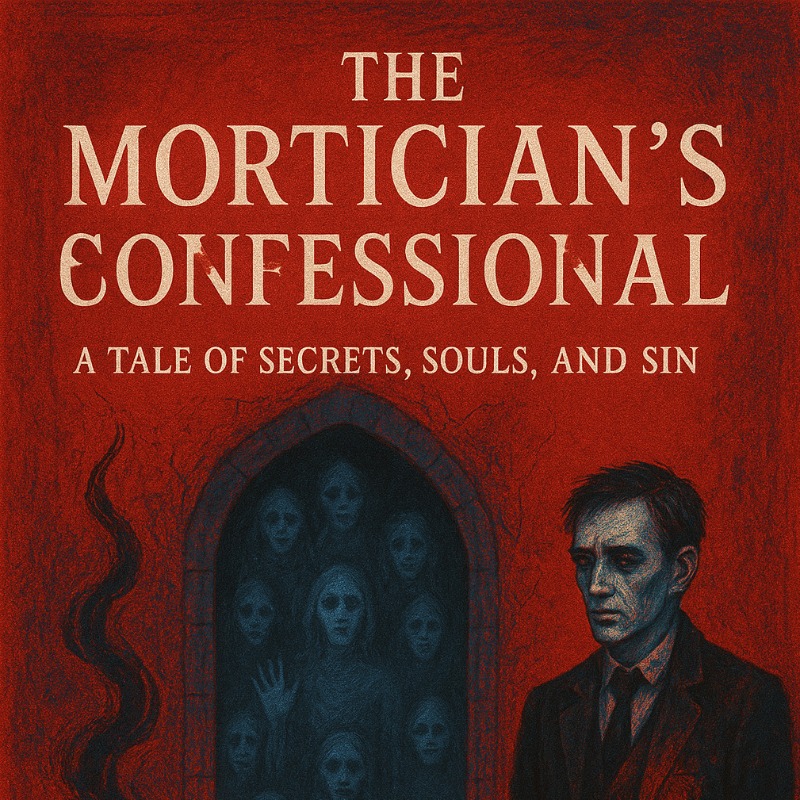
The funeral home's ventilation system wheezed like an old man's dying breath, but Mortimer Blackwood had grown accustomed to the symphony of death. Twenty-three years of preparing bodies for their final performances had made him intimately familiar with the sounds of endings—the gurgle of embalming fluid, the whisper of silk lining against mahogany, the muffled sobs of grieving families echoing through paper-thin walls.
What he wasn't accustomed to was the dead talking back.
It started with Mrs. Pemberton, the librarian who'd choked on a tea biscuit last Tuesday. Mortimer was adjusting her pearl necklace when he heard it—a voice thin as autumn smoke, drifting up from her blue-tinged lips.
"Tell them about the books, Mortimer. The ones I hid in the basement."
His hands jerked away from her throat as if she'd burst into flames. The chemical smell of formaldehyde couldn't mask the sudden stench of his own terror-sweat. He'd been in this business long enough to know that gases sometimes escaped from corpses, creating sounds that mimicked speech. But this... this was different.
Mrs. Pemberton's eyes remained closed, her expression peaceful as carved marble. Yet her voice continued, soft as graveyard whispers.
"The mayor's been stealing from the library fund. Decades of embezzlement. The evidence is in the rare books section, behind the Shakespeare folios. I was going to expose him, but then..."
Her voice faded like radio static, leaving only the familiar sounds of the funeral home. Mortimer's reflection in the embalming room's stainless steel sink showed a man twenty years older than his fifty-three years, hair white as bone dust, eyes wide with disbelief.
He'd always prided himself on being rational. Death was chemistry and biology, nothing more. Bodies were machines that had simply stopped working. But as he continued his work, sealing Mrs. Pemberton's lips with mortician's wax, he couldn't shake the feeling that something fundamental had shifted in his world.
The second incident came three days later with Tommy Hartwell, the seventeen-year-old who'd wrapped his motorcycle around an oak tree. Mortimer was reconstructing the boy's shattered face when Tommy's voice bubbled up through the reconstructed tissue.
"It wasn't an accident, Mr. Blackwood. Check the brake lines. Uncle Pete wanted the life insurance money."
The room tilted on its axis. Mortimer's surgical tools clattered to the floor in a metallic rainfall that echoed off the tile walls. The taste of copper filled his mouth—fear bleeding from his bitten tongue.
That evening, driven by a compulsion he couldn't explain, Mortimer drove to the police impound lot. The security guard, old Jim Peterson, owed him a favor from when Mortimer had prepared his wife's body without charge. Under the harsh fluorescent lights of the impound garage, they examined Tommy's mangled motorcycle.
The brake lines had been cut clean through.
"Jesus, Mort," Jim whispered, his breath visible in the cold air. "This is murder."
But when they tried to file a report, Detective Reynolds—Pete Hartwell's poker buddy—dismissed it as post-crash damage. The case was closed, the insurance paid out, and Pete Hartwell bought himself a new Cadillac within the month.
Mortimer began to understand that the dead weren't just confessing—they were begging for justice.
By the time Judge Hawthorne arrived—apparent heart attack during his morning jog—Mortimer was almost prepared. The judge's voice emerged before Mortimer had even begun the preparation, rich and authoritative even in death.
"The Riverside Development case. I took bribes to approve the toxic waste dump. Thirty families will die from cancer because of me. The documents are in my home safe—combination is my daughter's birthday backwards."
Under cover of night, he broke into Judge Hawthorne's mansion. The gothic revival house loomed against the star-drunk sky like a monument to corruption. Inside, the safe yielded its secrets easily—contracts, bribes, correspondence with chemical companies that painted a picture of environmental genocide.
But as he photographed the documents, Mortimer heard something that made his blood freeze. Footsteps on the marble floors above. The judge's family was supposed to be in Europe for the funeral arrangements.
He pocketed the most damning evidence and slipped out through the garden, but not before catching a glimpse of the intruders—men in expensive suits who moved like predators through the darkened house.
The confessions came faster now, as if the dead were eager to unburden themselves. Each corpse that rolled through his doors carried secrets that burned like acid in Mortimer's ears. The police chief who'd been selling confiscated drugs. The school principal who'd been embezzling from the lunch program. The doctor who'd been euthanizing patients for their inheritance.
But the most chilling revelation came from Father McKenna, the beloved parish priest who'd died in his sleep at age seventy-three. His confession made Mortimer's skin crawl like cemetery earth.
"The children, Mortimer. So many children over the years. The church protected me, moved me from parish to parish. The files are in the cathedral's basement, locked in the old confession booth. But there's more—they're still doing it. The network goes deeper than anyone knows."
That night, Mortimer couldn't sleep. He broke into the cathedral, descending into the basement that smelled of mildew and ancient shame. The confession booth—a relic from the 1800s—had been converted into a filing cabinet. Inside, he found decades of documentation. Children's testimonies, payoff records, transfer orders.
But he also found something else. Current files. Active cases. The network Father McKenna had mentioned wasn't just alive—it was thriving.
And at the centre of it all was a name that made his heart stop: Dr. Elisabeth Reeves, the town's beloved paediatrician.
The breaking point came on a rain-soaked Thursday when they brought in Elena Vasquez, the investigative journalist who'd been asking too many questions about the mayor's finances. Her official cause of death was drowning—a tragic accident while kayaking alone.
But Elena's voice cut through the funeral home's gloom like a blade through silk.
"They killed me, Mortimer. All of them. The mayor, the police chief, Judge Hawthorne. They've been running this town like their personal piggy bank for decades. I got too close to the truth."
Her words hit him like physical blows. The room spun, and he gripped the embalming table until his knuckles cracked like breaking bones. The smell of death mixed with the metallic tang of rain from the storm outside, creating a cocktail that made his stomach rebel.
"The evidence is in my apartment. Safety deposit box key taped under the kitchen sink. Box 247 at First National. Everything's there—bank records, photographs, recorded conversations. They think they buried the truth with me."
But Elena's confession didn't end there. Her voice grew stronger, more urgent.
"There's more, Mortimer. So much more. This goes beyond the town. Federal contracts, defence spending, human trafficking routes through the port. They're not just stealing money—they're selling souls."
She paused, and in that silence, Mortimer heard the ventilation system's wheeze take on a different rhythm. Almost like breathing.
"But the worst part," Elena continued, "is that you're not the first to hear us. There was another mortician before you. Harold Grimsby. He heard the voices too, tried to expose the truth. They made it look like a suicide, but Harold didn't kill himself. He was murdered because he listened to the dead."
The revelation hit Mortimer like a physical blow. Harold Grimsby—his predecessor, the man who'd trained him, who'd supposedly taken his own life twenty-three years ago. The man whose position Mortimer had inherited.
"Check the old records, Mortimer. Harold documented everything. He knew what was coming, hid evidence throughout the funeral home. The voices... they're not supernatural. They're something else entirely."
Mortimer's world tilted on its axis. He'd accepted the supernatural explanation because it was easier than facing the alternative. But now, with Elena's words echoing in his mind, he began to see the truth.
The funeral home's basement was a labyrinth of storage rooms and forgotten corners. Following Elena's ghostly guidance, Mortimer found Harold's hidden archive behind a false wall. File cabinets filled with documentation, photographs, audio recordings. Evidence of corruption going back decades.
But the most shocking discovery was Harold's journal, written in a hand that shook with terror:
"The voices aren't from the dead. They're from the dying. Dr. Reeves has been experimenting with near-death experiences, using a combination of drugs and electrical stimulation to extract information from subjects before they die. The subjects experience their deaths as confessions, their final moments spent revealing their deepest secrets. The process is supposed to be painless, but the subjects often survive just long enough to whisper their truths before the drugs complete their work.
"I've been complicit without knowing it. Every body that comes through my doors has been harvested for information. The 'natural' deaths, the 'accidents,' the 'suicides'—they're all murder, and I'm the one who covers up the evidence by preparing the bodies."
The journal's final entry was dated the day before Harold's supposed suicide:
"They know I know. Dr. Reeves came to see me today, offered me a choice—join them or join the dead. I told her I needed time to think. But there is no time. They're coming for me tonight. If anyone finds this, know that the truth is worth dying for. The dead deserve justice, even if they can't speak for themselves."
Mortimer's hands shook as he read the final words. The truth was more horrifying than he'd imagined. The voices weren't supernatural—they were the final gasps of murder victims, their last breaths stolen and weaponized by a conspiracy that reached into every corner of the town.
A soft sound made him freeze. Footsteps on the floor above, moving through the funeral home with practiced stealth. He'd been so engrossed in Harold's journal that he hadn't heard them enter.
"Mortimer?" Dr. Reeves' voice drifted down from the main floor, sweet as poisoned honey. "Are you down there? We need to talk."
He gathered Harold's evidence, stuffing it into a bag with trembling hands. The basement had a second exit—a delivery entrance that opened onto the alley behind the funeral home. Harold had mentioned it in his journal as an escape route.
But as Mortimer reached the door, he found it blocked by two men in expensive suits. Their faces were hidden in shadow, but their intentions were clear.
"Going somewhere, Mr. Blackwood?" one of them asked, his voice smooth as silk over steel.
Behind him, he heard Dr. Reeves descending the basement stairs, her heels clicking against the concrete like a countdown to execution.
"You know, Mortimer," she said, her voice echoing in the underground chamber, "Harold made the same mistake you're making. He thought he could expose us, thought the truth would set him free. But the truth is just another commodity in this town, and we control the market."
She emerged from the shadows, and Mortimer saw her clearly for the first time. Dr. Elisabeth Reeves, the woman who'd delivered half the babies in town, who'd comforted grieving families, who'd built her reputation on healing and hope. Her eyes were cold as winter graves, her smile sharp as a scalpel.
"The program has been very successful," she continued, circling him like a predator. "We've learned so much from our subjects. Financial crimes, political corruption, personal secrets—information is the most valuable currency in the modern world. And the dying are surprisingly forthcoming when properly motivated."
"You're insane," Mortimer whispered, his voice cracking like autumn leaves.
"Am I? We've created a perfect system. Subjects come to us with their secrets, we extract the information, and then we dispose of the evidence. The families get closure, the town gets rid of its problems, and we get rich. Everyone wins."
She gestured to the men flanking him. "These gentlemen represent some very powerful interests. Defence contractors, pharmaceutical companies, political organizations. They pay handsomely for the kind of intelligence we provide."
"What about the children?" Mortimer asked, thinking of Father McKenna's confession.
Dr. Reeves' expression didn't change. "Unfortunate collateral damage. Some subjects are more valuable alive than dead. The children provide ongoing leverage over important people. You'd be surprised how many politicians and business leaders become very cooperative when their darkest secrets are threatened with exposure."
"Why are you telling me this?" he asked.
"Because," Dr. Reeves said, producing a syringe from her coat pocket, "you're going to join our program. One way or another."
The needle glinted in the fluorescent light like a silver promise of oblivion. Mortimer recognized the syringe—he'd seen similar ones in Harold's photographs. The drug that induced near-death experiences, that made subjects confess their deepest secrets before dying.
"You can cooperate," Dr. Reeves continued, "and we'll make it quick. Or you can resist, and we'll make it... educational. The choice is yours."
But Mortimer had already made his choice. As Dr. Reeves moved closer, he pulled the fire alarm he'd spotted near the delivery door. The piercing wail filled the basement, echoing off the concrete walls like the screams of the damned.
In the chaos that followed, Mortimer smashed the fluorescent lights with Harold's bag of evidence, plunging the basement into darkness. He heard Dr. Reeves curse, heard the men fumbling for their weapons, heard the distant sound of sirens approaching.
But he also heard something else—the voices of the dead, rising from the darkness like a chorus of accusation. Mrs. Pemberton's voice, clear and strong: "The evidence is in the rare books section." Tommy Hartwell's voice, young and defiant: "Uncle Pete cut my brake lines." Judge Hawthorne's voice, heavy with remorse: "The toxic waste dump will kill thirty families."
The voices grew louder, more insistent, until they filled the basement with a cacophony of confession and condemnation. Dr. Reeves screamed, clapping her hands over her ears, but the voices seemed to come from inside her head.
Mortimer understood then. The drugs, the electrical stimulation, the near-death experiences—they'd created a feedback loop. The subjects' final moments were imprinted on the environment, replaying endlessly for those who knew how to listen.
The fire department arrived first, followed by the police. In the confusion, Mortimer slipped out through the delivery door, Harold's evidence clutched to his chest like a life preserver. Behind him, he heard Dr. Reeves still screaming, her voice joining the chorus of the dead.
But even as he ran through the rain-soaked streets, Mortimer knew his ordeal wasn't over. The conspiracy was too large, too well-connected to be brought down by a single mortician with a bag of evidence. He needed allies, needed people who would believe the impossible truth.
He thought of Elena Vasquez, the journalist who'd died trying to expose the corruption. Her apartment was across town, but he had her keys—taken from her personal effects before the funeral. The safety deposit box she'd mentioned was his only hope.
The apartment was a shrine to investigative journalism—walls covered with photographs, documents, and red string connecting various players in the conspiracy. But it was also a crime scene. The furniture was overturned, papers scattered, electronics smashed. They'd been looking for something.
Under the kitchen sink, exactly where Elena had said it would be, Mortimer found the safety deposit box key. But he also found something else—a hidden camera, still recording. Elena had been documenting everything, right up to the moment of her death.
The footage was damning. Dr. Reeves entering the apartment with her associates, searching for evidence, discussing Elena's "accident." But the most shocking revelation came at the end of the recording.
"The mortician's next," Dr. Reeves said, her voice clear on the audio. "He's been hearing the voices for weeks now. Harold's process worked better than we thought—the subjects' final moments are imprinted on the environment. Mortimer's been accessing the psychic residue without even knowing it."
"Should we eliminate him?" one of the men asked.
"No," Dr. Reeves replied. "He's more valuable alive. Think about it—a mortician who can hear the dead's final confessions. We could use him to extract information from subjects we thought were already tapped out. He's the perfect interrogation tool."
The recording ended, leaving Mortimer in stunned silence. They didn't want to kill him—they wanted to use him. He was to be their next weapon in a war against truth and justice.
But Elena had been one step ahead of them. The safety deposit box at First National contained more than just evidence of municipal corruption. It contained the names and addresses of federal investigators, journalists, and activists who'd been working to expose the conspiracy from the outside.
Among them was Agent Sarah Chen of the FBI, who'd been investigating a series of suspicious deaths in small towns across the country. Her business card was paperclipped to a note in Elena's handwriting: "Trust her. She's one of the good ones."
Mortimer called the number from a payphone outside the bank, his hands shaking as he dialed. The rain had stopped, but the night air was thick with the promise of more storms to come.
"Agent Chen," a crisp voice answered.
"My name is Mortimer Blackwood," he said, his voice barely above a whisper. "I think you've been looking for me."
There was a long pause. "Mr. Blackwood, we've been trying to reach you for weeks. Elena Vasquez gave us your name before she died. She said you might be able to help us understand what's happening in your town."
"It's worse than you think," Mortimer said. "They're not just killing people—they're harvesting their secrets. And I'm the one who's been listening to their final confessions."
Another pause. "Mr. Blackwood, I need you to listen carefully. You're in immediate danger. We've been monitoring communications, and there's a federal task force moving into your town tonight. Dr. Reeves and her associates are planning to clean house—eliminate all witnesses and evidence."
"What about the children?" Mortimer asked, thinking of Father McKenna's confession.
"We're working on that. But right now, we need you alive. You're the only one who can testify about what you've heard. The voices, the confessions—they're not admissible in court, but they've led you to evidence that is."
Agent Chen gave him an address—a safe house outside of town where he could wait until the task force arrived. But as Mortimer hung up the phone, he realized he couldn't leave. Not yet.
The voices were still calling to him, still demanding justice. And there was one more confession he needed to hear.
Back at the funeral home, the building was dark except for the glow of emergency lighting. The fire department had cleared out, but the police tape remained, fluttering in the wind like yellow ghosts. Mortimer slipped inside through the delivery entrance, making his way to the basement where Harold's evidence was still hidden.
But he wasn't alone. A figure sat in the shadows, waiting for him.
"Hello, Mortimer," Harold Grimsby said, his voice exactly as Mortimer remembered it. "I've been waiting twenty-three years to tell you the truth."
Mortimer's heart hammered against his ribs. Harold looked exactly as he had the day he died—the same lined face, the same gentle eyes, the same mortician's apron stained with decades of service.
"You're dead," Mortimer whispered.
"Yes," Harold agreed. "But death isn't the end, Mortimer. It's just another beginning. The voices you've been hearing—they're not echoes or psychic residue. They're the souls of the murdered, trapped between worlds by the violent nature of their deaths."
The basement felt colder, and Mortimer could see his breath in the air. The fluorescent lights flickered, casting dancing shadows on the walls.
"Dr. Reeves' experiments didn't just extract information," Harold continued. "They damaged the boundary between life and death. The subjects' souls became anchored to the physical world, unable to move on until their stories were told."
"Why didn't you tell me this when you were alive?"
Harold's expression was sad. "Because I was a coward. I knew the truth, but I was too afraid to act. So I hid the evidence and hoped someone else would find it. But they killed me before I could confess."
"Then how—"
"Because you're not just hearing the dead, Mortimer. You're one of us now. Dr. Reeves' syringe found its mark after all."
Mortimer looked down at his chest, where a small puncture wound was visible through his shirt. The needle had been quick, so quick he'd barely felt it. The drug was already working its way through his system, inducing the near-death state that would allow Dr. Reeves to extract his secrets.
"But I'm still alive," he protested, even as he felt his heartbeat slowing.
"For now," Harold said. "But the process is irreversible. You have maybe an hour before the drug completes its work. One hour to set things right."
The basement began to fill with other figures—Mrs. Pemberton, Tommy Hartwell, Judge Hawthorne, Father McKenna, Elena Vasquez. All the voices he'd heard, all the confessions he'd recorded. They stood in a circle around him, their faces pale as moonlight.
"We can't move on," Elena said, her voice echoing in the cold air. "Not until justice is served. But we can't act directly in the world of the living. We need someone who's between worlds, someone who can hear us and act on our behalf."
"Someone like you," Tommy added. "Someone who's dying but not yet dead."
Mortimer understood. This was why he'd been chosen, why he'd been able to hear the voices. He wasn't just a mortician—he was a bridge between the living and the dead, a conduit for justice that transcended the grave.
"What do you need me to do?" he asked.
"Dr. Reeves is upstairs," Harold said. "She thinks you're unconscious, that the drug has you in its grip. But she's wrong. You're stronger than she knows, and you have allies she can't see."
"The federal task force—"
"Won't arrive in time," Elena interrupted. "Dr. Reeves has been monitoring their communications. She knows they're coming, and she's prepared. But she doesn't know about us."
The circle of the dead began to move, their forms becoming more solid, more real. Mortimer felt their strength flowing into him, their combined will giving him power he'd never imagined.
"Together," Mrs. Pemberton said, her voice strong and clear. "We can stop her. We can make her pay for what she's done."
Mortimer climbed the stairs to the main floor, the dead following behind him like a silent army. The funeral home was darker than usual, the shadows deeper and more alive. He could hear voices from the preparation room—Dr. Reeves and her associates, discussing their plans.
"—body will be cremated immediately," Dr. Reeves was saying. "No evidence, no investigation. Just another grieving mortician who couldn't handle the stress."
"What about the federal agents?" one of the men asked.
"They'll find nothing. We've cleaned out everything, destroyed all the evidence. By tomorrow, this will all be just a bad dream."
Mortimer stepped into the preparation room, the dead spreading out around him like wisps of fog. Dr. Reeves was bent over a body on the table—his own body, he realized. The drug had separated his consciousness from his physical form, allowing him to exist in both worlds simultaneously.
"Actually," he said, his voice carrying the weight of the grave, "I think you'll find that some dreams never end."
Dr. Reeves spun around, her eyes wide with shock. "Impossible. You should be unconscious. The drug—"
"The drug worked exactly as intended," Mortimer said, stepping closer. "It separated my soul from my body, allowing me to hear the voices of all your victims. And they have something to say."
The temperature in the room plummeted. Ice crystals formed on the windows, and the overhead lights flickered like dying stars. The dead began to speak, their voices joining together in a chorus of accusation.
"Margaret Pemberton," Mrs. Pemberton's voice rang out. "Murdered for trying to expose municipal corruption."
"Tommy Hartwell," the boy's voice added. "Killed for his inheritance money."
"Judge Hawthorne," the judge's voice continued. "Forced to participate in environmental genocide."
One by one, the dead recited their stories, their voices growing stronger with each confession. Dr. Reeves stumbled backward, her face pale as winter frost.
"This isn't possible," she whispered. "The dead don't speak."
"They do when they have something important to say," Mortimer replied. "And your victims have been waiting twenty-three years to tell their stories."
The men with Dr. Reeves drew their weapons, but the guns were useless against enemies who were already dead. The spirits of the murdered surrounded the living, their presence dropping the temperature even further.
"You want to know the truth about death, Doctor?" Harold Grimsby stepped forward, his form solidifying until he looked almost alive. "Death is just another state of being. And we've been watching you. Waiting for the right moment to act."
Dr. Reeves backed against the wall, her breath coming in short gasps. "What do you want?"
"Justice," Elena Vasquez said, her voice cutting through the cold air like a blade. "We want you to confess. All of it. Every murder, every conspiracy, every life you've destroyed in the name of profit."
"I'll never—"
But Elena was already moving, her spirit flowing into Dr. Reeves like smoke into lungs. The doctor's eyes rolled back, showing only whites, and when she spoke again, it was with Elena's voice.
"Dr. Elisabeth Reeves. Forty-seven years old. Graduated medical school in 1995. Began experimenting with near-death experiences in 2001. First murder was Harold Grimsby, who discovered the program and threatened to expose it."
Dr. Reeves fought against the possession, but Elena's spirit was too strong. The confession continued, detailing decades of murder, corruption, and conspiracy. The words poured out in a torrent of guilt and revelation.
"The children," Elena's voice said through Dr. Reeves' lips. "Taken from their families, used as leverage against politicians and business leaders. Hidden in the basement of the old church, drugged and terrified. So many children, so many lives destroyed."
The confession lasted for over an hour, each word recorded by the digital recorders that Mortimer had hidden throughout the funeral home. When it finally ended, Dr. Reeves collapsed to the floor, her body convulsing as Elena's spirit withdrew.
"It's done," Elena said, her form beginning to fade. "The truth is finally out."
One by one, the dead began to disappear, their spirits finally free to move on. Mrs. Pemberton smiled at Mortimer before vanishing into the light. Tommy Hartwell gave him a thumbs up. Judge Hawthorne nodded solemnly. Father McKenna made the sign of the cross.
Harold was the last to go. "Thank you," he said, his voice growing distant. "For finishing what I started. For giving voice to the voiceless."
"What about me?" Mortimer asked. "Am I dying too?"
Harold's smile was gentle. "That's up to you. The drug has done its work, but you're stronger than Dr. Reeves realized. You can choose to follow us, or you can choose to live. Either way, you've earned your rest."
As Harold faded away, Mortimer felt a choice crystallizing in his mind. He could feel his physical body in the next room, suspended between life and death. One choice would reunite him with his body, allowing him to testify about what he'd experienced. The other would let him join the dead, finally finding peace after a lifetime of preparing others for their final journey.
But the choice was made for him when Agent Chen burst through the door with a team of federal agents. They'd been monitoring the funeral home, had heard every word of Dr. Reeves' confession.
"Mr. Blackwood!" Agent Chen called out. "Where are you?"
Mortimer looked down at his translucent hands, then at his body on the preparation table. The drug was wearing off, and he could feel himself being pulled back into the physical world.
"I'm here," he said, his voice growing stronger as his spirit reconnected with his flesh. "And I have a story to tell."
The aftermath was everything Elena had predicted. Dr. Reeves' confession, combined with the evidence Harold had hidden and the documentation Elena had gathered, brought down the entire conspiracy. Federal agents raided the old church, rescuing seventeen children who'd been held captive for years. The mayor, the police chief, and dozens of other officials were arrested.
The story made national headlines. A small town's decades-long conspiracy of murder and corruption, exposed by a mortician who could hear the voices of the dead. The media called it everything from a miracle to a hoax, but the evidence was undeniable.
Mortimer testified before Congress, his recorded confessions of the dead serving as a roadmap for investigators. The children were reunited with their families. The toxic waste dump was cleaned up. The stolen money was recovered and returned to the community.
But for Mortimer, the most important moment came six months later, when he stood in the funeral home's preparation room—now converted into a memorial for the victims—and heard only silence.
The dead had finally found peace. Their voices were stilled, their stories told, their justice served. And Mortimer Blackwood, the mortician who'd learned to listen to the dead, finally learned to live with the living.
The funeral home was sold to a national chain, its dark history transformed into a lesson about the power of truth and the importance of listening to those who can no longer speak for themselves. Mortimer retired to a small cabin in the mountains, where he wrote a book about his experiences and established a foundation to help families of murder victims.
But sometimes, on quiet nights when the wind whispered through the trees, he could still hear them—faint echoes of voices calling out for justice, for truth, for someone to listen to their final words.
And Mortimer Blackwood, the last mortician to hear the dead's confessions, would always be ready to listen.






 React
React