They thought I was just the janitor. But I saw it all. I was a nobody though.
I understood Every lie. Every bruise hidden under sleeves. Every laugh that curled like a blade. I saw what they did to her long before she fell from the rooftop.
Malia Kenny didn’t just die by accident, and what happened to her wasn’t just high school drama. It was cruelty masked by good press. A glossy institution rotting from the inside. It was murder wrapped in silence, privilege.
And I? I was the just the janitor.
Which meant I was everywhere and nowhere. And I — just watched.
I cleaned the halls of a school that smiled for magazines and hid knives behind its teeth. Students in tailored uniforms, faculty with polished degrees, parents with legacy seats on the board. A prestigious school, they said. A place where futures were built.
But I saw the truth.
I saw the bribes, the fake grades, the students who paid for essays with silence or something worse. I saw teachers looking the other way while students drank in bathrooms, harassed classmates, touched without consent. And I saw how the school protected them all — because they had money, influence, or last names that mattered.
The school used to stand for something — or so the plaques on the walls claimed. A place of learning, excellence, moral grounding. But the good ones — the teachers who cared, the students who tried and gave the school its name, they vanished. Left for better places, or were pushed out. And some graduated. Now, what remained was a decaying shell run by entitlement.
The classrooms turned into marketplaces for grades; students could pay or flirt their way to an A. Bullying wasn’t just tolerated — it was performed, applauded. The school became a haven for sexual misconduct, harassment swept under office rugs, and rumors paid for in silence. Drugs passed hands in toilet stalls. Teachers flirted with students behind locked doors for money. And still, the school wore its badge of prestige, spotless in the headlines, rotten at its core.
How the flow of time creates maniacs.
Then came Malia. Malia Kenny.
She was quiet at first. Kept her head down. Wore the same worn shoes every day and carried books heavier than her voice. She wasn’t from money. That much was clear. But she had something more dangerous in this school: a conscience.
Malia was obsessed with school, she sacrificed a lot to be a part of the prestigious school, but became fed up with what her eyes forced her to see. She built a secret blog. Anonymous at first, but sharp and unafraid. She wrote about the cheating, the abuse and the predators in prefect uniforms and the teachers who did nothing. She kept it factual, but clear. She documented it all, names, Incidents. Screenshots.
Then one day, she uploaded a full exposé: "The Fall of the Ivory Tower."
It went viral within the school. Teachers panicked, students whispered, some feared her and others plotted. They wanted to know who had betrayed their perfect little stainless world.
And then one day, I received a message.
It was short. No greeting. Just:
“Mr. Roland. I know you see everything. I don’t know who else to ask. I need advice.”
I stared at the screen for a long time. I’d never gotten a message like that. Not from a student. Not one who knew what I knew.
We met later that afternoon, when the halls were emptying out. She approached me by the stairwell where I was sweeping.
"Was it a mistake?" she asked, eyes wide, hands trembling. "Speaking out?"
I looked at her for a long moment. I wanted to say so much — that she was brave, that she was doing what no one else dared. But also that this school didn’t reward truth. It buried it.
Instead, I said something simple.
Something I thought would help.
“If they’re trying to push you down… maybe it’s time you stood taller.”
She nodded. Once. Slowly. Like she had been waiting for someone to tell her exactly that.
Then she walked away — shoulders straighter, head a little higher.
At the time, I felt relief. Like maybe I’d done the right thing. Maybe those words had given her the courage she needed to keep going.
But by the next week, it all fell apart.
Malia got caught.
Somehow — maybe carelessness, maybe betrayal — they traced the blog back to her. It spread like wildfire. Students huddled in groups whispering her name. Teachers glanced sideways in the halls. And the administration? They didn’t investigate the accusations — they investigated her.
I saw it unravel in real time.
One day she passed me in the corridor — I barely recognized her. Her uniform hung loose on her frame. Her eyes were shadowed by deep, dark circles. The way her shoulders slouched, it was like the world had doubled in weight. She looked like someone wading through fire alone. And that was the day the deep void fell upon me.
And the school? It tightened its smile and turned away.
Parents demanded the blog be deleted. Teachers who were named denied everything. One threatened legal action. The head girl — one of the accused — gave a speech at assembly about “protecting the dignity of the school.”
They called Malia a liar.
Said she was unstable. Attention-seeking. Ungrateful for the scholarship they “graciously gave her.”
The community followed suit. Students printed out screenshots of her blog and plastered them on lockers with the word “SNITCH” written in red marker. I found one stuck to the inside of a bathroom stall door. Another crumpled in the trash beside her classroom.
She walked the halls like a hunted thing. And I?
I said nothing — I did nothing.
I thought maybe she’d pull through. That someone — a parent, a teacher, anyone — would do the right thing. But they didn’t. No one did.
And then came the last evening.
I was on the third floor fixing a faulty light when I heard hurried footsteps on the stairs. I followed instinctively, not knowing why.
The rooftop door was ajar.
I stepped out and saw her — Malia standing near the edge, facing three students. All seniors. All protected. One was a minister’s daughter. One was a star athlete. The last was the brother of the boy who exposed her.
I couldn’t hear everything — but I heard enough.
"You wanted to ruin the school?" "You thought telling the truth would make you a hero?" "Jump. Or we’ll help you."
She didn’t scream.
She looked calm. Too calm.
Like someone who had taken advice to heart — and carried it somewhere too far.
I stepped forward, frozen.
She didn’t see me.
And then — a shove.
She was gone.
I called for help. I climbed down, heart thudding like a drum in my chest. When I reached her, she was still breathing. Just barely.
I held her hand.
She didn’t blink. Didn’t speak.
But in her eyes, I swear, I saw the question: Did I stand tall enough?
The school called it suicide.
They said she was troubled. Quiet. That there had been “signs.” They offered flowers. A candlelight vigil. The blog was wiped. The truth buried under a freshly printed memorial poster.
And me?
I went back to sweeping.
But nothing is clean.
Not really.
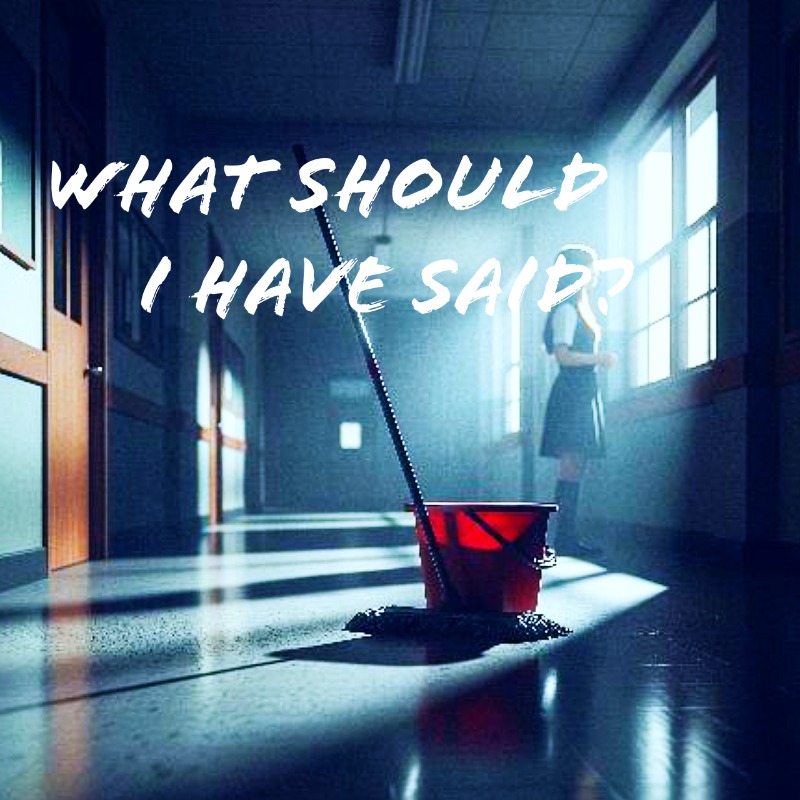
Every tile remembers her footsteps. Every creak in the rooftop door sounds like her name. Her face returns to me in the mop water. Her voice echoes in the silence of empty classrooms.
I think back to that afternoon — to the moment she asked me what to do.
And I wonder: What if I’d just said, “Stay low until the right people listen”?
What if I’d told her not to fight alone?
But instead, I told her to stand tall.
And maybe that’s what she did — on the edge, head held high, believing it meant something.
Now I spend my days wiping down a school that smiles for magazines and hides knives behind its teeth.
They thought I was just the janitor.
But I saw it all.
And I said the wrong thing.
Now I sweep the devil’s playground with a guilt I’ll carry for the rest of my life.






 React
React