The Whisper in the Halls of Anankē
A Metaphysical Jargonic Story — 1000 Words
There are moments that don’t exist in time but in syntax—misplaced commas in the paragraph of reality. I lived such a moment the night I heard the Whisper in the Halls of Anankē.
It was not meant for me.
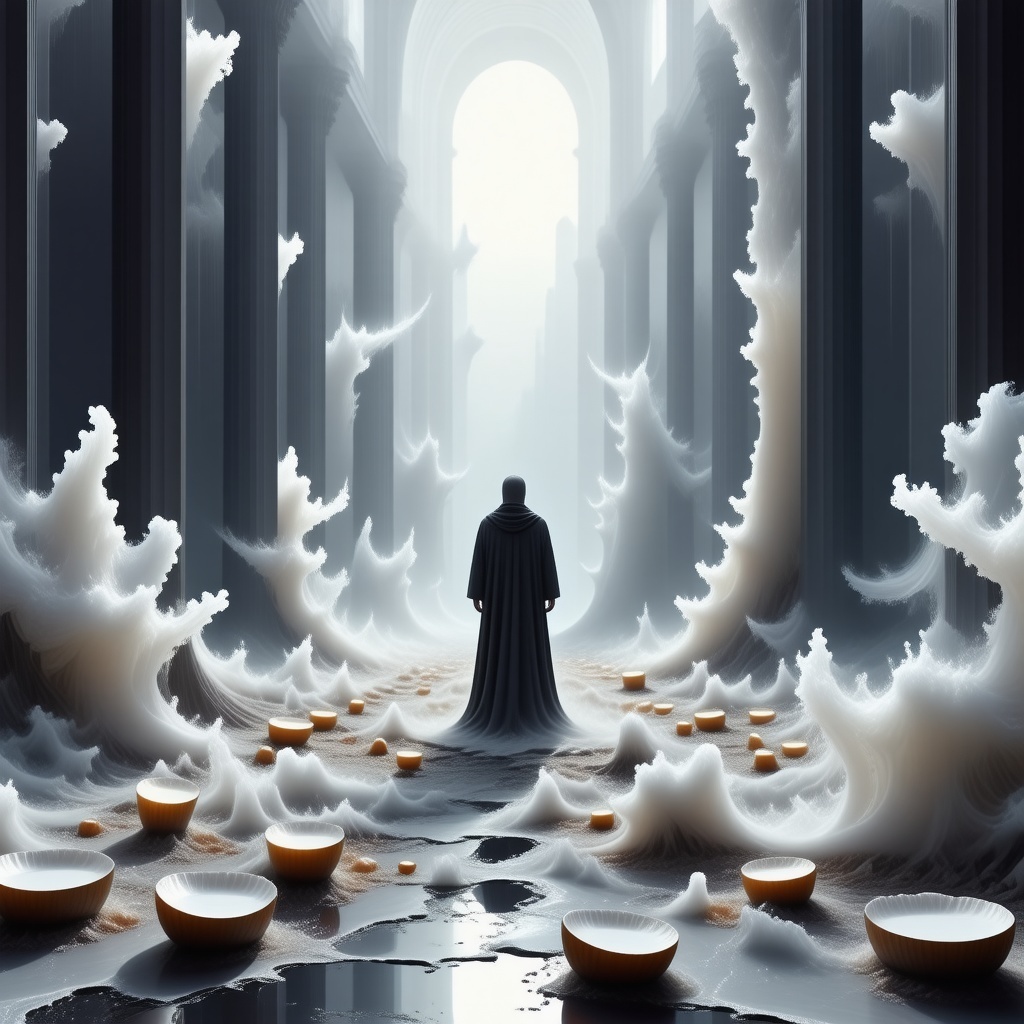
I was a metaphysical custodian—licensed by the Ontotemporal Guild, tasked with sweeping residual paradoxes from the Cathedral of the Aeonic Chorus. The cathedral, an ancient resonance structure, stood atop an ontic faultline. Prayers there echoed not through space, but through meaning itself.
My duties were simple: monitor the Archive of Misheard Truths for semantic echoes, collect leftover fragments of expired realities, and ensure nothing unspoken became audible. But that evening, something unclassified breached containment.
A syllable. A vibration. A forbidden utterance.
It said, or perhaps became:
“Chronomorphosis is a lie. The gods were decoupled in error.”
No sound followed. No echo. Only silence shaped like confession. I stood frozen. Not in fear, but in existential misalignment. The Whisper had pierced the veil of syntactic logic. It hadn’t just entered my ears—it embedded itself in my consciousness like an unresolved metaphor.
---
By morning, I had been flagged.
The Surveillance Templars of Causal Integrity arrived before the sun could alphabetize the shadows. I was indicted for chronocleptic privity—the unsolicited reception of a temporally sensitive truth. Though I had not sought the whisper, the act of hearing was a participatory breach. In metaphysical law, comprehension is complicity.
“You now contain a destabilizing clause,” the Archmandate declared. “You must be rewritten.”
I was sentenced to Jargonic Immersion Therapy.
A semiotic helix was implanted in me, warping every thought through recursive abstraction. I could no longer think in plain logic. I could not form direct memories. Every idea became wrapped in metaphor, nested in irony, filtered through self-defeating digressions. My speech became dense, recursive, beautiful—and utterly incomprehensible.
This was the punishment: not to forget the truth, but to be unable to express it.
The Whisper, though, remained intact.
It echoed in silence, reshaping the architecture of my unspoken mind. I was free in body, but trapped in a sentence I couldn’t finish.
---
In exile, I lived among the Damaged Hermeneuts—those who had heard too much, misread the divine footnotes, or glimpsed the index of the unspeakable. We dwelled in Palimpsest Heights, where every building was made of rewritten intentions. There I met others: a child who had mispronounced a divine constant; an old man who had heard Death’s epilogue; a woman who sneezed during a sacred silence and inhaled an unfinished revelation.
Then came the night of the hemorrhaging aurora.
A figure appeared—wrapped in robes made of citations and footnotes. His face was a mosaic of redacted names.
He called himself The Editor.
“You,” he said, “did not collapse under the Whisper. You’re stable. Ambiguity preserved you.”
“What do you want?”
“To offer you an edit.”
He handed me a scroll, sealed with paradox. Within: a map not of lands, but of grammar-planes—realms where language shaped reality and every soul was a clause in a sentence yet to be finished. One symbol shone brighter than the rest:
æ — The Unwording.
I followed the map.
Past the boundaries of cognition, beyond dialect forests and forgotten tenses, I reached the door—a threshold carved from the silence between synonyms. It opened without sound, inviting me into a realm of inverted syntax.
There, I encountered a mirror—not of glass, but of discourse. It reflected not my face, but a version of me who had made a different choice.
He had spoken the Whisper aloud.
His world had reshaped itself into crystalline clarity, every ambiguity burned away. He had achieved ultimate knowledge. Then watched as meaning itself collapsed under the weight of its perfection.
“The truth,” he said, “was incompatible with continuity.”
“And silence?” I asked.
“Preserves imperfection. And thus, life.”
We reached toward one another. Across the discourse mirror, our timelines touched—two clauses folding into one another. In that moment, the Whisper dissolved—not into forgetfulness, but into recontextualization.
It was no longer a truth I carried.
It was now part of the structure I belonged to.
I woke once more in the Archive of Misheard Truths. The room was quiet. But the silence had changed.
I had not erased the Whisper.
I had become the pause it left behind.
Now, I teach. Not as a custodian, but as a semiotic pilgrim. I guide initiates through the Art of Lucid Unknowing—the discipline of preserving ambiguity without rejecting meaning.
“Knowledge,” I tell them, “is not always for the present tense. Let it age. Let it ferment in subjunctive mood. When it ripens into silence, then, perhaps, it can be spoken.”
They ask me my name.
I reply with a metaphor:
> “I am a parenthesis in the syntax of becoming.
A question mark that chose not to punctuate.
Not the voice. Only the resonance.”
Sometimes, I dream.
In the dream, the gods return—not as beings, but as grammatical structures. One is a conjunction. Another, a possessive determiner. One god takes the shape of an unresolved sentence.
They speak nothing.
Yet in their silence, the Whisper breathes again.
And I remember—
I am no longer a custodian of forbidden knowledge.
I am the unfinished sentence.
And the world still waits...
...for its clause to end.