Title
⸻
Sub title
A Story of Love, Loss, and the Quiet Power of Forgiveness
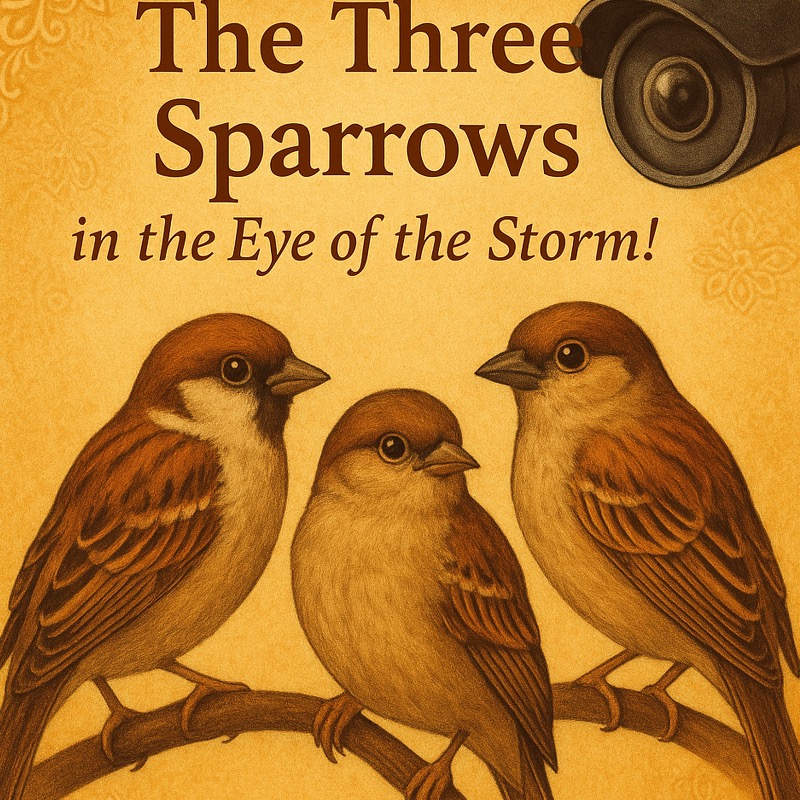
We were the three sparrows—my sisters and I. That’s what my parents called us, lovingly, as we fluttered around them in our childhood home. We grew up in the warmth of their care, in a house that echoed with laughter, Sunday lunches, shared festivals, and stories told under the whirring ceiling fan.
Then we flew the nest—one to the West, one to the East, and me somewhere in between. Different time zones. Different continents. But somehow, the thread held. We called. We laughed. We remembered. Our family bond was strong, like the roots of an old tree that still nourished each of us, no matter how far we grew.
My parents remained in our family home, living independently with each other’s unwavering support. My father was the quiet strength of the house, and my mother, the gentle rhythm that kept it alive.
Then came COVID.
The virus swept through the world like a storm. When it reached our doorstep, it hit us hard. My father fell ill. I wasn’t there. None of us were. Flights had stopped. Borders had closed. But I did what I could—I reached out to every contact I had, and a kind relative helped us secure a hospital bed. That in itself felt like a miracle. Beds were being sold at a premium. People were dying in waiting rooms. It was a time when humanity bent under pressure.
My father was admitted. He was given care. We hoped. We prayed. But the virus was stronger.
We lost him.
And I lost a part of myself that day.
We couldn’t attend the funeral. We couldn’t hold each other or our mother. We couldn’t even say goodbye. Grief, in those days, was a lonely thing. It sat silently beside you, over Zoom calls and WhatsApp messages. It lingered in the pauses between conversations.
After he passed, Amma was alone in that big, empty house. The silence was loud. The same halls that once echoed with conversations now felt unbearably still.
Worried for her safety and peace of mind, we decided to install security cameras in the house. It seemed like the best we could do from a distance. The app was installed on my phone. I’d check in regularly—just a glance to see if she was okay. Sometimes I’d see her watering the tulsi plant, sitting by the window, or dozing in the armchair. It comforted me. She was there. Still strong.
Time moved slowly, then all at once.
Eventually, borders opened, and travel resumed. We planned a long-awaited family reunion at Amma’s place. It was the moment we had longed for—a return to something familiar. To see each other. To be whole again, even if one seat would forever remain empty.
Around that time, we also installed a camera at my home. With my husband often away and the kids becoming more independent, I felt it was wise. I used the same app. The same password. It was simple. Familiar.
I didn’t think twice.
But unknowingly, that tiny decision connected all the dots I hadn’t meant to connect. Since my sisters had the app to monitor Amma’s home, my house feed became visible to them as well.
Their homes also became visible to me.
None of us realised it. We were busy, caught up in the joy of finally being together, trying to fill the space that loss had created.
And then, one day, I opened the app.
I was intending to check on Amma, just a quick look before bedtime. But instead, I tapped a different camera—my sister’s. I didn’t notice at first. Her kitchen came into view. Familiar voices filled the screen. I froze.
They were talking. About me.
It wasn’t venomous. But it wasn’t anything either. Little comments. A private joke. A sigh. A remark about something I’d said. Something I’d done. Words spoken when people feel safe, when they assume the listener isn’t in the room.
But I was.
And I wasn’t supposed to be.
My heart sank. I didn’t want to hear more, but I couldn’t un-hear what I already had.
I closed the app, but it was too late. The words lingered. And with them came doubt. Was that what they thought of me? Had they always felt this way?
I didn’t tell them. How could I? Wouldn’t it make things worse?
So I said nothing. I carried it quietly. I smiled at the reunion. I laughed when expected. But something inside me had shifted.
I began to pull away—not in anger, but in self-preservation. Just a little space. Just enough to protect whatever hadn’t been bruised yet.
That’s the thing with love—it makes you vulnerable. And technology, for all its benefits, can sometimes be a doorway to hurt you were never supposed to walk through.
Days turned into weeks, and the ache stayed. I replayed their words in my mind more times than I’d like to admit. But I also began to reflect.
Hadn’t I done the same? Venting to one sister about the other? Making flippant comments without thinking? Haven’t we all, in moments of frustration or fatigue, said things we didn’t truly mean?
And hadn’t I always believed that forgiveness was a form of strength?
One evening, I sat with Amma. She was watching the sunset from her chair, a quiet calm in her eyes.
“You know,” she said suddenly, “your father and I had our share of fights too. We said things sometimes… things we didn’t mean. But we never held onto them. We forgave before the day ended. That’s how we stayed whole.”
Her words nestled gently into my heart.
In that moment, I realised something important: I had a choice. I could carry the hurt, let it grow into resentment, and build walls between myself and the people I loved. Or—I could choose to understand. To forgive. To believe that love is not the absence of flaws, but the courage to look past them.
So I called my sisters.
I told them everything. About the camera. About what I heard. About how it made me feel.
There was a long silence.
Then came the apologies. Not excuses—just honest, heartfelt regret. And tears.
We spoke for hours that night. We cleared old cobwebs, revisited buried misunderstandings, and acknowledged how fragile love can be when bruised by assumption.
The next day, we changed all our camera settings. New passwords. Separate accounts. But more importantly—we opened a new window in our hearts. One that lets in light instead of suspicion.
Because at the end of the day, we are still the three sparrows. Still circling Amma. Still tied to each other by more than just blood or memory. We are bound by love—and now, by forgiveness too.
⸻
What I Learned
Not all things are meant to be seen. Not all words are meant to be heard. Privacy, even within families, is sacred.
Technology is a gift—but only when used with care. A single password can unlock more than just a camera—it can reveal hearts unguarded, moments misunderstood, and relationships that need mending.
But here’s the thing: hurt doesn’t have to be the end of the story. It can be the beginning of healing, if we let it.
If you’ve ever felt betrayed by what you heard or saw unintentionally, I hope you find the courage to speak—not in anger, but in vulnerability. And if you’ve ever been on the other side of that moment, I hope you meet it with grace.
Because love, like family, is messy. It’s made of truth and tenderness, hurt and healing. But most of all, it’s made of the choice to begin again.






 React
React