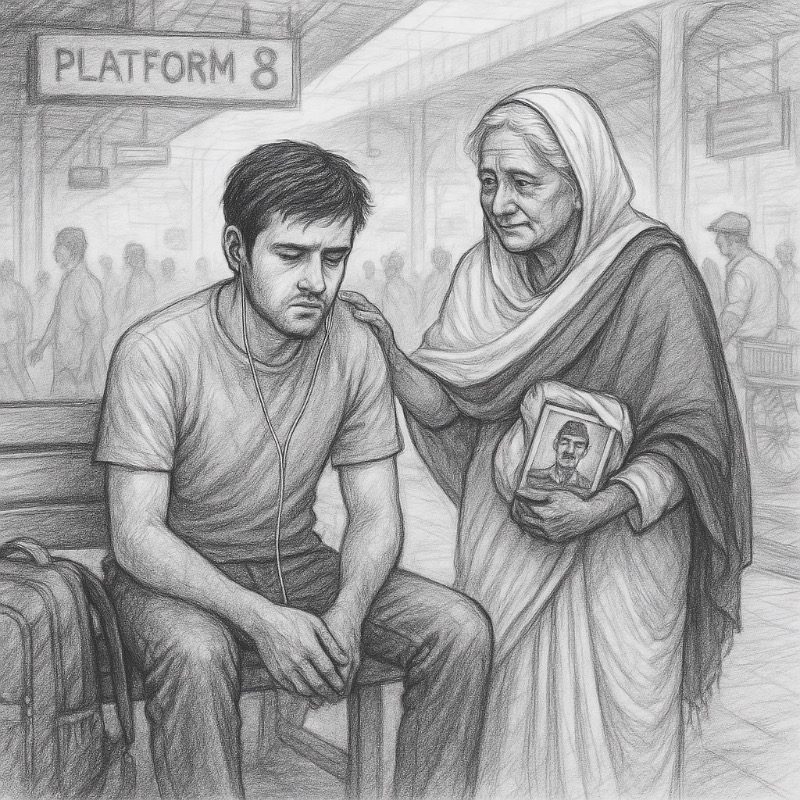
New Delhi Railway Station, Platform 8. July 26th - Kargil Vijay Diwas.
The world around him rushed, hawkers shouting, announcements reverberating, but for 25-year-old Raghav Verma, everything felt muted. He sat on a worn-out bench, staring blankly at the tracks. Earphones in, eyes fixed on nothing, he replayed the interview in his head with every pause, every mistake, every “thank you, you may leave now.”
He had come chasing a dream. He was now going home with nothing but a rejection slip and heavier shoulders. Then, a soft tap on his shoulder.
An elderly woman stood before him. White saree. Green shawl. Ankles swollen from travel. A purse clutched tightly to her chest. Her held a firmness that had a spark of its own.
“Beta… will you help me get home?”
He blinked, thinking what he could do.
“Sorry, ma’am?”
“Dras,” she said. “I need to go to Dras.”
Raghav almost said no. He was tired and drained. His train to Lucknow was about to arrive in twenty minutes.
But something in her voice made him pause and reconsider.
“Yes, Auntie,” he found himself saying.
She smiled. Not the smile of someone who needed help, but of someone who had been waiting for that yes.
Her name was Leela Narayan. A retired schoolteacher from Jammu. She didn’t talk much on the train, just kept looking out the window, chanting shlokas under her breath, holding her bag like it was something sacred.
It was only when they passed Srinagar, going up toward the mountains, that she opened it. Inside was a black-and-white photo of Captain Vikram Batra. A folded, yellowed letter from Major Padmapani Acharya. And a tiny Indian flag— in not such-good condition, burnt at the edges, and faintly stained.
“These boys,” she said softly, “called me Amma. I cooked for them. I prayed with them. I bandaged their hands when doctors were overburdened.”
Raghav listened, stunned. She had been there. Really there. Not just during the war, but in the war.
“I stayed back,” she said. “My school had turned into a shelter. I was supposed to leave with the women and children. But I couldn’t. These boys… they reminded me of my own son.”
She never mentioned the son again.
At the Dras War Memorial, she didn’t look at the names like a tourist would. She walked as though her feet remembered the path from long ago.
She paused at each name, Captain Anuj Nayyar, Lt. Saurabh Kalia, Grenadier Yogendra Singh Yadav, Rifleman Sanjay Kumar.
She hummed stories about them: what they laughed at, how they carried extra socks for others, how they’d wink before walking into fire.
Raghav just followed Amma.
He had read about these heroes. He had seen films, learnt battle statistics, recited slogans.
But in her voice, they weren’t chapters in a history book. They were real and brave.
As they stood before the wall of names, she took out a sealed envelope and handed it to him.
“Give this to the Defence Minister,” she said. “Please.”
Inside was a hand-written list. Names of jawans she remembered seeing, some carried in makeshift stretchers, some whose names were never called out again on the radio.
Some marked as missing. Some never mentioned at all.
“I couldn’t save them all,” she said, her voice trembling for the first time. “But I remembered them. Every single one.”
Raghav held the envelope like it weighed more than paper.
Two weeks later, the Ministry responded.
The list was verified. Families were traced. Long-pending compensation began. Names were quietly added to the digital war memorial.
And next to the entry of civilian volunteers, a new line appeared: Leela Narayan – Civilian Medic Volunteer, Dras Sector, 1999.
She didn’t attend the ceremony. She said she would rather light a diya at home. But across the room, uniformed officers stood in silence when her name was read. Because all of them really understood what she had done.
Raghav never gave another SSB exam. He stopped "trying" to join the Army as he knew he would. He trained harder than ever. This time, it wasn’t for ambition. It was for something sacred.
When he passed out of the Indian Military Academy, it was Leela Amma who was invited to pin the stars on his shoulders. She said nothing. Just opened her bag one last time, took out the frayed Tricolour, and placed it in his hand. Her fingers on his palm. “Take them home this time,” she whispered. “All of them.”
Years later, standing in uniform before a crowd of young cadets, Captain Raghav Verma ended his speech with these words: “I didn’t choose the Army. I didn’t even know I was worthy of it. I just said yes, to an old woman at a railway station. A woman who remembered our martyrs better than our textbooks ever will. That one yes… changed my life. And it brought forgotten heroes finally home.”
And in the front row, in a white saree and green shawl, sat Leela Amma.
Smiling quietly. Watching another boy walk into duty with his heart full, and his hands carrying the memory of many.






 React
React