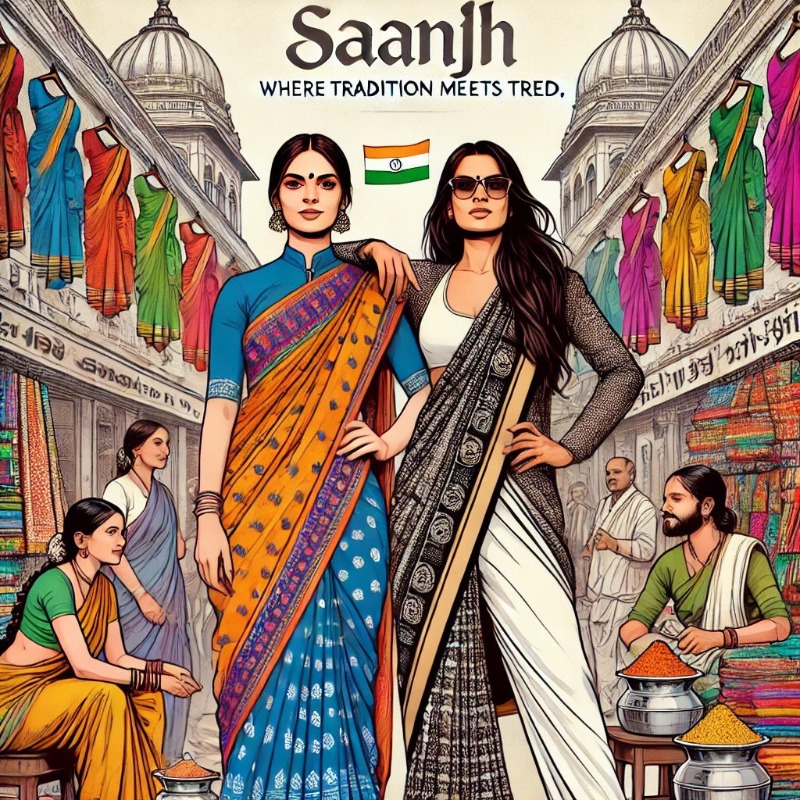
In the bustling town of Varanasi, where the Ganges flowed with stories of old, two women stood as fierce rivals. Aditi and Roshni had been competing against each other since childhood. Whether it was school debates, sports competitions, or later, their businesses, they were always on opposite sides. Aditi ran "Khushbu Sarees," a traditional handloom saree shop, while Roshni owned "Banarasi Elegance," a modern boutique specializing in designer sarees. Their rivalry was well-known in the market, and customers often took sides, fueling their competition.
Aditi came from a family of weavers, deeply rooted in the centuries-old Banarasi handloom tradition. She respected the art of weaving and took immense pride in supporting local artisans. Roshni, on the other hand, had studied fashion design in Mumbai. She believed that sarees needed modernization to appeal to the younger generation. While Aditi focused on heritage, Roshni thrived on innovation.
Their shops stood on opposite sides of the busy Thatheri Bazaar, separated by a narrow street but divided by years of rivalry. If one introduced a new design, the other quickly followed with something better. If one lowered prices, the other offered an irresistible deal. Their competitive spirit kept them both sharp, but it also built an invisible wall between them.
One day, a sudden announcement shook their world. A big shopping mall was opening in Varanasi, bringing with it well-known fashion brands from across India. These brands would offer machine-made sarees at lower prices, directly threatening the existence of small businesses like Aditi’s and Roshni’s.
At first, both women were determined to fight their own battles. Aditi believed that her handwoven sarees carried tradition, while Roshni was confident that her modern designs would attract young customers. However, reality hit hard. Sales began to drop as customers flocked to the mall for cheaper alternatives. The once-crowded lanes of their shops were now quiet.
The weavers who had worked under Aditi’s family for generations began expressing their fears. “Didi,” said Ravi, one of the senior weavers, “if these machine-made sarees take over, what will happen to us?”
Meanwhile, Roshni’s tailors, who embroidered her sarees with intricate designs, started looking for other jobs. “Madam,” one of them told her, “people don’t want to spend extra on handcrafted work when they can buy readymade styles from the mall.”
One evening, as Aditi sat outside her shop watching a handful of customers walk past without stopping, she saw Roshni standing outside her boutique, looking just as worried. Swallowing her pride, Aditi approached Roshni.
"We need to talk," she said firmly.
Roshni raised an eyebrow but nodded. They went to a small tea stall nearby, where they had spent years avoiding each other. Over hot cups of chai, Aditi spoke first. "This mall is going to ruin both of us if we don’t do something together."
Roshni sighed. "I’ve been thinking the same. But how can we work together when we have always been against each other?"
Aditi took a deep breath. "We combine the best of both worlds. Your modern designs with my traditional weaves. We can create a fusion saree line—something unique that no machine-made saree can match."
Roshni hesitated but saw the logic. "Aditi, I never thought I would say this, but that might actually work."
With newfound determination, they began working together. Aditi’s artisans crafted beautiful Banarasi silk sarees, and Roshni added her contemporary touch—lighter fabrics, modern prints, and trendy embellishments.
Their first challenge was convincing the artisans. “How will this fusion work?” one of Aditi’s weavers asked skeptically. “Traditional sarees have their own charm. Why mix it with modern designs?”
Roshni explained, “Because young women today want tradition and comfort. They love the beauty of handwoven sarees but also want lighter fabrics and fresh designs. We are not replacing tradition; we are reinventing it.”
Slowly, the artisans began to see the vision. They experimented with blending zari work with pastel shades, introduced silk-georgette hybrids, and added minimal embroidery instead of heavy embellishments.
They launched their joint collection under the brand "Saanjh – Where Tradition Meets Trend."
Word spread quickly. Customers were excited about the fusion sarees, and soon, their sales picked up. Social media influencers featured their work, and even the younger crowd, who once preferred mall brands, now admired the blend of heritage and style.
However, success didn’t come without its challenges. One evening, a customer angrily stormed into their shop, holding a saree. “This is too light for a Banarasi! I wanted the traditional heavy feel.”
Aditi quickly handled the situation. “Madam, this is our new lightweight collection, perfect for daily wear. But if you want something heavier, we also have those.” She guided the customer to another rack, where classic weaves were still available.
Meanwhile, Roshni received a different complaint from a college student. “This is beautiful, but it still feels too traditional for me.”
Instead of dismissing the feedback, they took it as an opportunity. They introduced two separate collections: “Saanjh Classic” for those who loved tradition and “Saanjh Modern” for contemporary designs.
The rivalry that had once kept them apart now became their greatest strength. They learned that competition had pushed them to be their best, but collaboration made them unstoppable.
As the first festival season arrived after their partnership, Aditi and Roshni stood at their new store—together. The sign above read: Saanjh – Aditi & Roshni.
Smiling at each other, they realized that sometimes, the best victories come from joining hands, not fighting against each other.
As they stood outside their shop, watching the bustling crowd, Roshni smirked. "You know, Aditi, I never thought I’d say this, but I’m glad you’re my partner."
Aditi laughed. "Same here. But just so you know, I still think my designs are better."
Roshni rolled her eyes. "Fine, let’s settle this with sales figures after the festival."
And just like that, their friendly competition remained alive—but this time, it was fueled by mutual respect and a shared dream, not rivalry.