Every town has its dreamers, but not all dreams are made of gold. Some are woven from desperation, stitched together with threads of hope so thin that they could snap at any moment. For Amelia Clarke, her dream was never one anyone could understand. She wasn’t the brightest in her class, nor the most talented, but she had something that set her apart: a fire inside her that refused to go out, no matter how many times life tried to douse it.
She lived in a small town where the most ambitious people dreamed of being something simple—a doctor, a lawyer, a teacher. And then there was Amelia. She wasn’t chasing stability. She wasn’t chasing the expected. She wasn’t even chasing a career.
Amelia Clarke was chasing the midnight stars.
To most, the concept was laughable. After all, who could become a professional astronomer from a tiny, underfunded school in the middle of nowhere? The closest thing they had to a telescope was an old pair of binoculars that belonged to Mr. Wyatt, the school janitor, and they were barely functional. The students in her class had long since given up on the notion of something bigger, something beyond the four walls of their town. But not Amelia.
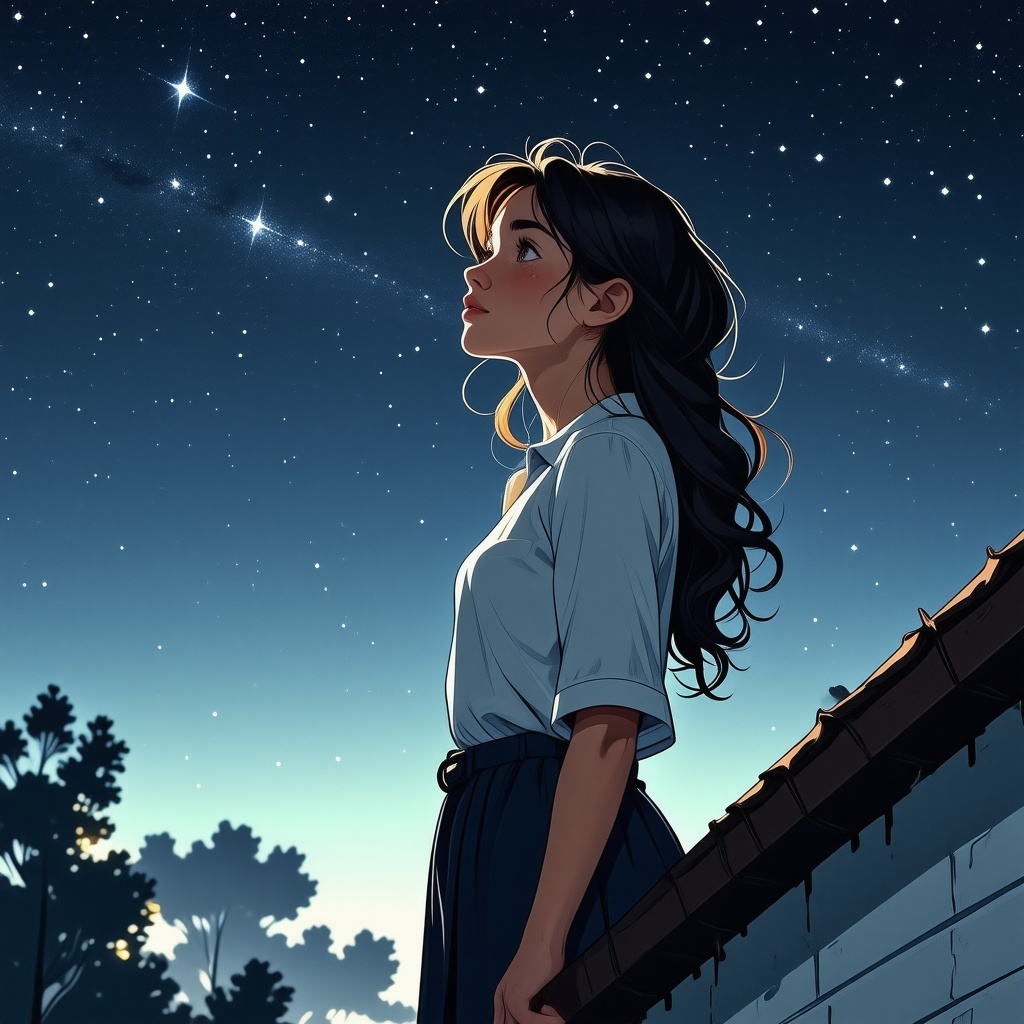
Every night, she would stand on the roof of her house, alone, gazing at the sky, as though the stars might whisper their secrets to her. But instead of hearing them, she only saw the glaring divide between her dream and her reality. Her family was struggling. Her mother worked two jobs just to keep the lights on, and her father—who had abandoned them when Amelia was five—was little more than a memory, a hollow ache she tried not to remember. There was no money for fancy telescopes, no funding for university. If Amelia wanted to chase her dream, she would have to fight for it. But where to begin?
The opportunity came in the form of a competition.
The prestigious Sutherland Space Institute, a world-renowned astronomical research facility, announced an annual contest: “The Starlight Scholar Challenge.” The winner would receive a full scholarship to study astronomy—something Amelia had long thought impossible for someone like her. The catch? The challenge required not only a deep understanding of space but the ability to solve a series of complex theoretical problems. To be chosen, one needed to show not just knowledge, but ingenuity—someone capable of seeing beyond the stars into the unknown.
Amelia had no illusions. She was an underdog, the kind of person who people expected to fail. The other contestants were from elite schools, groomed for years to succeed. Her chances were slim, but something inside her refused to accept that reality.
She decided to enter.
Each day after school, while her classmates watched TV or hung out at the local diner, Amelia spent hours in the library—learning everything she could. She devoured books on physics, space-time, quantum theory—anything that could help her make sense of the universe. She scavenged for discarded equipment, patching together makeshift telescopes with whatever she could find. Her eyes bled with the strain, but every time she looked up at the night sky, it felt like the universe was looking back at her, waiting.
The weeks passed. Her confidence wavered, but she refused to quit. Her hands became calloused from hours of scribbling notes and fixing lenses. She couldn’t afford a private tutor, so she relied on the kindness of the library’s aging librarian, Mrs. Boyle, who had a passion for stargazing herself. Mrs. Boyle had a soft spot for Amelia’s determination, and on the rare occasions she could get away from work, she would sit with Amelia and help her unravel the mysteries of the cosmos.
But as the competition date loomed closer, Amelia felt herself sinking. The other students in her class had long since laughed off her chances. They were right. Amelia wasn’t meant for greatness. Her dreams were too big, too impossible.
Then came the twist she hadn’t anticipated.
On the night before the final submission, a freak storm tore through the town. The wind howled, and the rain pelted the ground like it was trying to erase everything in its path. Amelia’s house lost power, and her makeshift observatory—what little equipment she had left—was wrecked. The storm destroyed her only telescope. In that moment, as she stood outside in the storm, staring at the broken remnants of her dream, Amelia felt something inside her snap.
She was done. The universe had spoken. It wasn’t meant to be.
But just as she was about to give up, a flash of lightning lit up the sky, and for the first time, she saw something new. It wasn’t the stars. It wasn’t the storm. It was a tiny clearing in the clouds—the very smallest glimpse of a constellation she had been studying for weeks. She didn’t know why, but in that moment, something inside her clicked. She had to go on. Even without the equipment, even without the resources—she would find a way.
Amelia packed her things, grabbed her notebook, and ran. She ran through the storm, through the flooded streets, until she found herself at the old observatory on the outskirts of town—the one no one ever used anymore, its towering telescope long abandoned. She didn’t care about the risks. She didn’t care about the storm. She knew what she had to do.
She climbed to the top of the observatory, feeling like an intruder in the abandoned place. But there, amidst the chaos of her mind and the pouring rain, she set up her makeshift system—a broken telescope, a shattered lens, and a makeshift stand she had cobbled together. The storm raged around her, but she adjusted the lenses, focused on the constellation she had glimpsed earlier, and began to map it.
Hours passed. She lost track of time, but in the quiet space between the thunder and the chaos, Amelia saw something the others hadn’t. She didn’t need the perfect equipment. She didn’t need money. She didn’t need to be like everyone else.
What she needed was to believe.
When she submitted her challenge, no one expected the results. No one expected the girl from the tiny town to outperform the best and brightest of the elite schools. But Amelia didn’t need the stars to align perfectly—she just needed to know where to look.
In the end, Amelia didn’t just win a scholarship. She won the respect of the world. Her name was etched into the annals of the Sutherland Space Institute’s history as a symbol of perseverance and ingenuity. And when she stood before the audience at the awards ceremony, clutching the scholarship in her hand, she realized the truth: the dream had always been hers to chase, no matter how impossible it seemed.
Because sometimes, the brightest stars aren’t the ones you see in the sky—they’re the ones that burn inside you.
The End.






 React
React